BOOLEAN LOGIC
https://www.youtube.com/watch?v=gI-qXk7XojA
CHECKLIST
History
On-off states
And, or , not – key operators
Truth tables
Drawing a circuit
Postulates, principles of duality, DeMorgan’s theorem
Nor, nand, xor, xnor gates- symbolic representation, truth tables
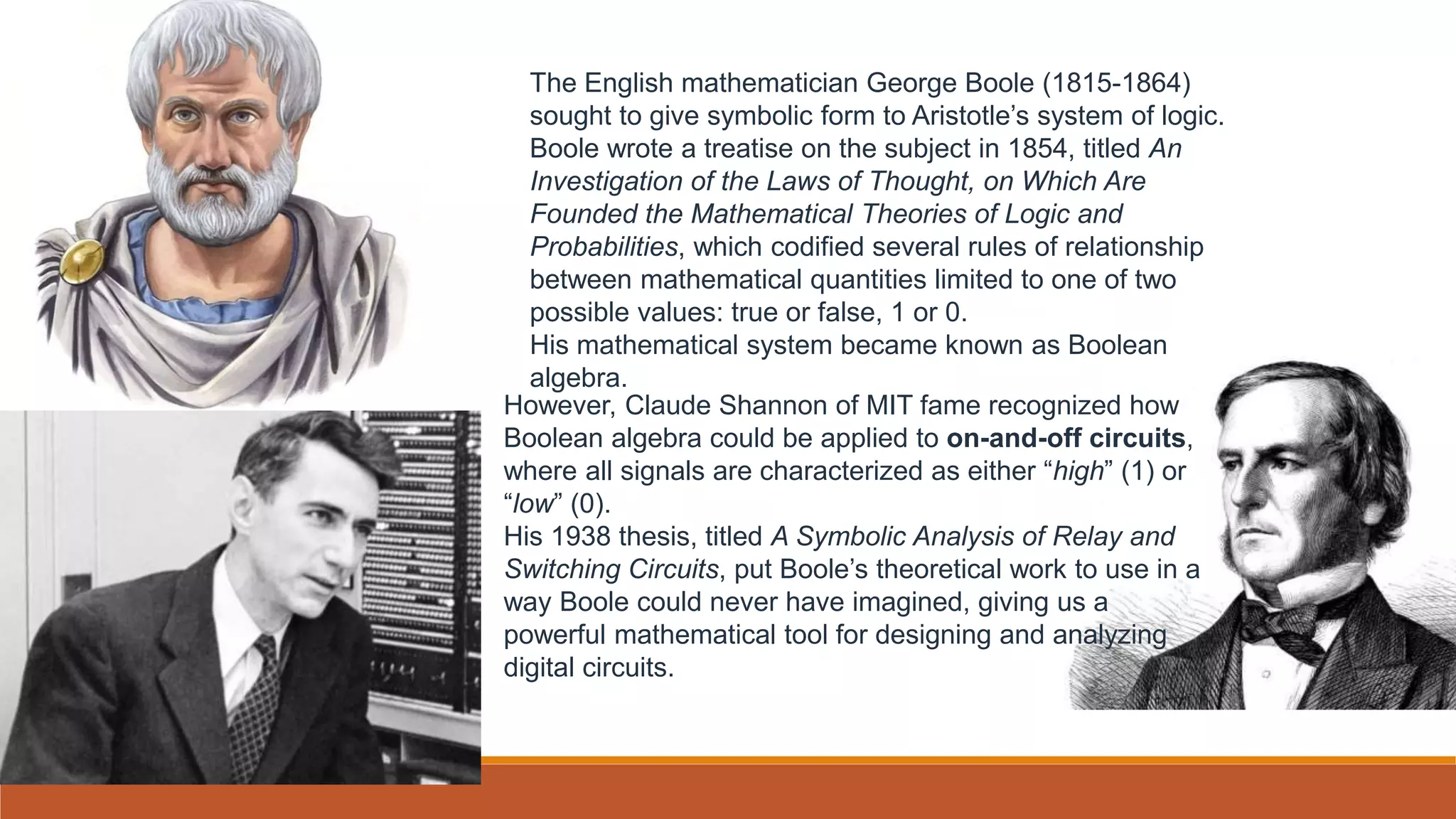
The English mathematician George Boole (1815-1864)
sought to give symbolic form to Aristotle’s system of logic.
Boole wrote a treatise on the subject in 1854, titled An
Investigation of the Laws of Thought, on Which Are
Founded the Mathematical Theories of Logic and
Probabilities, which codified several rules of relationship
between mathematical quantities limited to one of two
possible values: true or false, 1 or 0.
His mathematical system became known as Boolean
algebra.
However, Claude Shannon of MIT fame recognized how
Boolean algebra could be applied to on-and-off circuits,
where all signals are characterized as either “high” (1) or
“low” (0).
His 1938 thesis, titled A Symbolic Analysis of Relay and
Switching Circuits, put Boole’s theoretical work to use in a
way Boole could never have imagined, giving us a
powerful mathematical tool for designing and analyzing
digital circuits.
Boolean Algebra is the underlying mathematical structure of
digital logic which is most often implemented via VLSI of CMOS
circuits in the form of CPU, memory, and other digital
technologies which are used to do things like run your laptop,
or route packets over networks and so on.
Deep down, inside the computer, inside the CPU, are transistors
implementing NAND ports, NOR ports, NOT gates, the building
blocks of digital logic. These have direct equivalents in boolean
algebra.
GATES are DIGITAL BUILDING BLOCKS. They are called
DIGITAL because they operate on digital principles. They
require a signal (also called a PULSE or INPUT) that is
either 0v (LOW) or HIGH and give out a signal that is either LOW
or HIGH.
The decision which results into either YES(True) or NO(FALSE)
is called a BINARY DECISION.
Values True (0)and False (1)are called TRUTH Values.
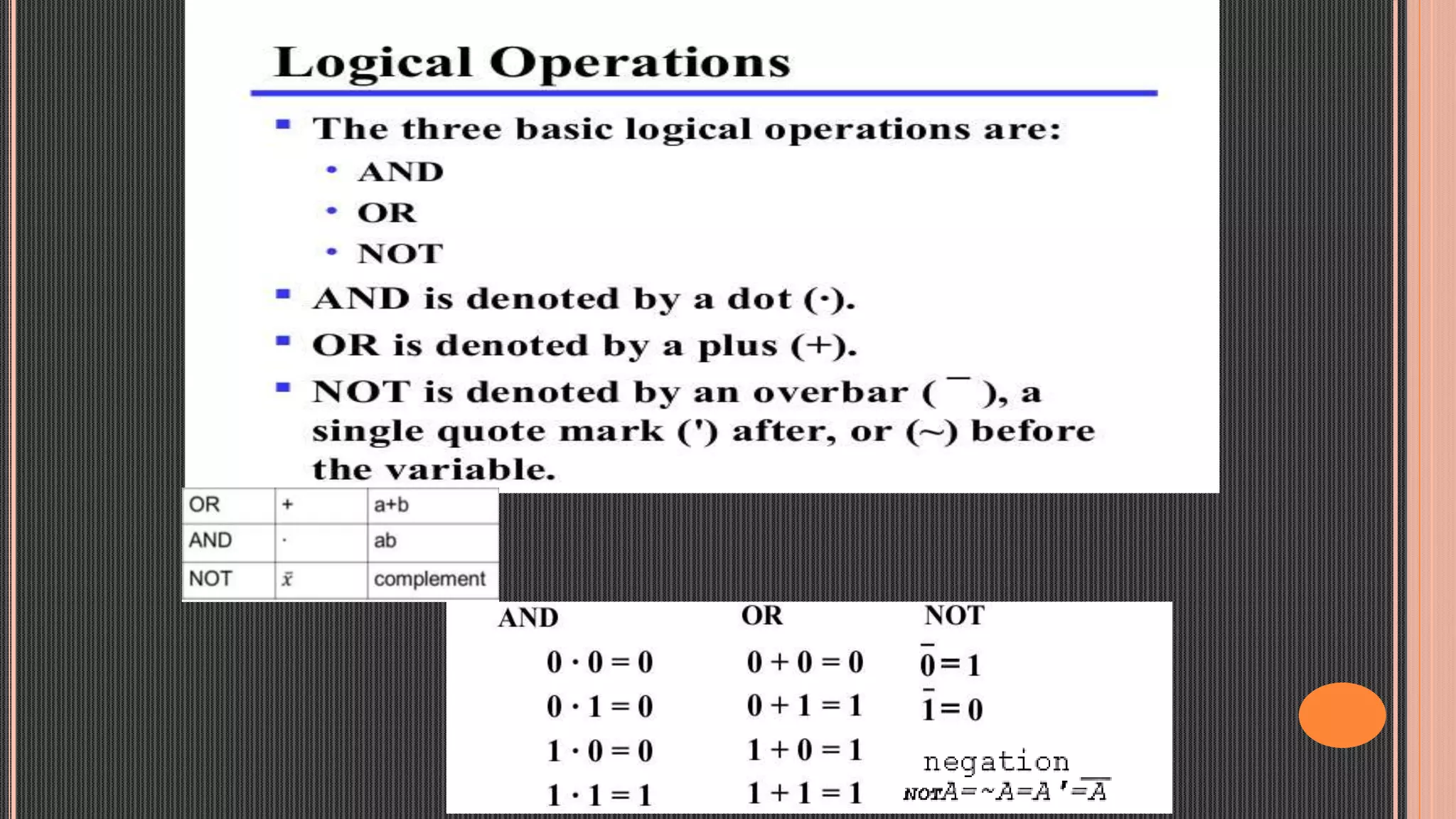
Logical Operators operate on binary values and binary
variables.(And, Or, Not)
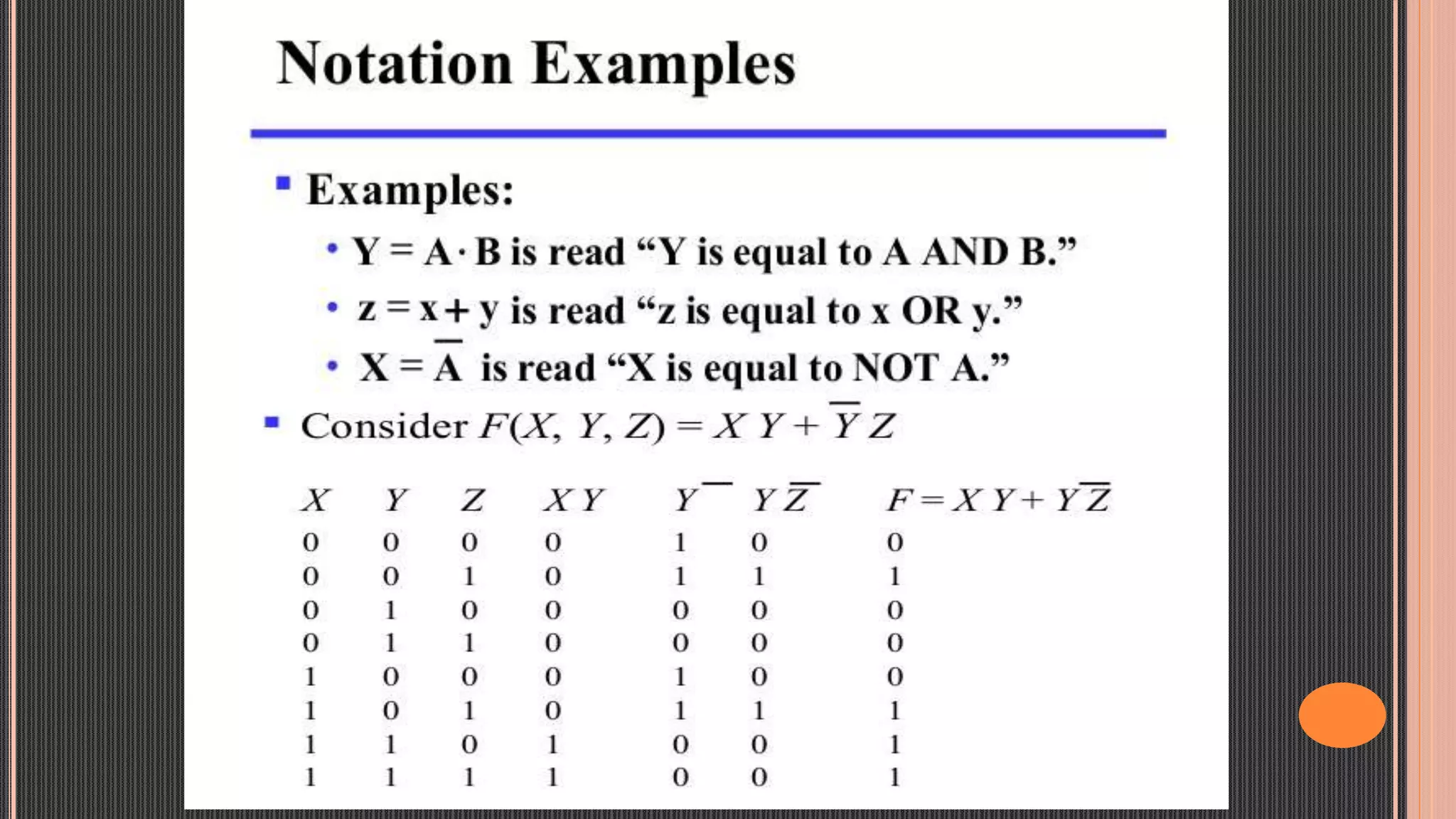
Using Boolean logic, verify using truth table that X + XY = X for each
X, Y in {0,1}
Prepare a table of combinations for the following Boolean logic expressions:
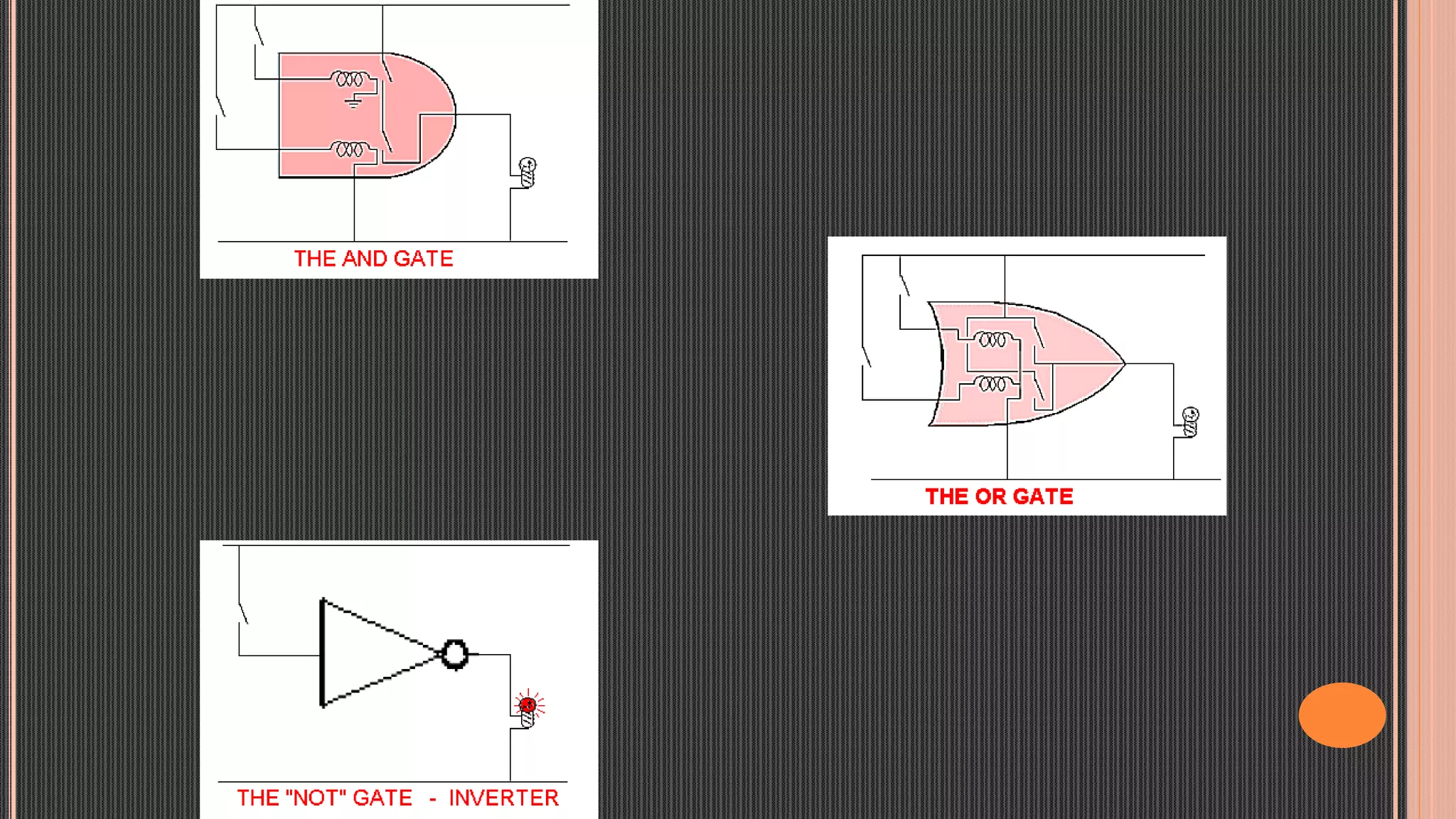
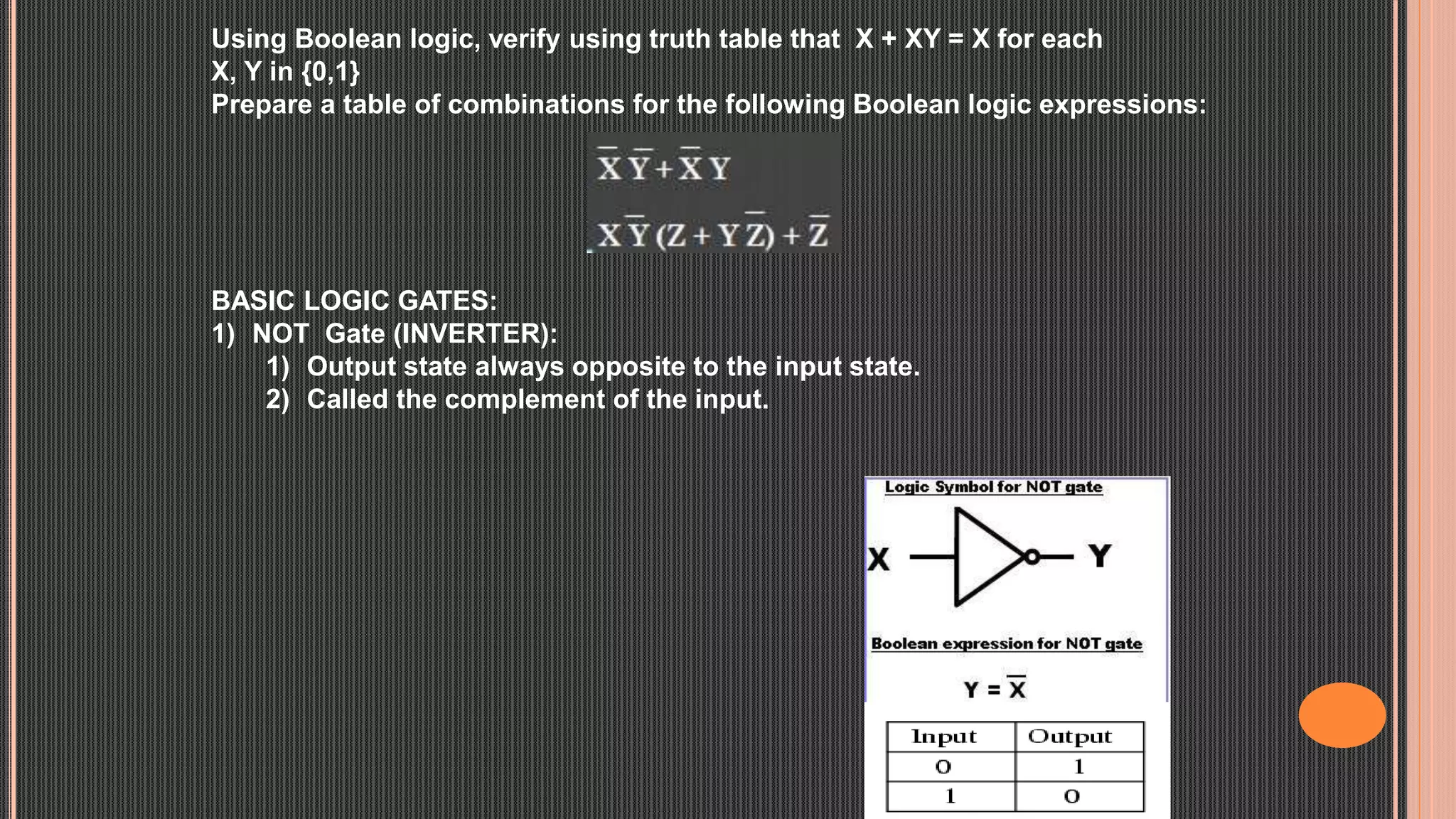
BASIC LOGIC GATES:
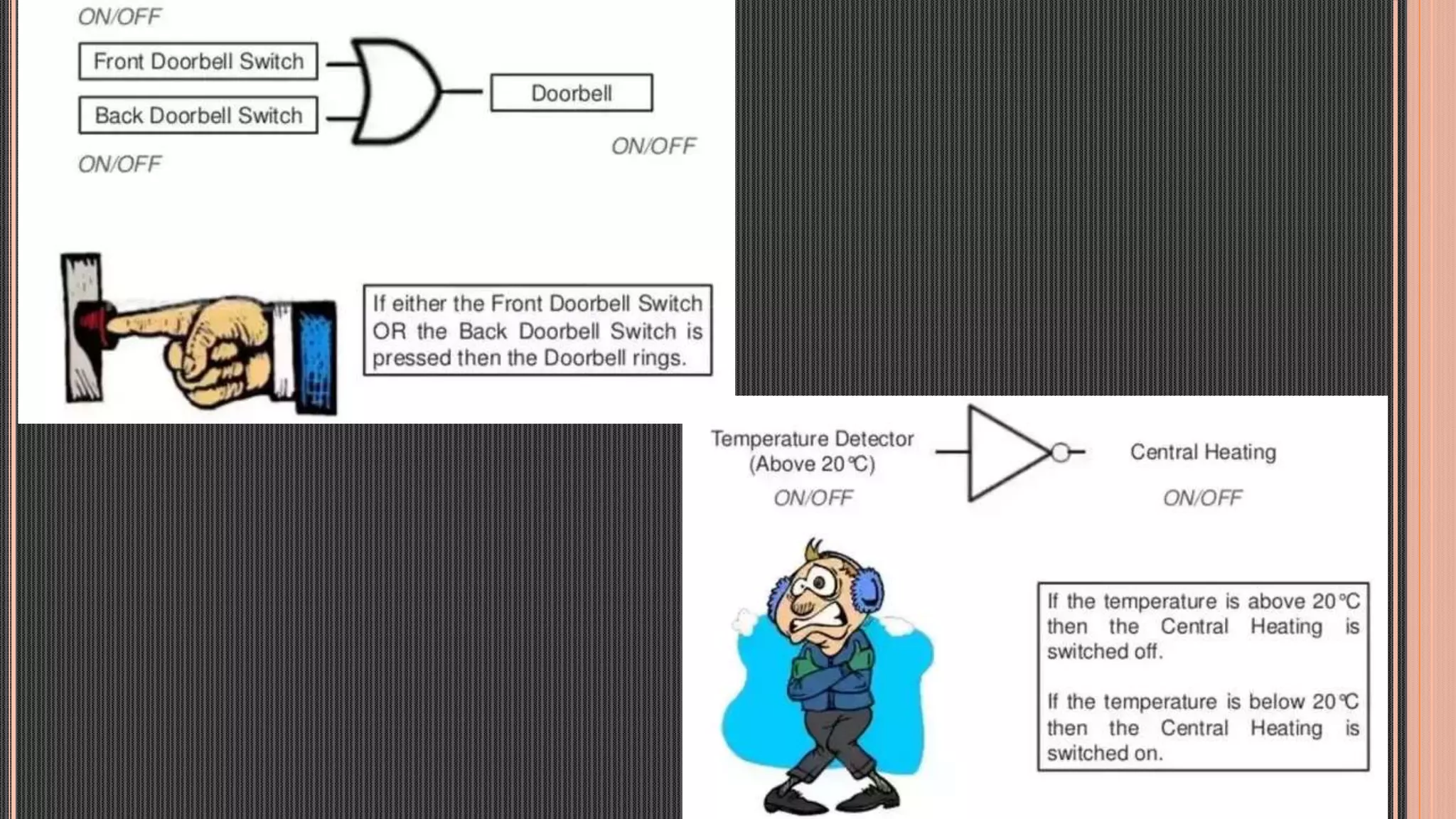
1) NOT Gate (INVERTER):
1) Output state always opposite to the input state.
2) Called the complement of the input.
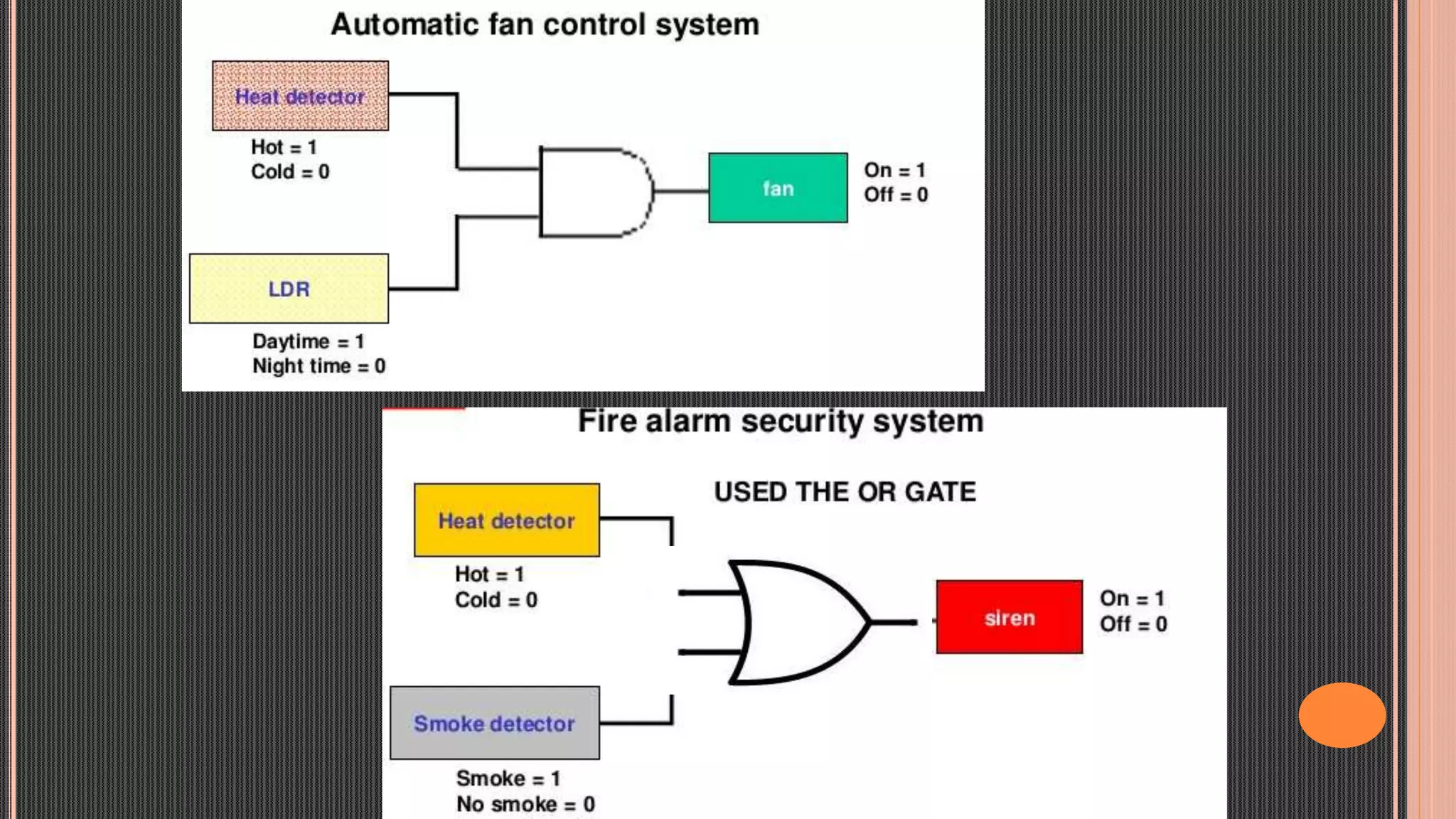
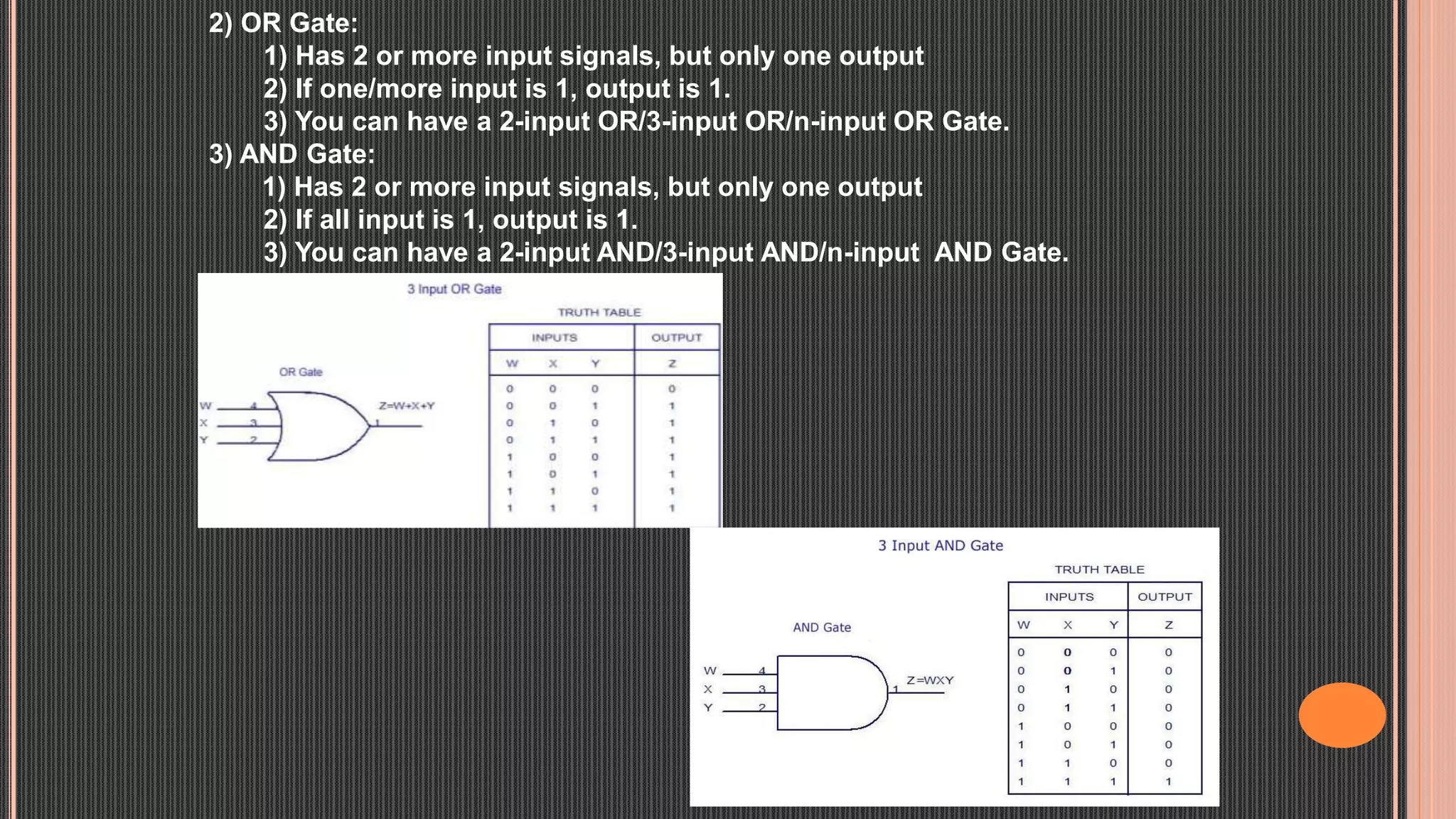
2) OR Gate:
1) Has 2 or more input signals, but only one output
2) If one/more input is 1, output is 1.
3) You can have a 2-input OR/3-input OR/n-input OR Gate.
3) AND Gate:
1) Has 2 or more input signals, but only one output
2) If all input is 1, output is 1.
3) You can have a 2-input AND/3-input AND/n-input AND Gate.
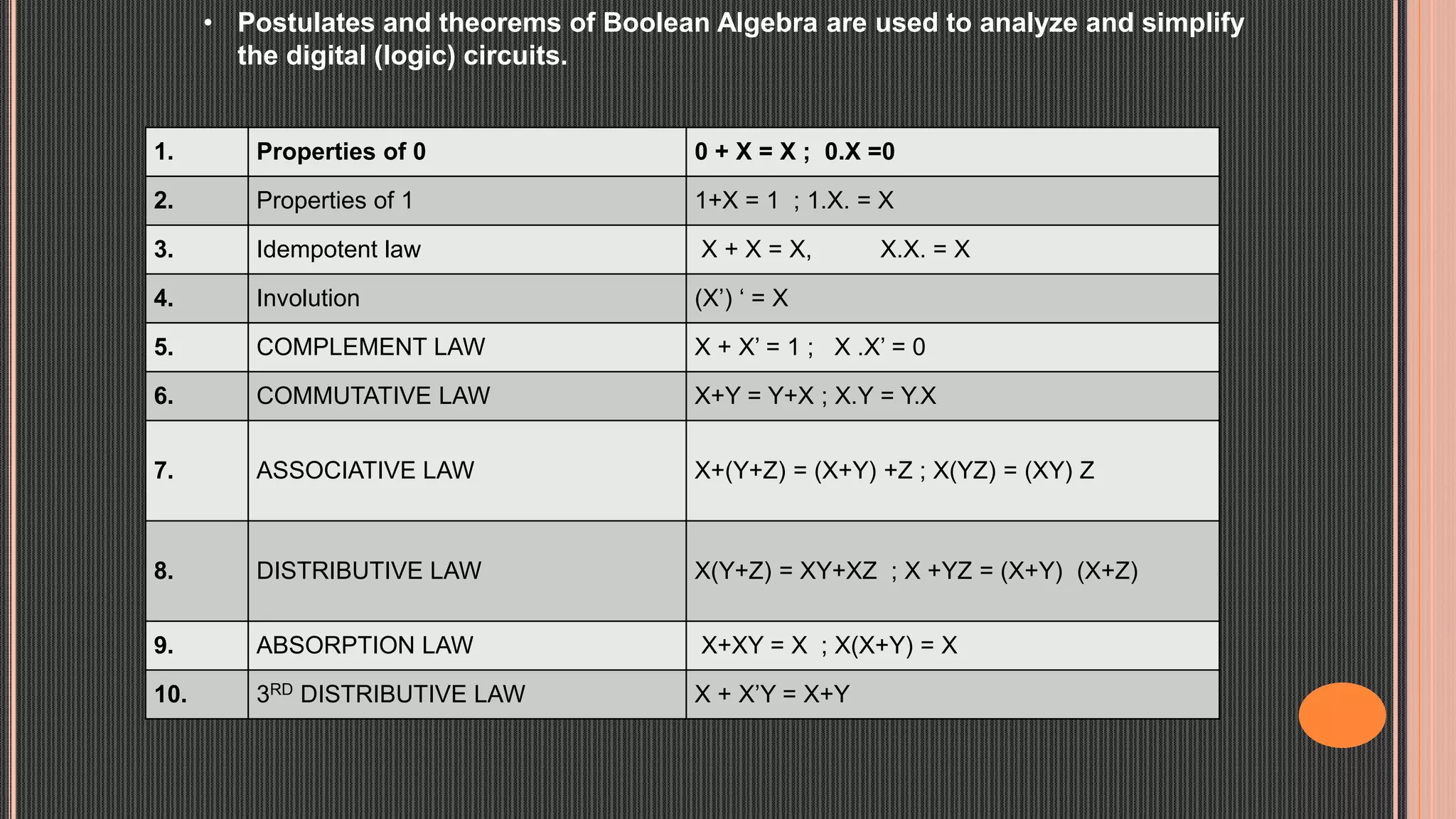
• Postulates and theorems of Boolean Algebra are used to analyze and simplify
the digital (logic) circuits.
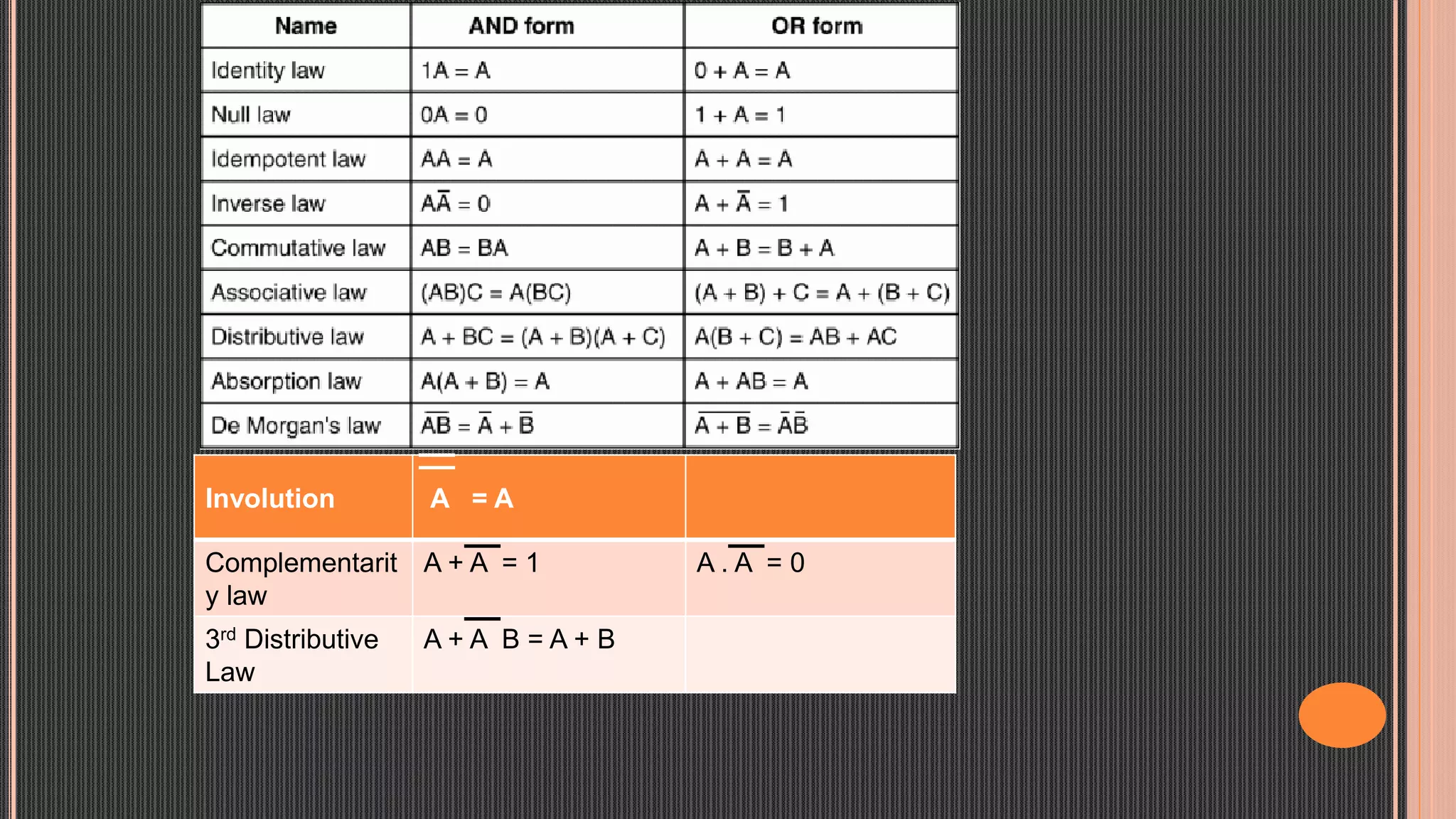
1. Properties of 0 0 + X = X ; 0.X =0
2. Properties of 1 1+X = 1 ; 1.X. = X
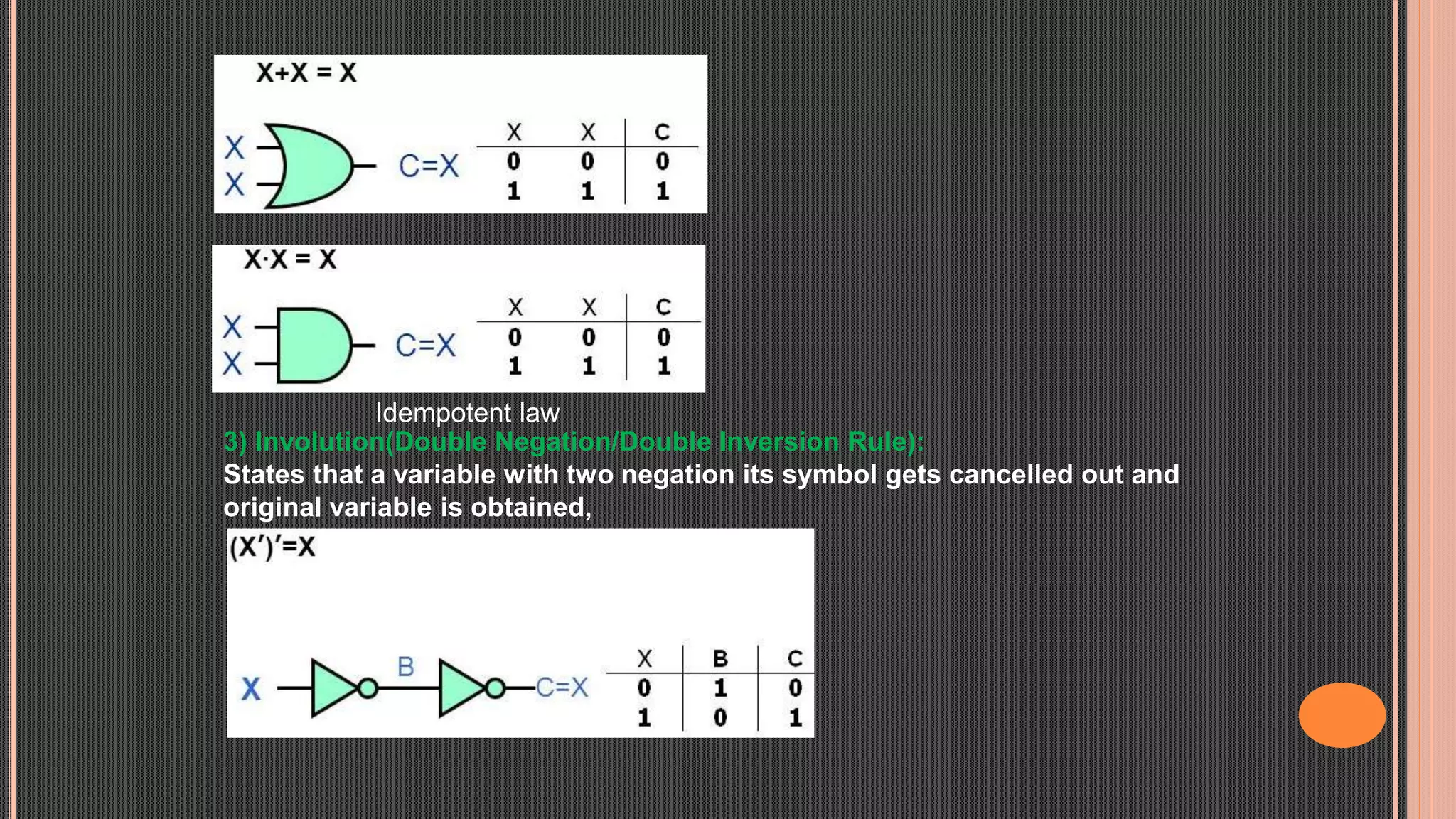
3. Idempotent law X + X = X, X.X. = X
4. Involution (X’) ‘ = X
5. COMPLEMENT LAW X + X’ = 1 ; X .X’ = 0
6. COMMUTATIVE LAW X+Y = Y+X ; X.Y = Y.X
7. ASSOCIATIVE LAW X+(Y+Z) = (X+Y) +Z ; X(YZ) = (XY) Z
8. DISTRIBUTIVE LAW X(Y+Z) = XY+XZ ; X +YZ = (X+Y) (X+Z)
9. ABSORPTION LAW X+XY = X ; X(X+Y) = X
10. 3RD DISTRIBUTIVE LAW X + X’Y = X+Y
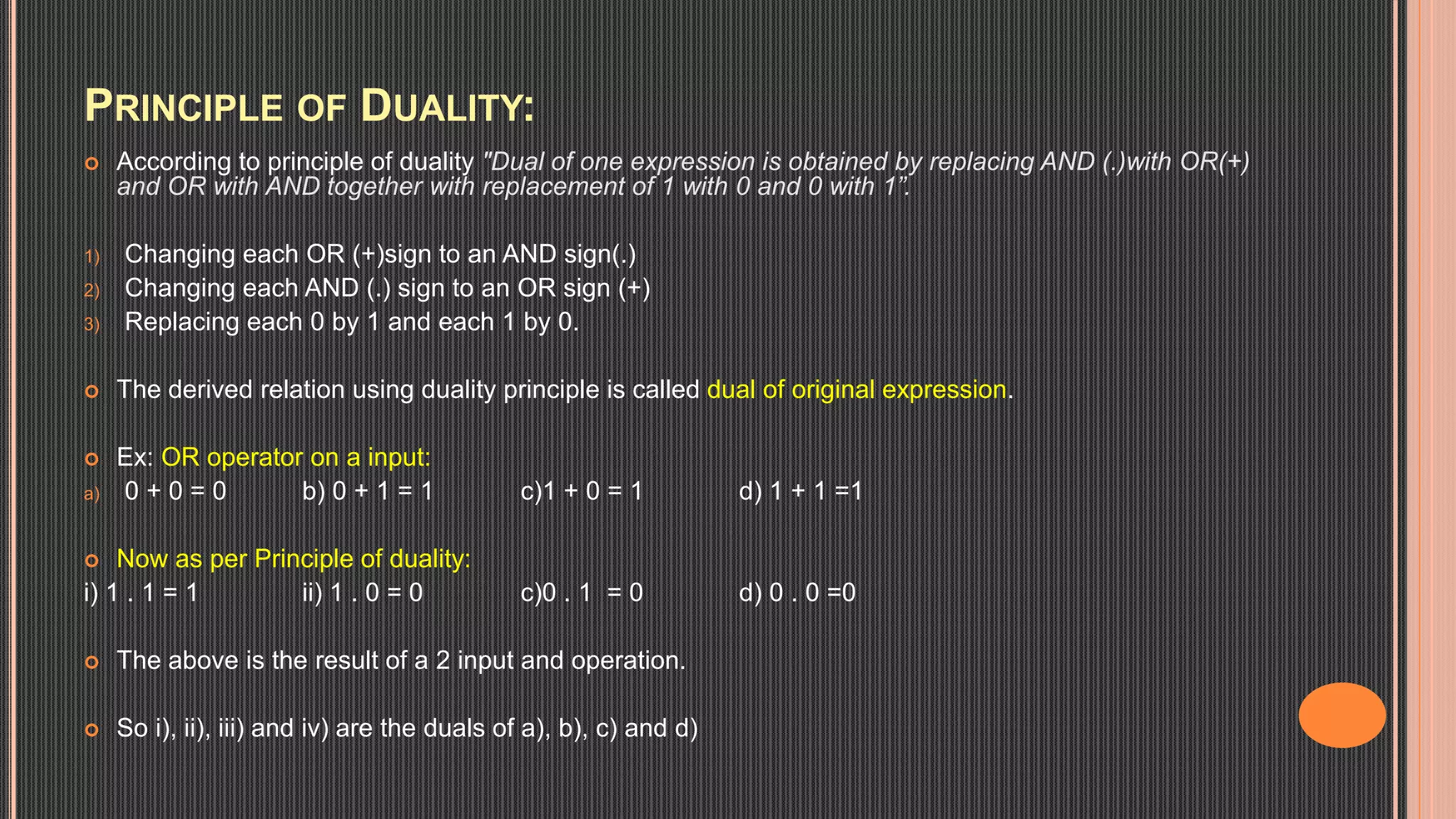
PRINCIPLE OF DUALITY:
 According to principle of duality "Dual of one expression is obtained by replacing AND (.)with OR(+)
and OR with AND together with replacement of 1 with 0 and 0 with 1”.
1) Changing each OR (+)sign to an AND sign(.)
2) Changing each AND (.) sign to an OR sign (+)
3) Replacing each 0 by 1 and each 1 by 0.
 The derived relation using duality principle is called dual of original expression.
 Ex: OR operator on a input:
a) 0 + 0 = 0 b) 0 + 1 = 1 c)1 + 0 = 1 d) 1 + 1 =1
 Now as per Principle of duality:
i) 1 . 1 = 1 ii) 1 . 0 = 0 c)0 . 1 = 0 d) 0 . 0 =0
 The above is the result of a 2 input and operation.
 So i), ii), iii) and iv) are the duals of a), b), c) and d)
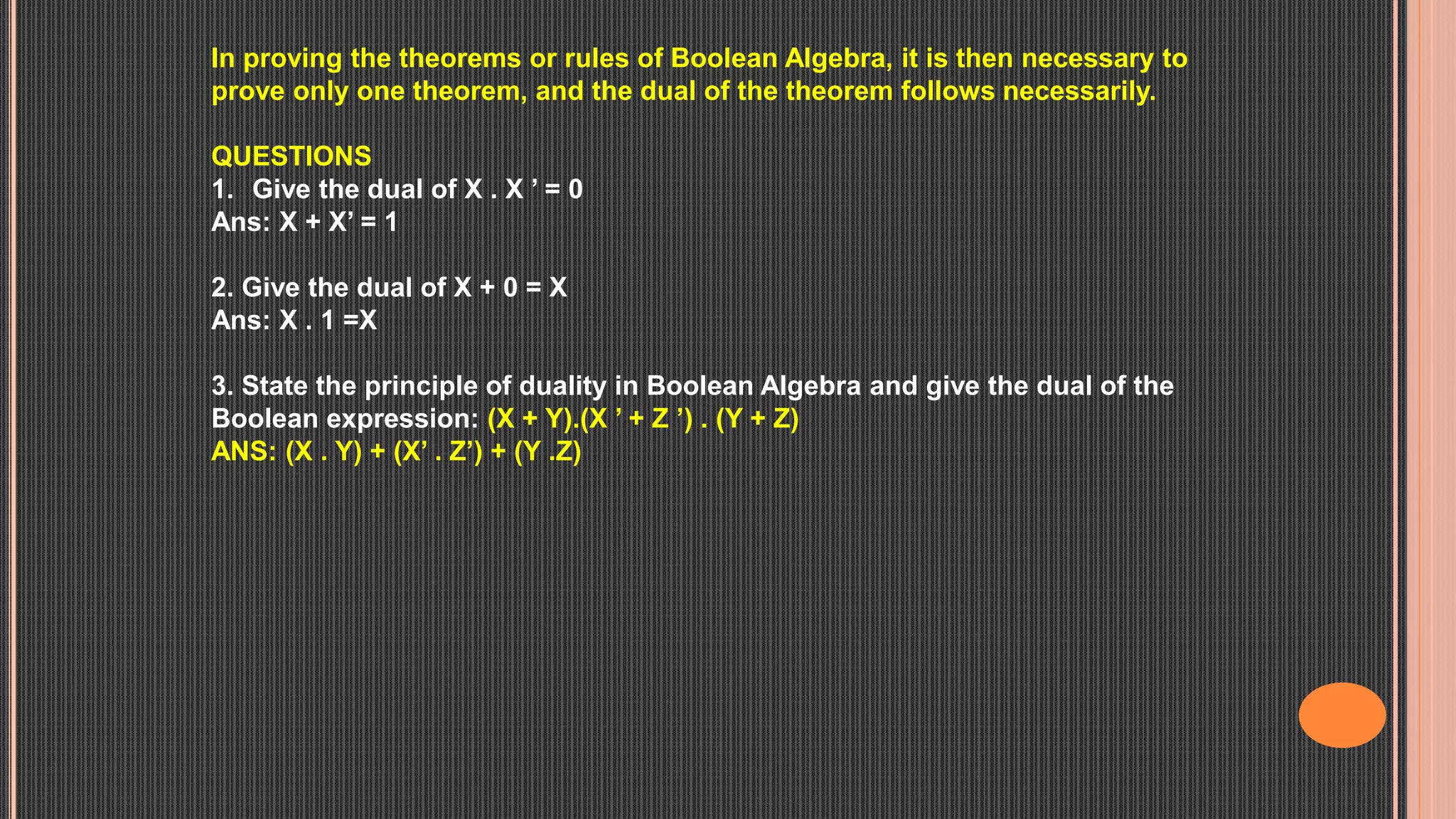
In proving the theorems or rules of Boolean Algebra, it is then necessary to
prove only one theorem, and the dual of the theorem follows necessarily.
QUESTIONS
1. Give the dual of X . X ’ = 0
Ans: X + X’ = 1
2. Give the dual of X + 0 = X
Ans: X . 1 =X
3. State the principle of duality in Boolean Algebra and give the dual of the
Boolean expression: (X + Y).(X ’ + Z ’) . (Y + Z)
ANS: (X . Y) + (X’ . Z’) + (Y .Z)
PROOF OF THEOREMS
3) Involution(Double Negation/Double Inversion Rule):
States that a variable with two negation its symbol gets cancelled out and
original variable is obtained,
Idempotent law
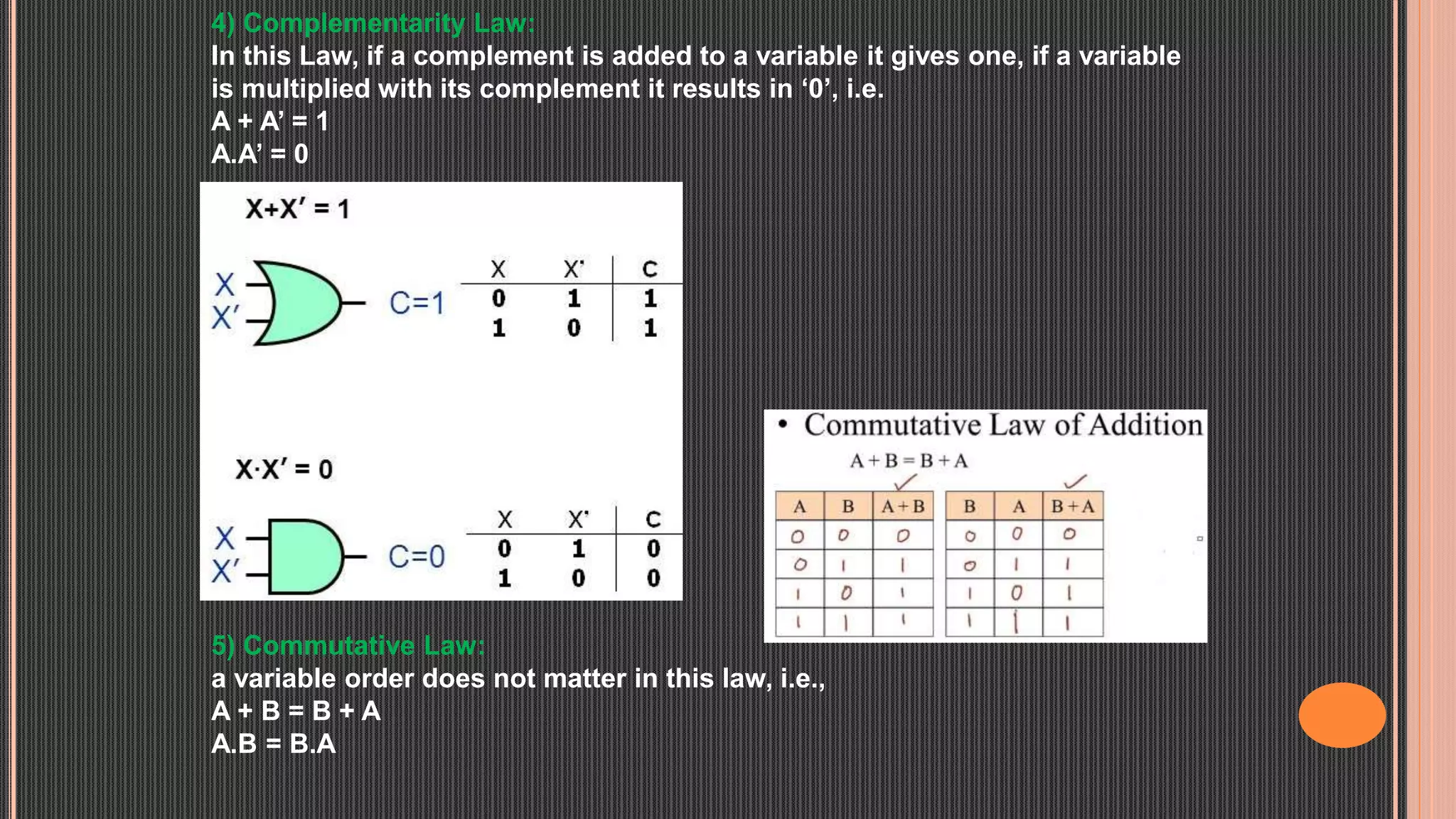
4) Complementarity Law:
In this Law, if a complement is added to a variable it gives one, if a variable
is multiplied with its complement it results in ‘0’, i.e.
A + A’ = 1
A.A’ = 0
5) Commutative Law:
a variable order does not matter in this law, i.e.,
A + B = B + A
A.B = B.A
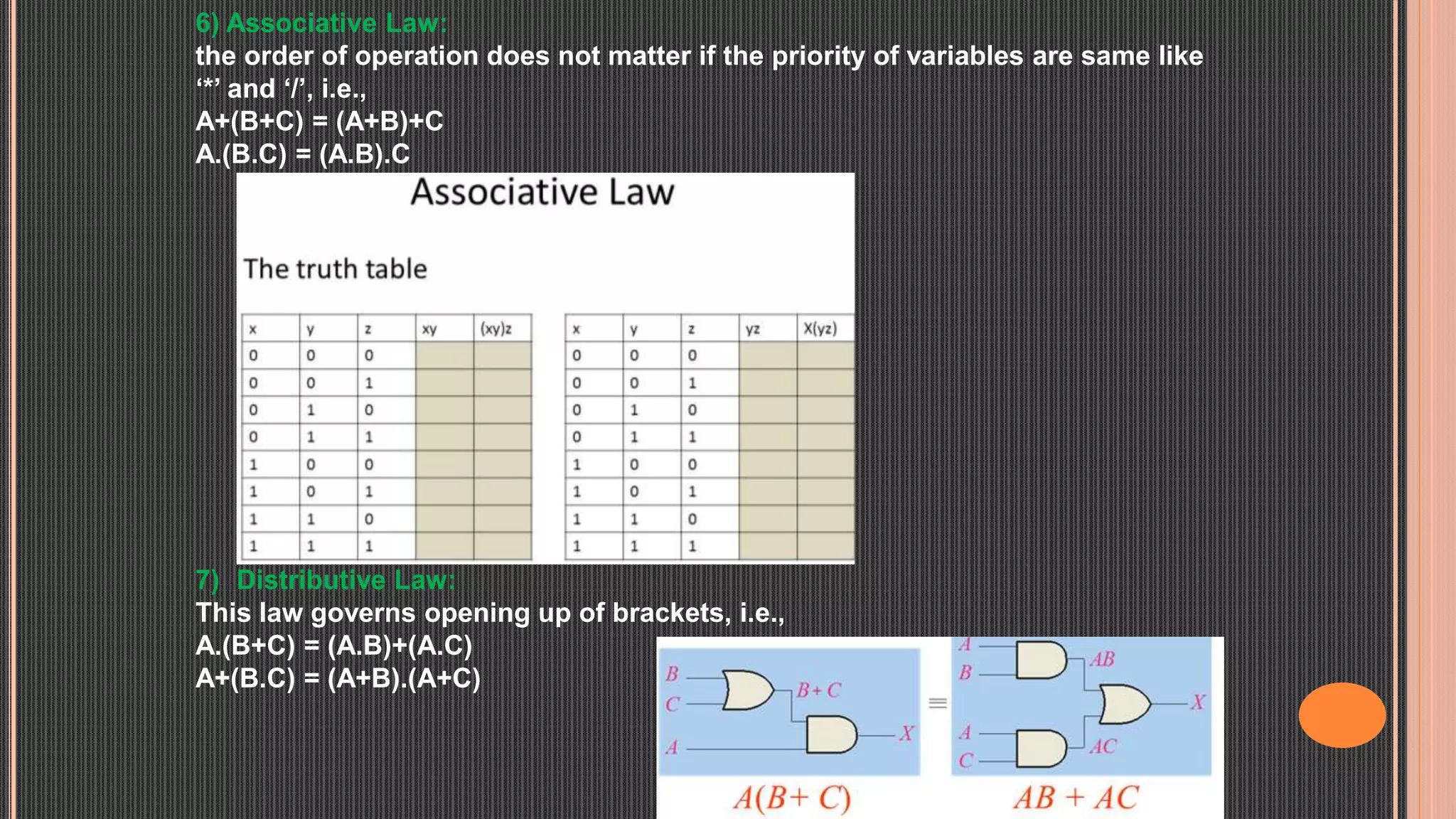
6) Associative Law:
the order of operation does not matter if the priority of variables are same like
‘*’ and ‘/’, i.e.,
A+(B+C) = (A+B)+C
A.(B.C) = (A.B).C
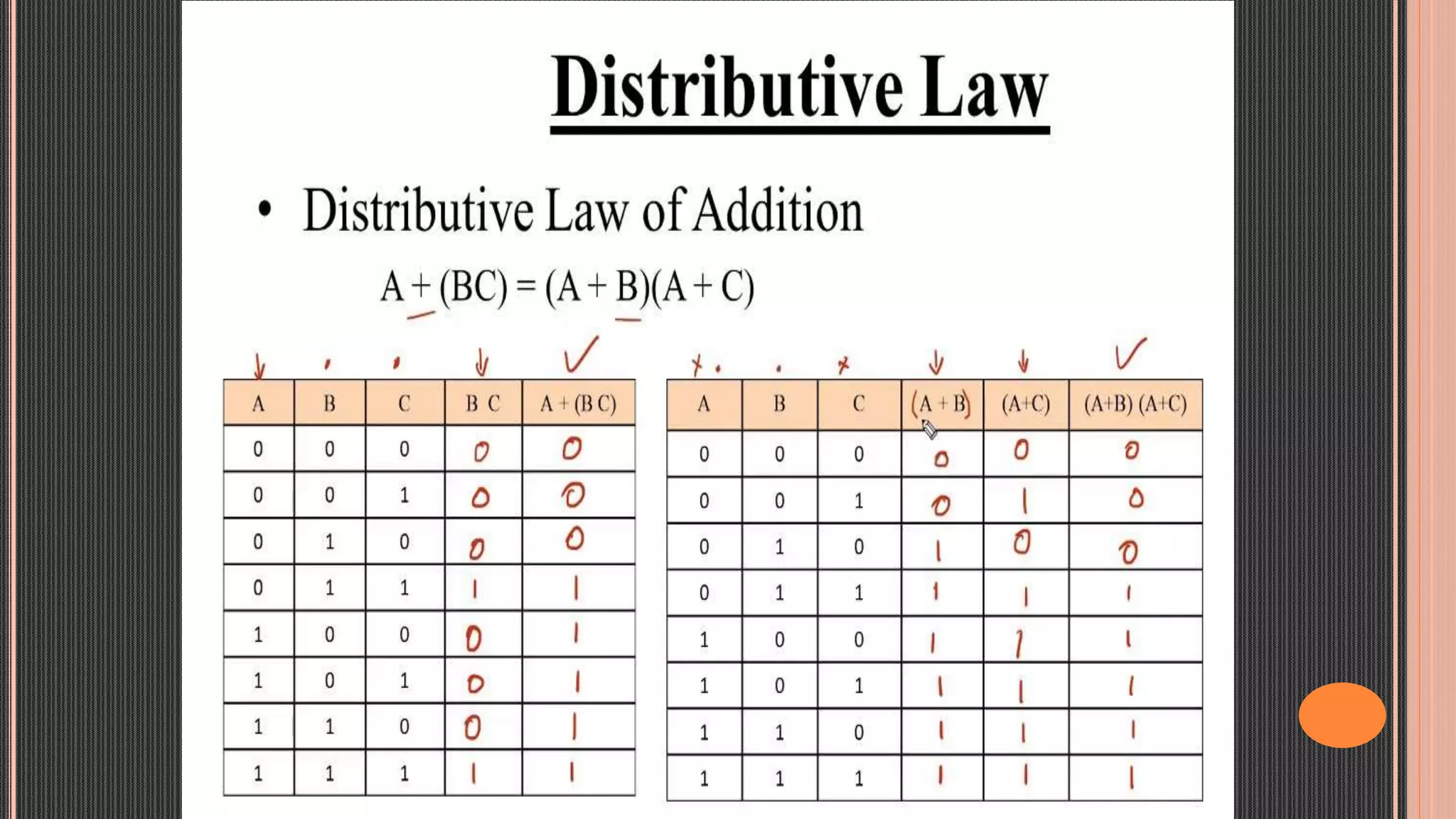
7) Distributive Law:
This law governs opening up of brackets, i.e.,
A.(B+C) = (A.B)+(A.C)
A+(B.C) = (A+B).(A+C)
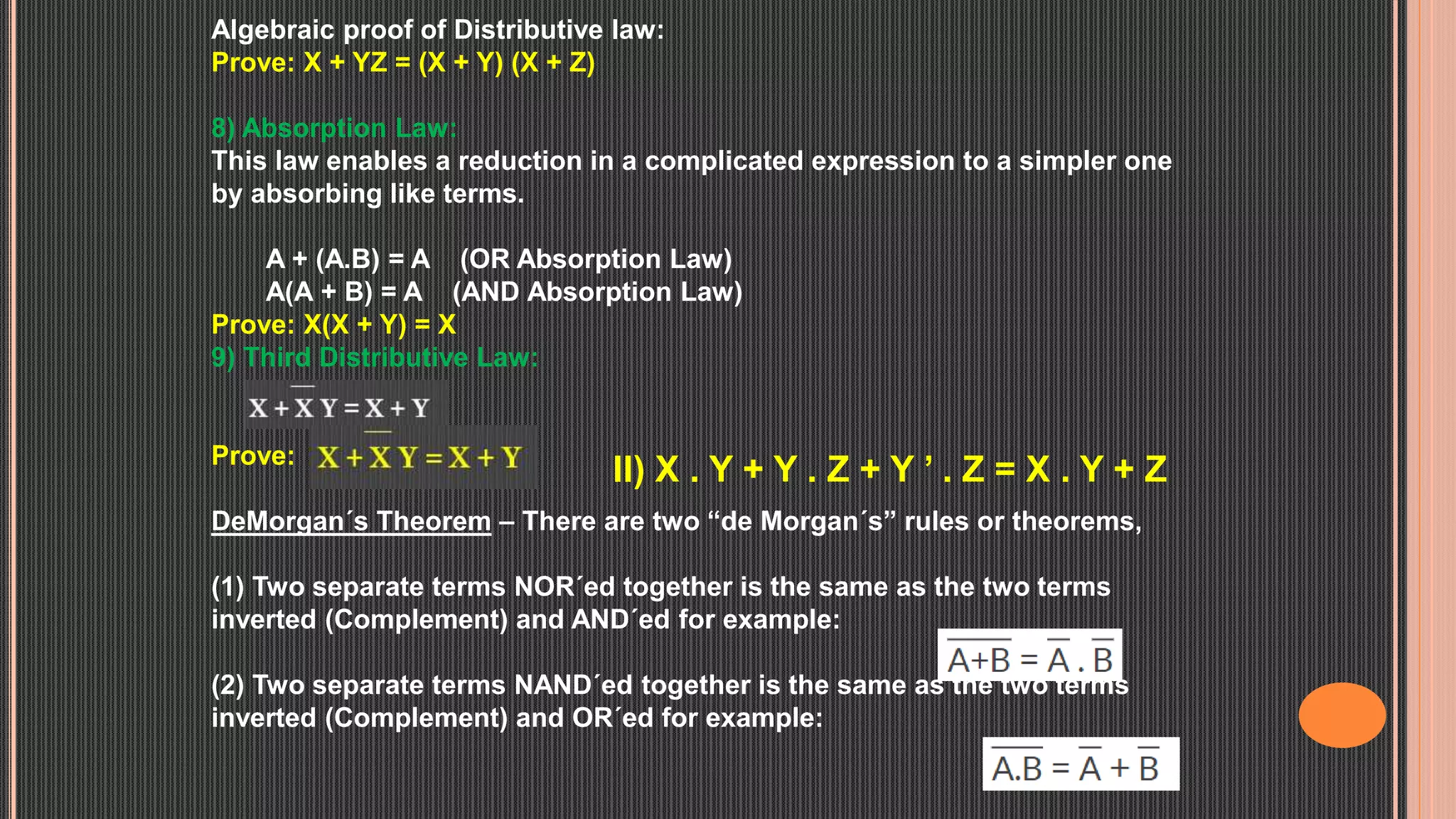
Algebraic proof of Distributive law:
Prove: X + YZ = (X + Y) (X + Z)
8) Absorption Law:
This law enables a reduction in a complicated expression to a simpler one
by absorbing like terms.
A + (A.B) = A (OR Absorption Law)
A(A + B) = A (AND Absorption Law)
Prove: X(X + Y) = X
9) Third Distributive Law:
Prove:
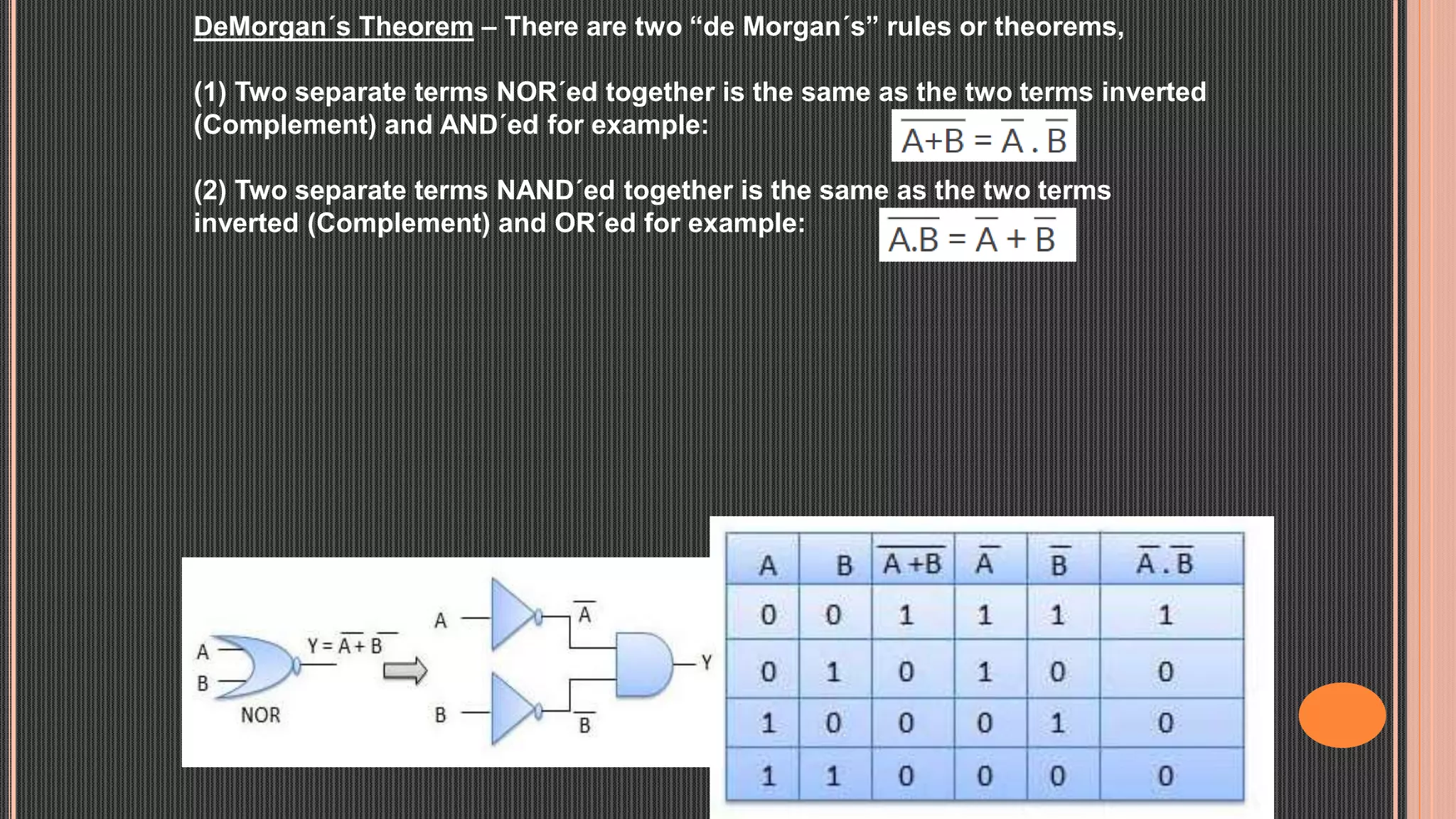
DeMorgan´s Theorem – There are two “de Morgan´s” rules or theorems,
(1) Two separate terms NOR´ed together is the same as the two terms
inverted (Complement) and AND´ed for example:
(2) Two separate terms NAND´ed together is the same as the two terms
inverted (Complement) and OR´ed for example:
II) X . Y + Y . Z + Y ’ . Z = X . Y + Z
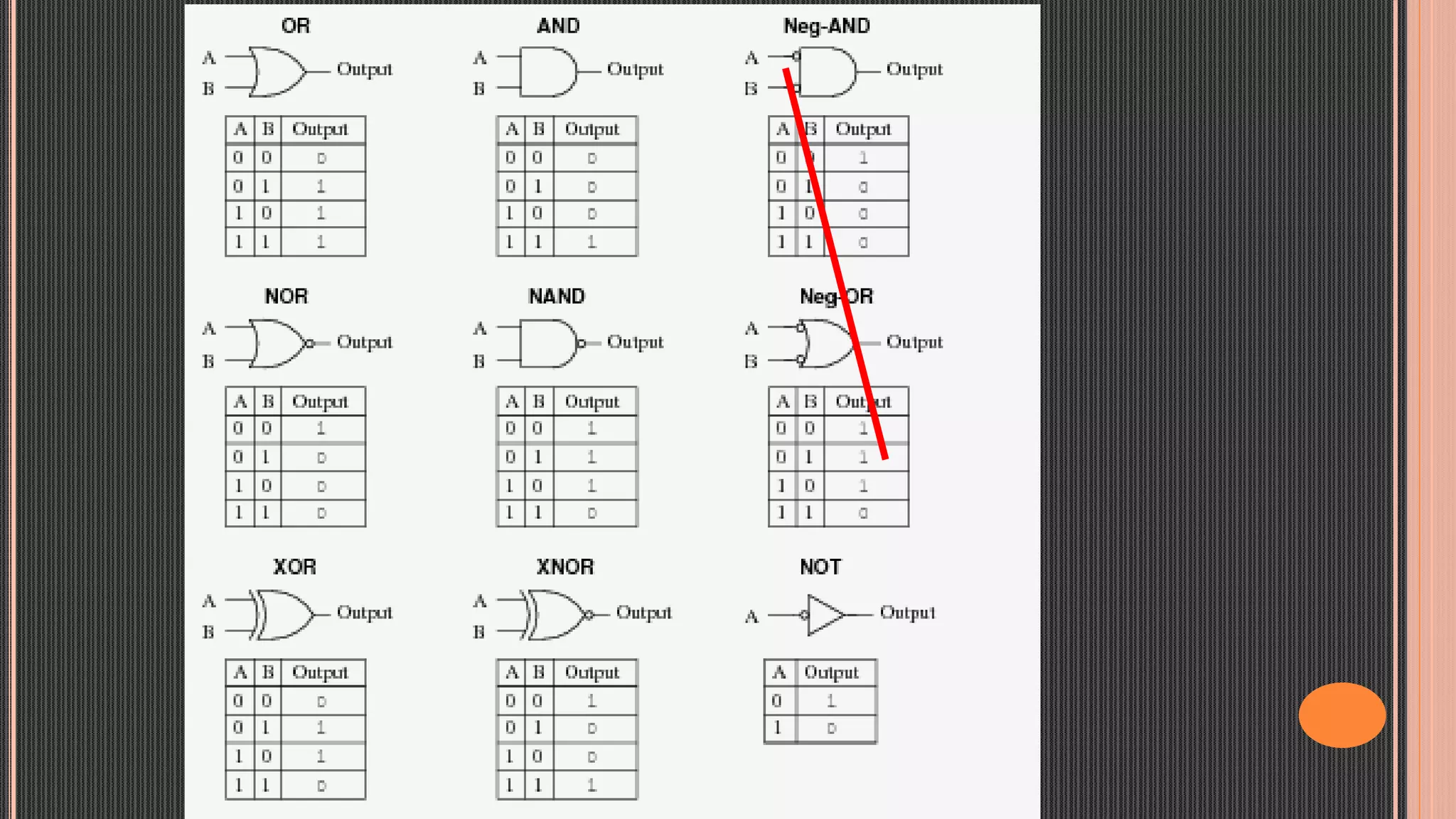
There are some more logic gates which are derived from 3 basic gates (AND, OR,
NOT).
These are more popular and used widely in the industry.
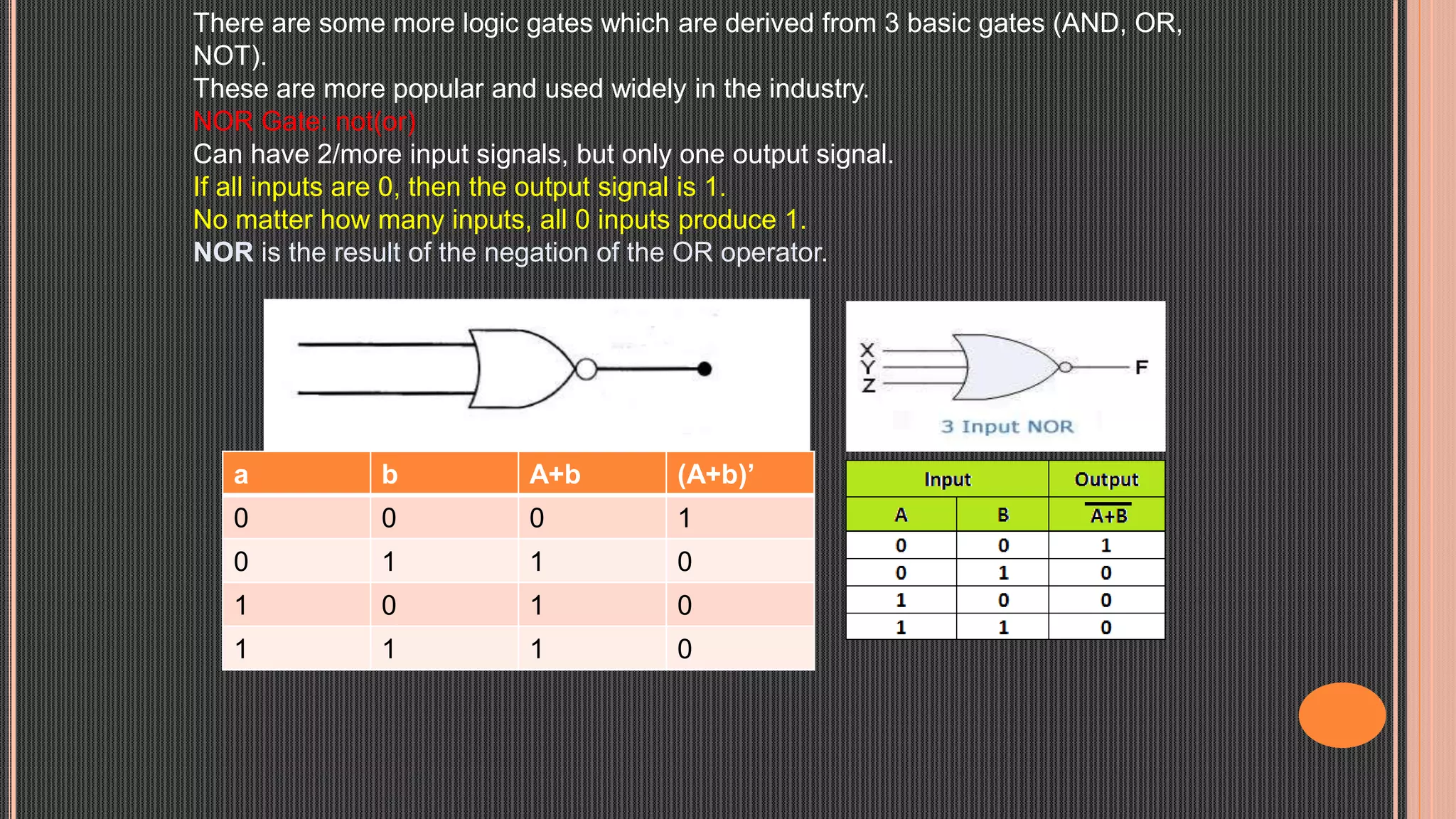
NOR Gate: not(or)
Can have 2/more input signals, but only one output signal.
If all inputs are 0, then the output signal is 1.
No matter how many inputs, all 0 inputs produce 1.
NOR is the result of the negation of the OR operator.
a b A+b (A+b)’
0 0 0 1
0 1 1 0
1 0 1 0
1 1 1 0
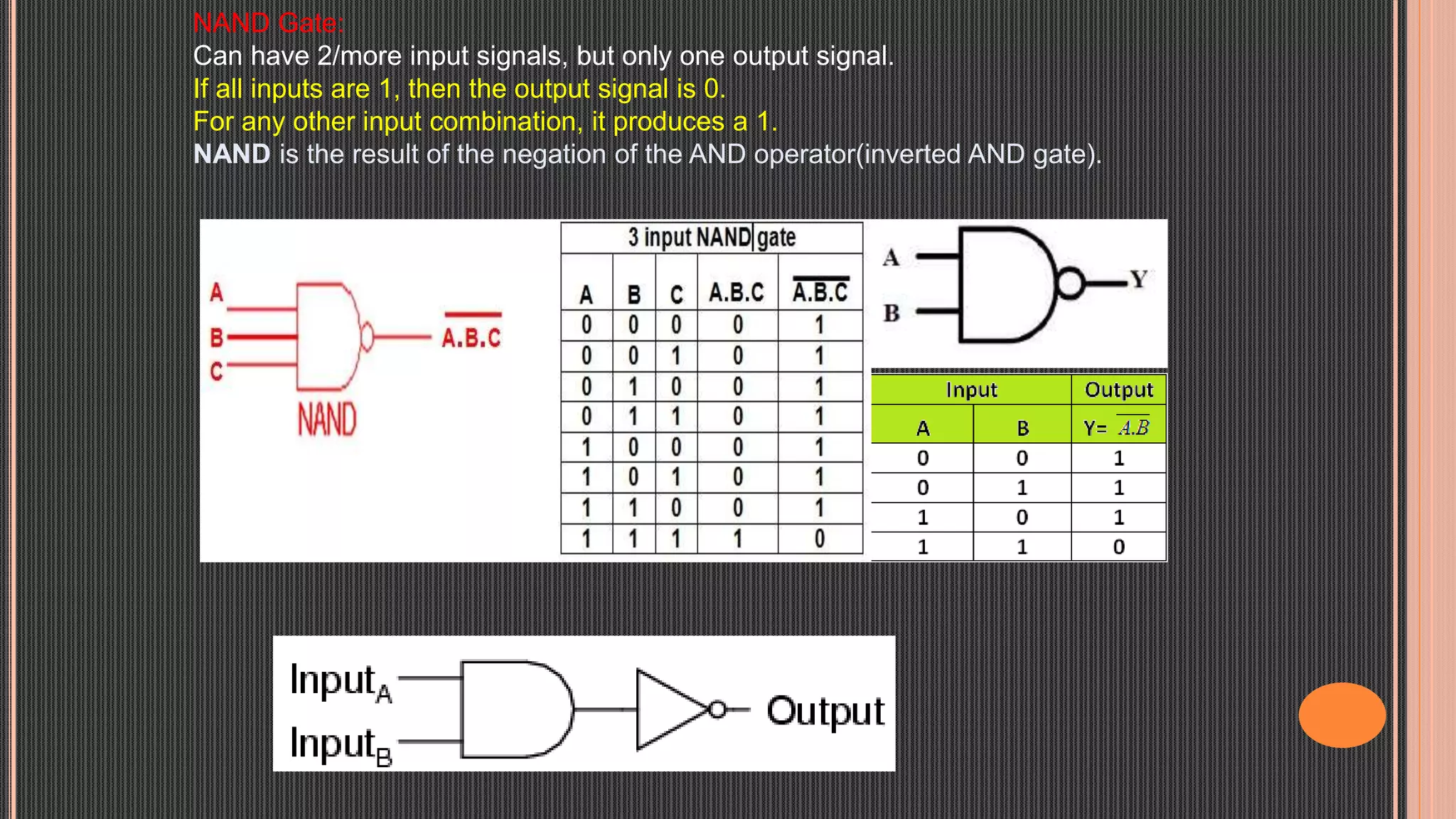
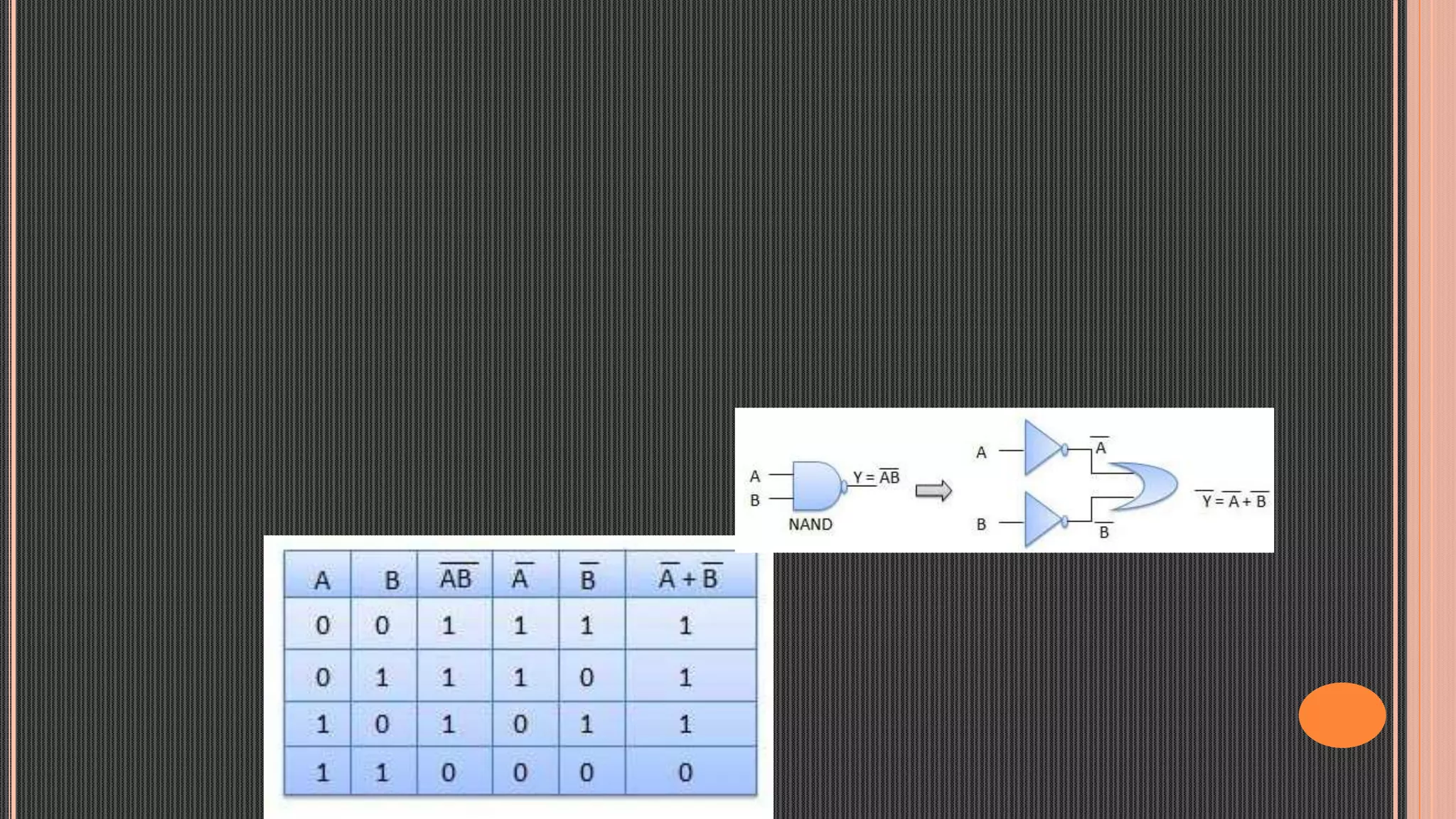
NAND Gate:
Can have 2/more input signals, but only one output signal.
If all inputs are 1, then the output signal is 0.
For any other input combination, it produces a 1.
NAND is the result of the negation of the AND operator(inverted AND gate).
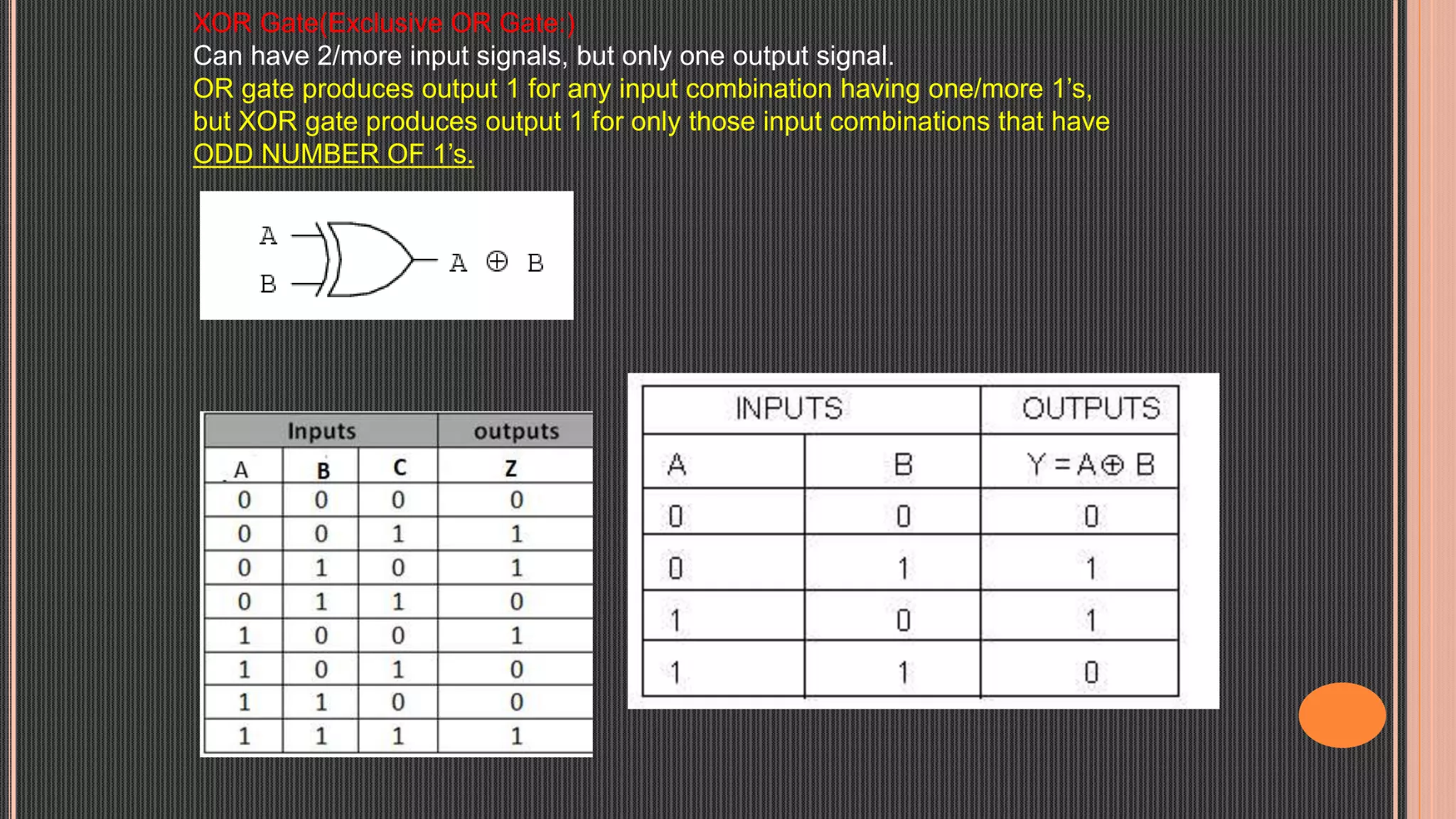
XOR Gate(Exclusive OR Gate:)
Can have 2/more input signals, but only one output signal.
OR gate produces output 1 for any input combination having one/more 1’s,
but XOR gate produces output 1 for only those input combinations that have
ODD NUMBER OF 1’s.
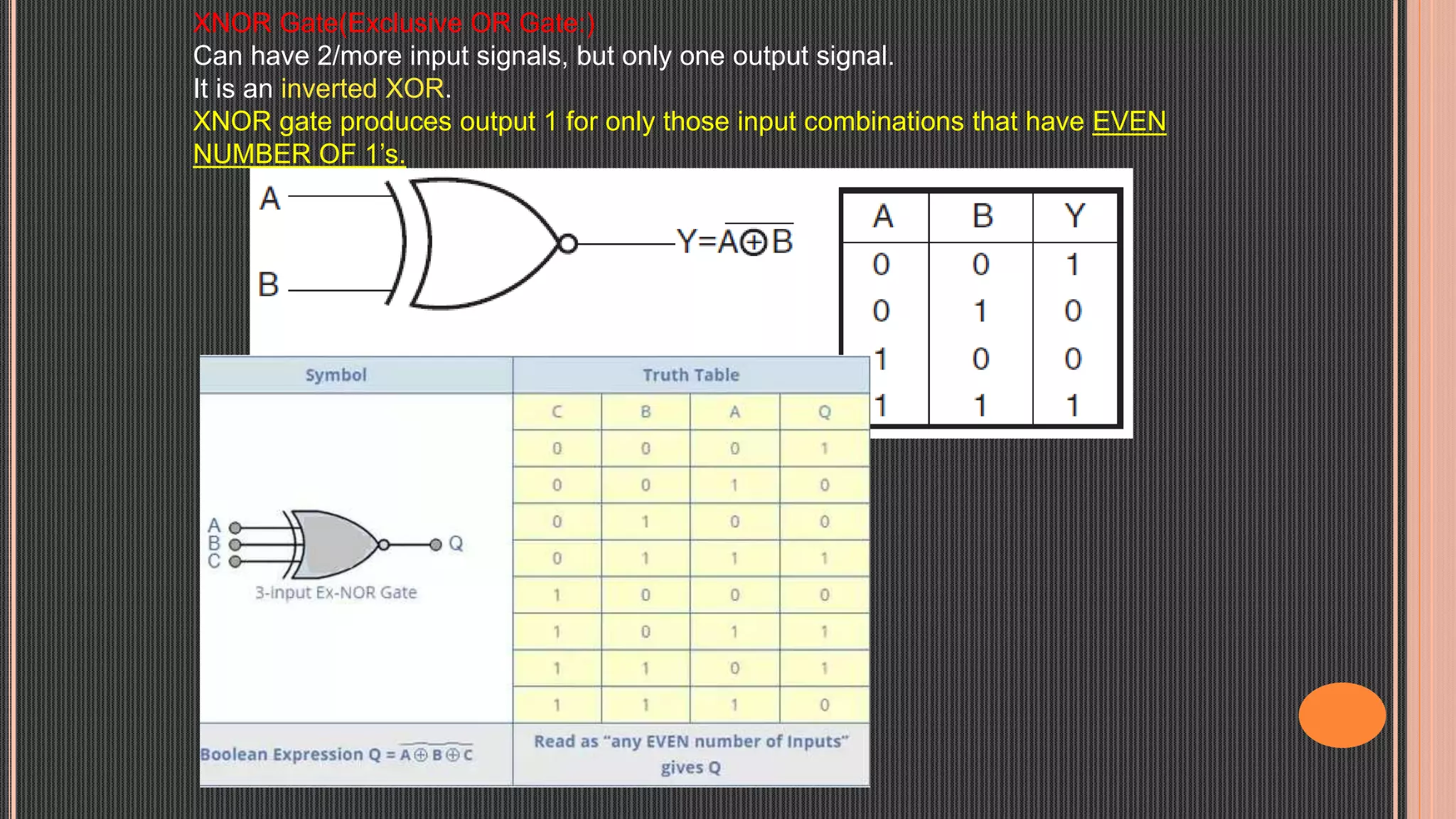
XNOR Gate(Exclusive OR Gate:)
Can have 2/more input signals, but only one output signal.
It is an inverted XOR.
XNOR gate produces output 1 for only those input combinations that have EVEN
NUMBER OF 1’s.
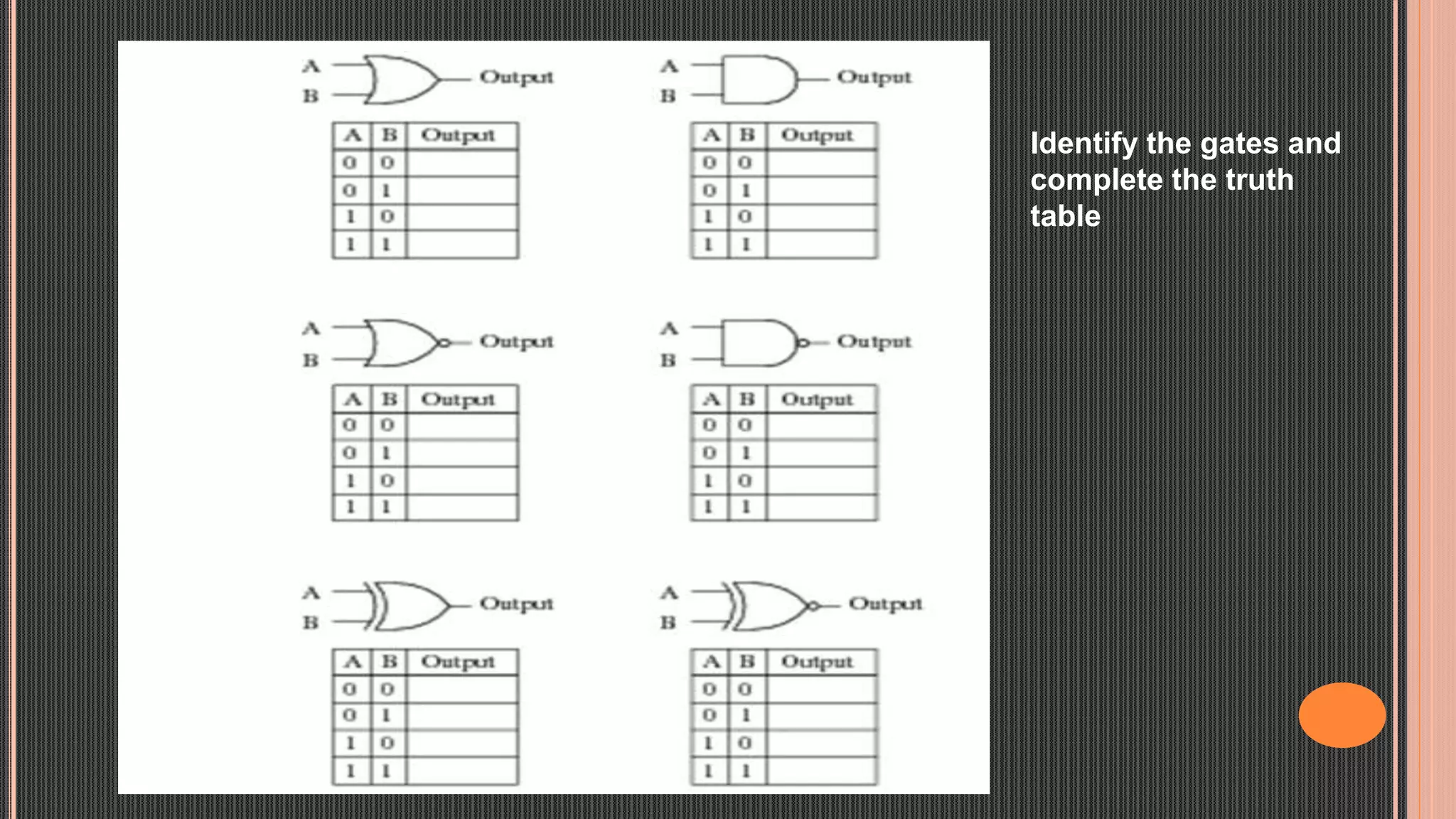
Identify the gates and
complete the truth
table
Design a circuit for the given Boolean expression:
F(a,b,c) = AB + AC ’ + B’ A’ C
DeMorgan´s Theorem – There are two “de Morgan´s” rules or theorems,
(1) Two separate terms NOR´ed together is the same as the two terms inverted
(Complement) and AND´ed for example:
(2) Two separate terms NAND´ed together is the same as the two terms
inverted (Complement) and OR´ed for example:
Involution A = A
Complementarit
y law
A + A = 1 A . A = 0
3rd Distributive
Law
A + A B = A + B
NAND and NOR gates are more popular, less expensive and easier to design.
Also referred as UNIVERSAL gates…

Boolean Logic.pptx

  • 1.
  • 2.
    CHECKLIST History On-off states And, or, not – key operators Truth tables Drawing a circuit Postulates, principles of duality, DeMorgan’s theorem Nor, nand, xor, xnor gates- symbolic representation, truth tables
  • 3.
    The English mathematicianGeorge Boole (1815-1864) sought to give symbolic form to Aristotle’s system of logic. Boole wrote a treatise on the subject in 1854, titled An Investigation of the Laws of Thought, on Which Are Founded the Mathematical Theories of Logic and Probabilities, which codified several rules of relationship between mathematical quantities limited to one of two possible values: true or false, 1 or 0. His mathematical system became known as Boolean algebra. However, Claude Shannon of MIT fame recognized how Boolean algebra could be applied to on-and-off circuits, where all signals are characterized as either “high” (1) or “low” (0). His 1938 thesis, titled A Symbolic Analysis of Relay and Switching Circuits, put Boole’s theoretical work to use in a way Boole could never have imagined, giving us a powerful mathematical tool for designing and analyzing digital circuits.
  • 4.
    Boolean Algebra isthe underlying mathematical structure of digital logic which is most often implemented via VLSI of CMOS circuits in the form of CPU, memory, and other digital technologies which are used to do things like run your laptop, or route packets over networks and so on. Deep down, inside the computer, inside the CPU, are transistors implementing NAND ports, NOR ports, NOT gates, the building blocks of digital logic. These have direct equivalents in boolean algebra. GATES are DIGITAL BUILDING BLOCKS. They are called DIGITAL because they operate on digital principles. They require a signal (also called a PULSE or INPUT) that is either 0v (LOW) or HIGH and give out a signal that is either LOW or HIGH. The decision which results into either YES(True) or NO(FALSE) is called a BINARY DECISION. Values True (0)and False (1)are called TRUTH Values. Logical Operators operate on binary values and binary variables.(And, Or, Not)
  • 10.
    Using Boolean logic,verify using truth table that X + XY = X for each X, Y in {0,1} Prepare a table of combinations for the following Boolean logic expressions: BASIC LOGIC GATES: 1) NOT Gate (INVERTER): 1) Output state always opposite to the input state. 2) Called the complement of the input.
  • 11.
    2) OR Gate: 1)Has 2 or more input signals, but only one output 2) If one/more input is 1, output is 1. 3) You can have a 2-input OR/3-input OR/n-input OR Gate. 3) AND Gate: 1) Has 2 or more input signals, but only one output 2) If all input is 1, output is 1. 3) You can have a 2-input AND/3-input AND/n-input AND Gate.
  • 12.
    • Postulates andtheorems of Boolean Algebra are used to analyze and simplify the digital (logic) circuits. 1. Properties of 0 0 + X = X ; 0.X =0 2. Properties of 1 1+X = 1 ; 1.X. = X 3. Idempotent law X + X = X, X.X. = X 4. Involution (X’) ‘ = X 5. COMPLEMENT LAW X + X’ = 1 ; X .X’ = 0 6. COMMUTATIVE LAW X+Y = Y+X ; X.Y = Y.X 7. ASSOCIATIVE LAW X+(Y+Z) = (X+Y) +Z ; X(YZ) = (XY) Z 8. DISTRIBUTIVE LAW X(Y+Z) = XY+XZ ; X +YZ = (X+Y) (X+Z) 9. ABSORPTION LAW X+XY = X ; X(X+Y) = X 10. 3RD DISTRIBUTIVE LAW X + X’Y = X+Y
  • 13.
    PRINCIPLE OF DUALITY: According to principle of duality "Dual of one expression is obtained by replacing AND (.)with OR(+) and OR with AND together with replacement of 1 with 0 and 0 with 1”. 1) Changing each OR (+)sign to an AND sign(.) 2) Changing each AND (.) sign to an OR sign (+) 3) Replacing each 0 by 1 and each 1 by 0.  The derived relation using duality principle is called dual of original expression.  Ex: OR operator on a input: a) 0 + 0 = 0 b) 0 + 1 = 1 c)1 + 0 = 1 d) 1 + 1 =1  Now as per Principle of duality: i) 1 . 1 = 1 ii) 1 . 0 = 0 c)0 . 1 = 0 d) 0 . 0 =0  The above is the result of a 2 input and operation.  So i), ii), iii) and iv) are the duals of a), b), c) and d)
  • 14.
    In proving thetheorems or rules of Boolean Algebra, it is then necessary to prove only one theorem, and the dual of the theorem follows necessarily. QUESTIONS 1. Give the dual of X . X ’ = 0 Ans: X + X’ = 1 2. Give the dual of X + 0 = X Ans: X . 1 =X 3. State the principle of duality in Boolean Algebra and give the dual of the Boolean expression: (X + Y).(X ’ + Z ’) . (Y + Z) ANS: (X . Y) + (X’ . Z’) + (Y .Z)
  • 15.
  • 16.
    3) Involution(Double Negation/DoubleInversion Rule): States that a variable with two negation its symbol gets cancelled out and original variable is obtained, Idempotent law
  • 17.
    4) Complementarity Law: Inthis Law, if a complement is added to a variable it gives one, if a variable is multiplied with its complement it results in ‘0’, i.e. A + A’ = 1 A.A’ = 0 5) Commutative Law: a variable order does not matter in this law, i.e., A + B = B + A A.B = B.A
  • 18.
    6) Associative Law: theorder of operation does not matter if the priority of variables are same like ‘*’ and ‘/’, i.e., A+(B+C) = (A+B)+C A.(B.C) = (A.B).C 7) Distributive Law: This law governs opening up of brackets, i.e., A.(B+C) = (A.B)+(A.C) A+(B.C) = (A+B).(A+C)
  • 20.
    Algebraic proof ofDistributive law: Prove: X + YZ = (X + Y) (X + Z) 8) Absorption Law: This law enables a reduction in a complicated expression to a simpler one by absorbing like terms. A + (A.B) = A (OR Absorption Law) A(A + B) = A (AND Absorption Law) Prove: X(X + Y) = X 9) Third Distributive Law: Prove: DeMorgan´s Theorem – There are two “de Morgan´s” rules or theorems, (1) Two separate terms NOR´ed together is the same as the two terms inverted (Complement) and AND´ed for example: (2) Two separate terms NAND´ed together is the same as the two terms inverted (Complement) and OR´ed for example: II) X . Y + Y . Z + Y ’ . Z = X . Y + Z
  • 21.
    There are somemore logic gates which are derived from 3 basic gates (AND, OR, NOT). These are more popular and used widely in the industry. NOR Gate: not(or) Can have 2/more input signals, but only one output signal. If all inputs are 0, then the output signal is 1. No matter how many inputs, all 0 inputs produce 1. NOR is the result of the negation of the OR operator. a b A+b (A+b)’ 0 0 0 1 0 1 1 0 1 0 1 0 1 1 1 0
  • 22.
    NAND Gate: Can have2/more input signals, but only one output signal. If all inputs are 1, then the output signal is 0. For any other input combination, it produces a 1. NAND is the result of the negation of the AND operator(inverted AND gate).
  • 23.
    XOR Gate(Exclusive ORGate:) Can have 2/more input signals, but only one output signal. OR gate produces output 1 for any input combination having one/more 1’s, but XOR gate produces output 1 for only those input combinations that have ODD NUMBER OF 1’s.
  • 24.
    XNOR Gate(Exclusive ORGate:) Can have 2/more input signals, but only one output signal. It is an inverted XOR. XNOR gate produces output 1 for only those input combinations that have EVEN NUMBER OF 1’s.
  • 25.
    Identify the gatesand complete the truth table
  • 27.
    Design a circuitfor the given Boolean expression: F(a,b,c) = AB + AC ’ + B’ A’ C
  • 28.
    DeMorgan´s Theorem –There are two “de Morgan´s” rules or theorems, (1) Two separate terms NOR´ed together is the same as the two terms inverted (Complement) and AND´ed for example: (2) Two separate terms NAND´ed together is the same as the two terms inverted (Complement) and OR´ed for example:
  • 29.
    Involution A =A Complementarit y law A + A = 1 A . A = 0 3rd Distributive Law A + A B = A + B
  • 31.
    NAND and NORgates are more popular, less expensive and easier to design. Also referred as UNIVERSAL gates…