Beware	
  of	
  Low	
  Frequency	
  Data	
  
Ernest	
  Chan,	
  Ph.D.	
  
QTS	
  Capital	
  Management,	
  LLC.	


•  Previously,	
  researcher	
  at	
  IBM	
  T.	
  J.	
  Watson	
  Lab	
  in	
  machine	
  
learning,	
  researcher/trader	
  for	
  Morgan	
  Stanley,	
  Credit	
  Suisse,	
  
and	
  various	
  hedge	
  funds.	
  
•  Principal	
  of	
  QTS	
  Capital	
  Management,	
  a	
  commodity	
  pool	
  
operator	
  and	
  trading	
  advisor.	
  
•  Author:	
  	
  
–  Quan%ta%ve	
  Trading:	
  How	
  to	
  Build	
  Your	
  Own	
  Algorithmic	
  
Trading	
  Business	
  	
  (Wiley	
  2009).	
  
–  Algorithmic	
  Trading:	
  Winning	
  Strategies	
  and	
  Their	
  
Ra%onale	
  (Wiley	
  2013).	
  
•  Blogger:	
  epchan.blogspot.com	


About	
  Me	
  
2	
  
GIGO	
  
•  Garbage	
  in,	
  garbage	
  out	
  is	
  well-­‐known	
  to	
  
programmers.	
  
•  Data	
  integrity	
  is	
  crucial	
  to	
  backtesVng	
  trading	
  
strategies.	
  
– Common	
  problem:	
  Historical	
  prices	
  backtested	
  
weren’t	
  the	
  actual	
  prices	
  we	
  could	
  execute	
  at.	
  	
  
– Typical	
  outcome:	
  backtest	
  performance	
  is	
  greatly	
  
inflated	
  compared	
  to	
  realisVc	
  historical	
  
performance.	
  
Example	
  1:	
  CEF	
  Premium	
  Reversion	
  
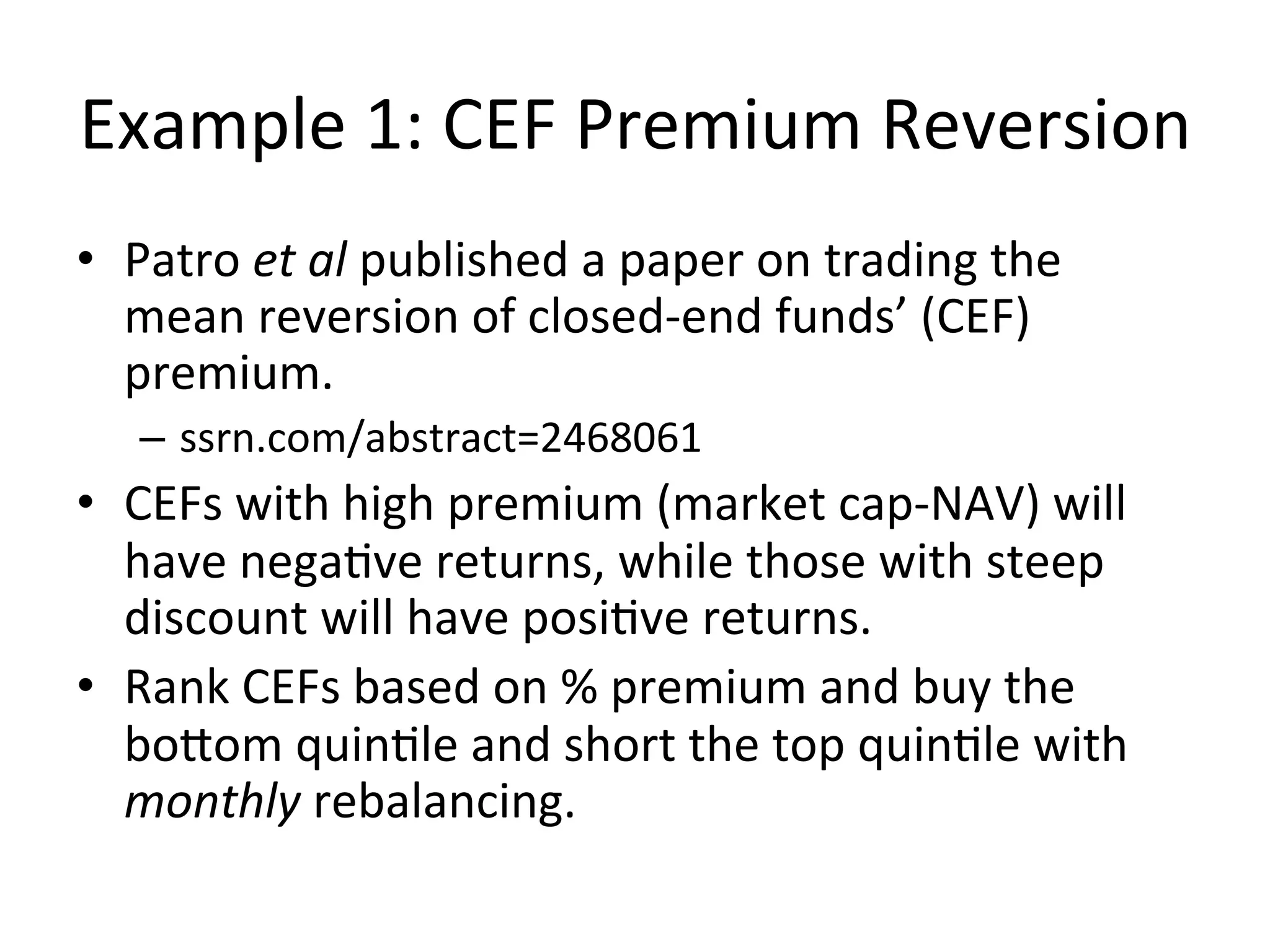
•  Patro	
  et	
  al	
  published	
  a	
  paper	
  on	
  trading	
  the	
  
mean	
  reversion	
  of	
  closed-­‐end	
  funds’	
  (CEF)	
  
premium.	
  
–  ssrn.com/abstract=2468061	
  
•  CEFs	
  with	
  high	
  premium	
  (market	
  cap-­‐NAV)	
  will	
  
have	
  negaVve	
  returns,	
  while	
  those	
  with	
  steep	
  
discount	
  will	
  have	
  posiVve	
  returns.	
  
•  Rank	
  CEFs	
  based	
  on	
  %	
  premium	
  and	
  buy	
  the	
  
bobom	
  quinVle	
  and	
  short	
  the	
  top	
  quinVle	
  with	
  
monthly	
  rebalancing.	
  
Example	
  1:	
  CEF	
  Premium	
  Reversion	
  
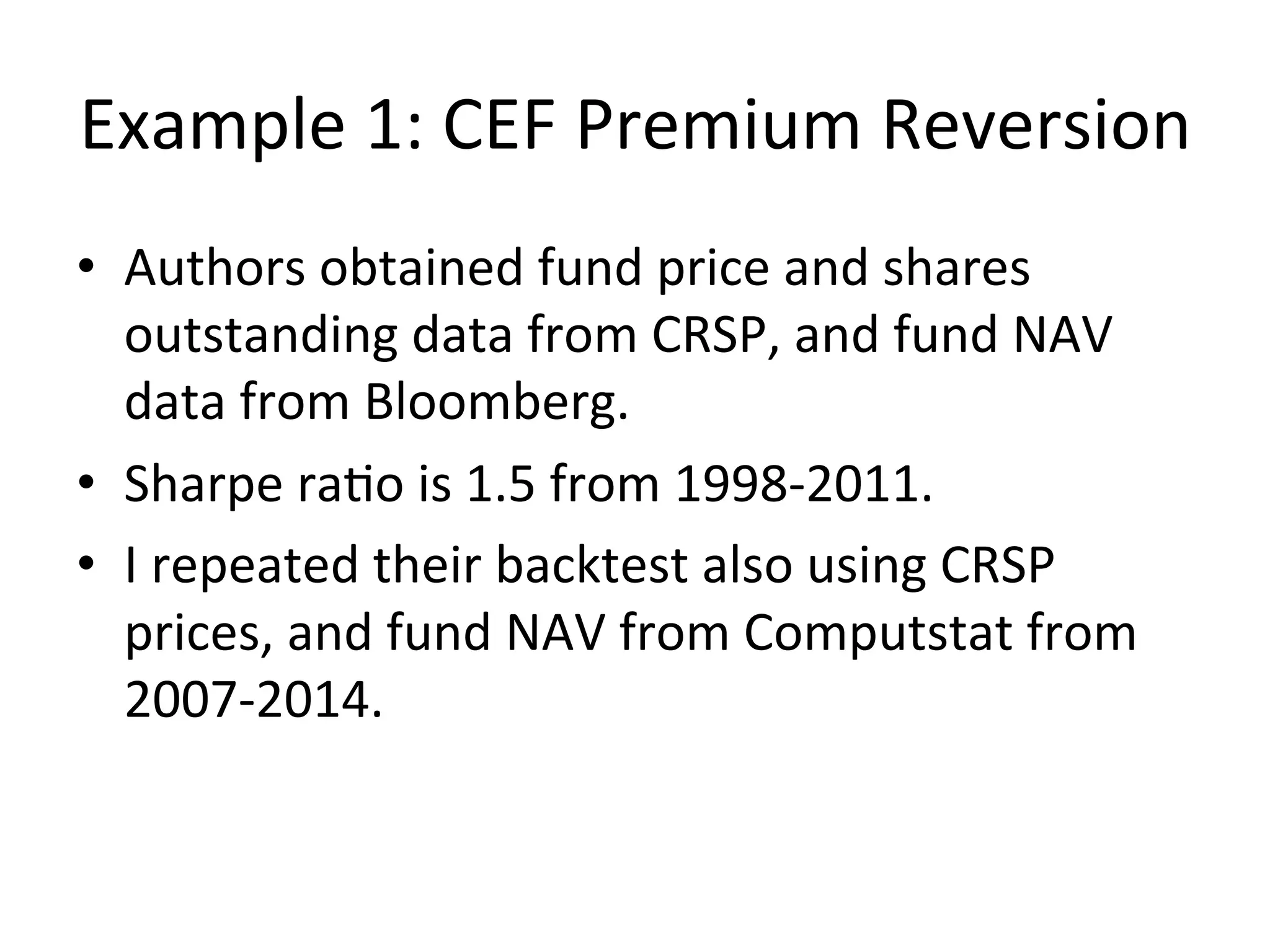
•  Authors	
  obtained	
  fund	
  price	
  and	
  shares	
  
outstanding	
  data	
  from	
  CRSP,	
  and	
  fund	
  NAV	
  
data	
  from	
  Bloomberg.	
  
•  Sharpe	
  raVo	
  is	
  1.5	
  from	
  1998-­‐2011.	
  
•  I	
  repeated	
  their	
  backtest	
  also	
  using	
  CRSP	
  
prices,	
  and	
  fund	
  NAV	
  from	
  Computstat	
  from	
  
2007-­‐2014.	
  
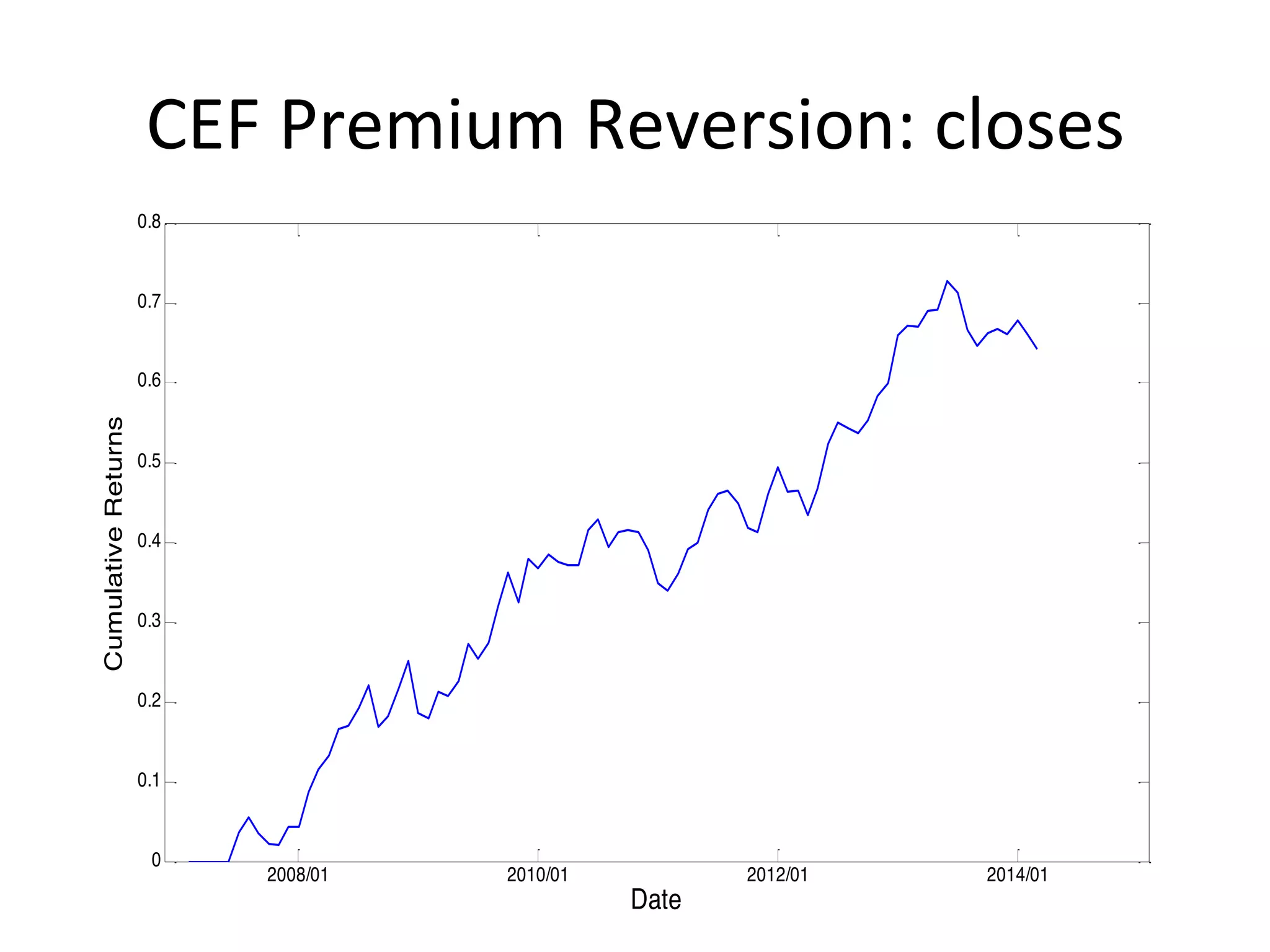
CEF	
  Premium	
  Reversion:	
  closes	
  
2008/01 2010/01 2012/01 2014/01
0
0.1
0.2
0.3
0.4
0.5
0.6
0.7
0.8
Date
CumulativeReturns
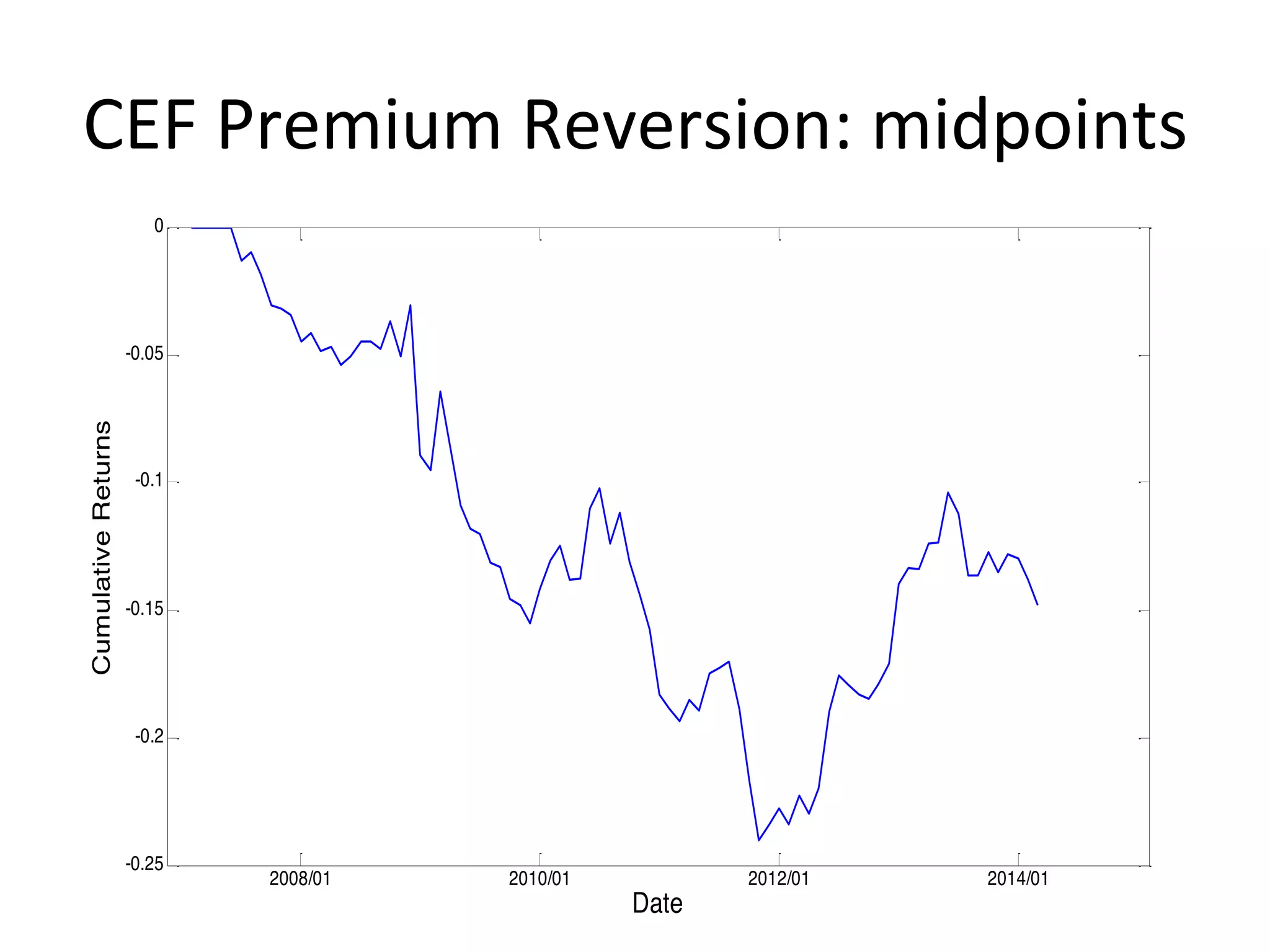
CEF	
  Premium	
  Reversion:	
  midpoints	


2008/01 2010/01 2012/01 2014/01
-0.25
-0.2
-0.15
-0.1
-0.05
0
Date
CumulativeReturns
Midpoints	
  vs	
  closes	
  
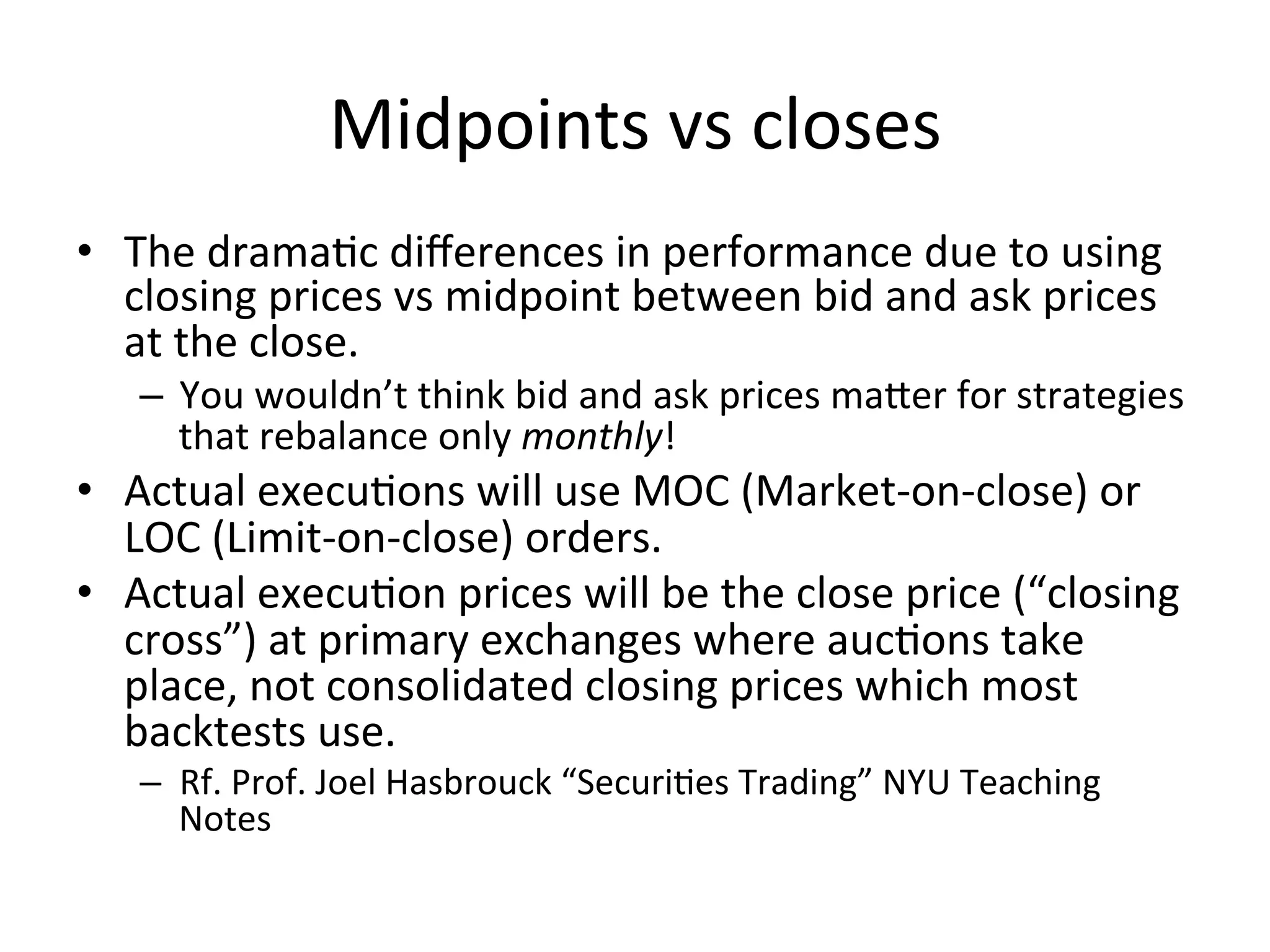
•  The	
  dramaVc	
  differences	
  in	
  performance	
  due	
  to	
  using	
  
closing	
  prices	
  vs	
  midpoint	
  between	
  bid	
  and	
  ask	
  prices	
  
at	
  the	
  close.	
  
–  You	
  wouldn’t	
  think	
  bid	
  and	
  ask	
  prices	
  maber	
  for	
  strategies	
  
that	
  rebalance	
  only	
  monthly!	
  
•  Actual	
  execuVons	
  will	
  use	
  MOC	
  (Market-­‐on-­‐close)	
  or	
  
LOC	
  (Limit-­‐on-­‐close)	
  orders.	
  
•  Actual	
  execuVon	
  prices	
  will	
  be	
  the	
  close	
  price	
  (“closing	
  
cross”)	
  at	
  primary	
  exchanges	
  where	
  aucVons	
  take	
  
place,	
  not	
  consolidated	
  closing	
  prices	
  which	
  most	
  
backtests	
  use.	
  
–  Rf.	
  Prof.	
  Joel	
  Hasbrouck	
  “SecuriVes	
  Trading”	
  NYU	
  Teaching	
  
Notes	
  
Consolidated	
  closes	
  
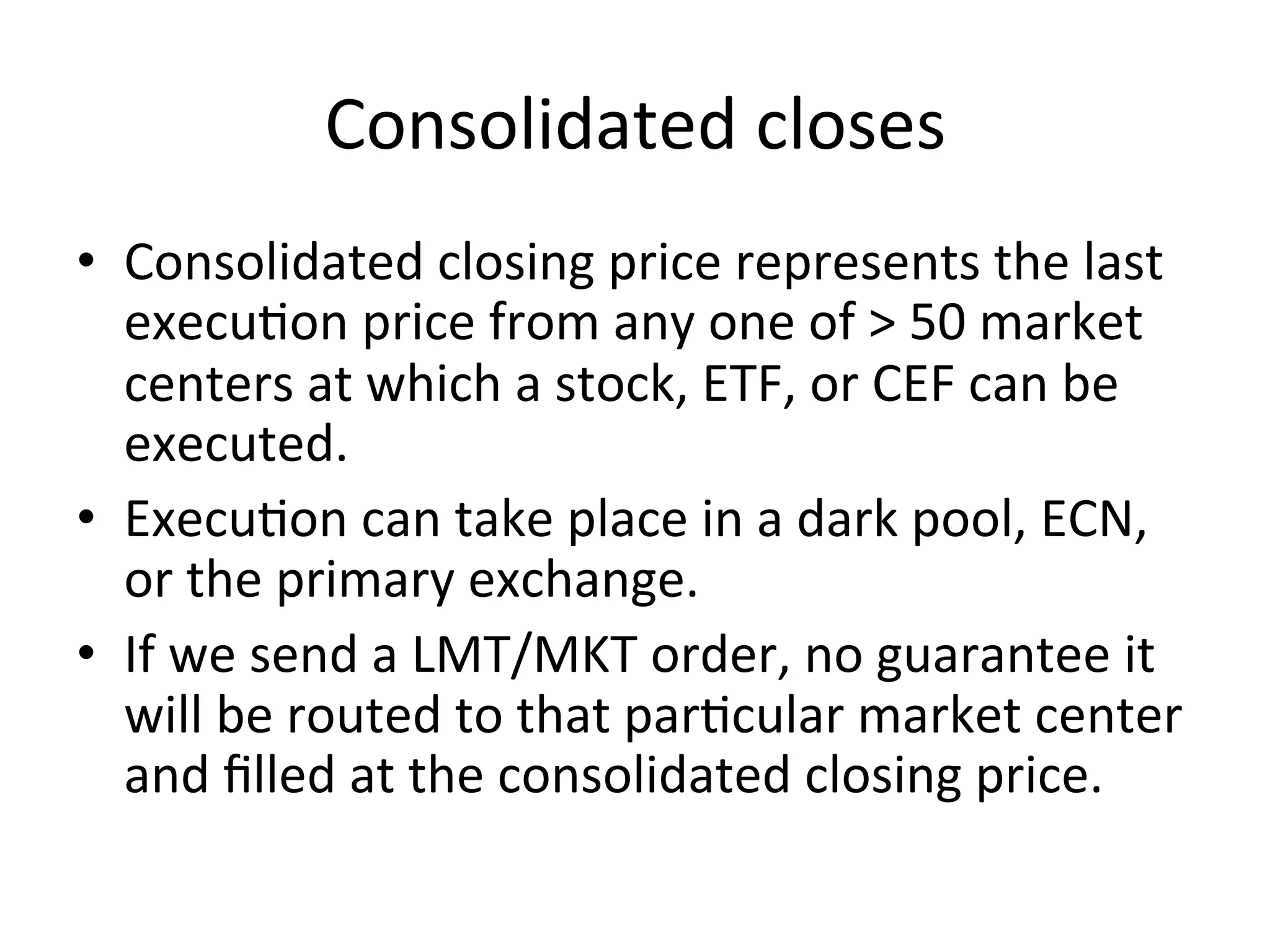
•  Consolidated	
  closing	
  price	
  represents	
  the	
  last	
  
execuVon	
  price	
  from	
  any	
  one	
  of	
  >	
  50	
  market	
  
centers	
  at	
  which	
  a	
  stock,	
  ETF,	
  or	
  CEF	
  can	
  be	
  
executed.	
  
•  ExecuVon	
  can	
  take	
  place	
  in	
  a	
  dark	
  pool,	
  ECN,	
  
or	
  the	
  primary	
  exchange.	
  
•  If	
  we	
  send	
  a	
  LMT/MKT	
  order,	
  no	
  guarantee	
  it	
  
will	
  be	
  routed	
  to	
  that	
  parVcular	
  market	
  center	
  
and	
  filled	
  at	
  the	
  consolidated	
  closing	
  price.	
  	
  
Primary	
  closes	
  
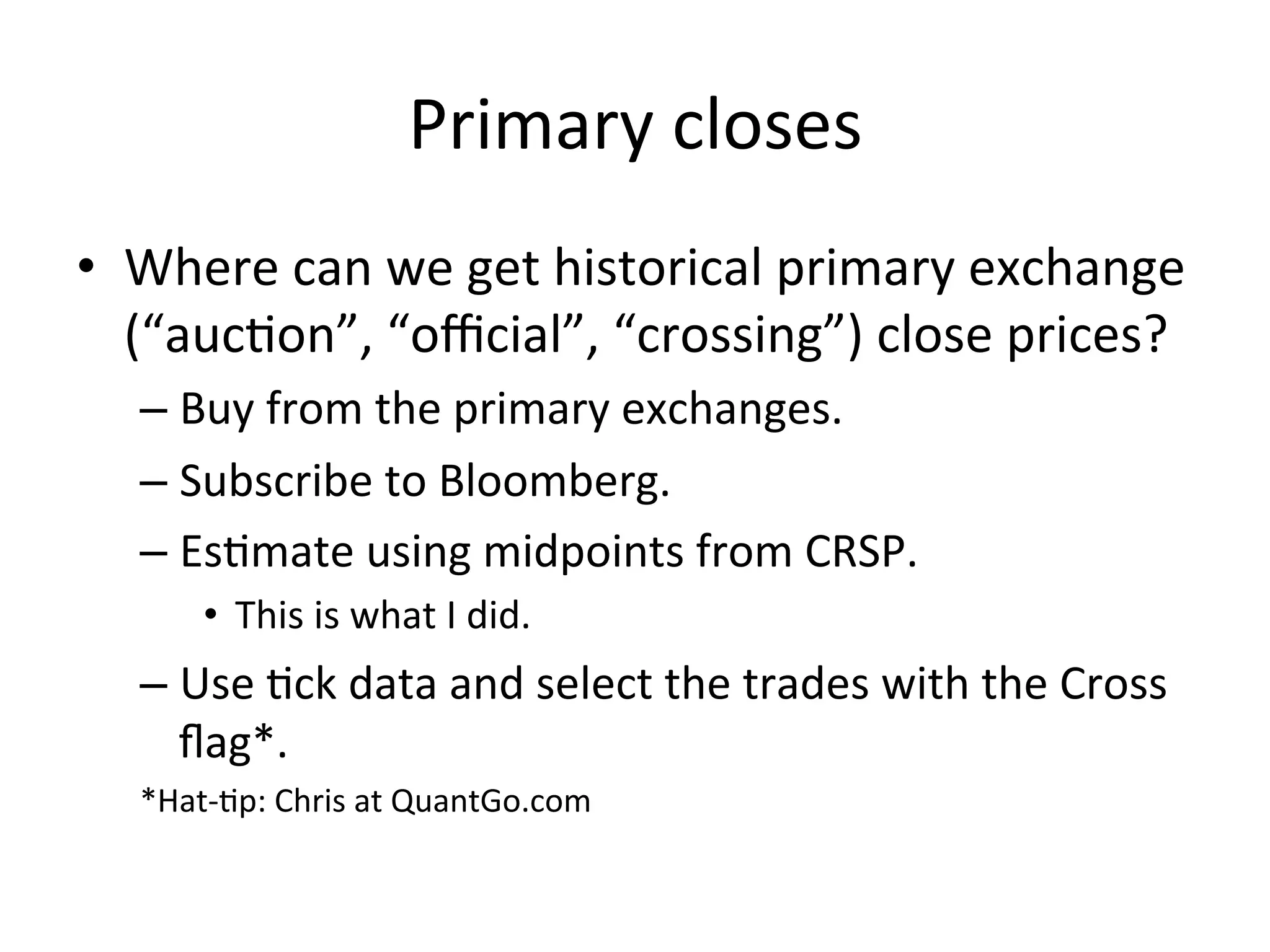
•  Where	
  can	
  we	
  get	
  historical	
  primary	
  exchange	
  
(“aucVon”,	
  “official”,	
  “crossing”)	
  close	
  prices?	
  
– Buy	
  from	
  the	
  primary	
  exchanges.	
  
– Subscribe	
  to	
  Bloomberg.	
  	
  
– EsVmate	
  using	
  midpoints	
  from	
  CRSP.	
  	
  
•  This	
  is	
  what	
  I	
  did.	
  
– Use	
  Vck	
  data	
  and	
  select	
  the	
  trades	
  with	
  the	
  Cross	
  
flag*.	
  
*Hat-­‐Vp:	
  Chris	
  at	
  QuantGo.com	
  
Example	
  2:	
  Opening	
  gap	
  
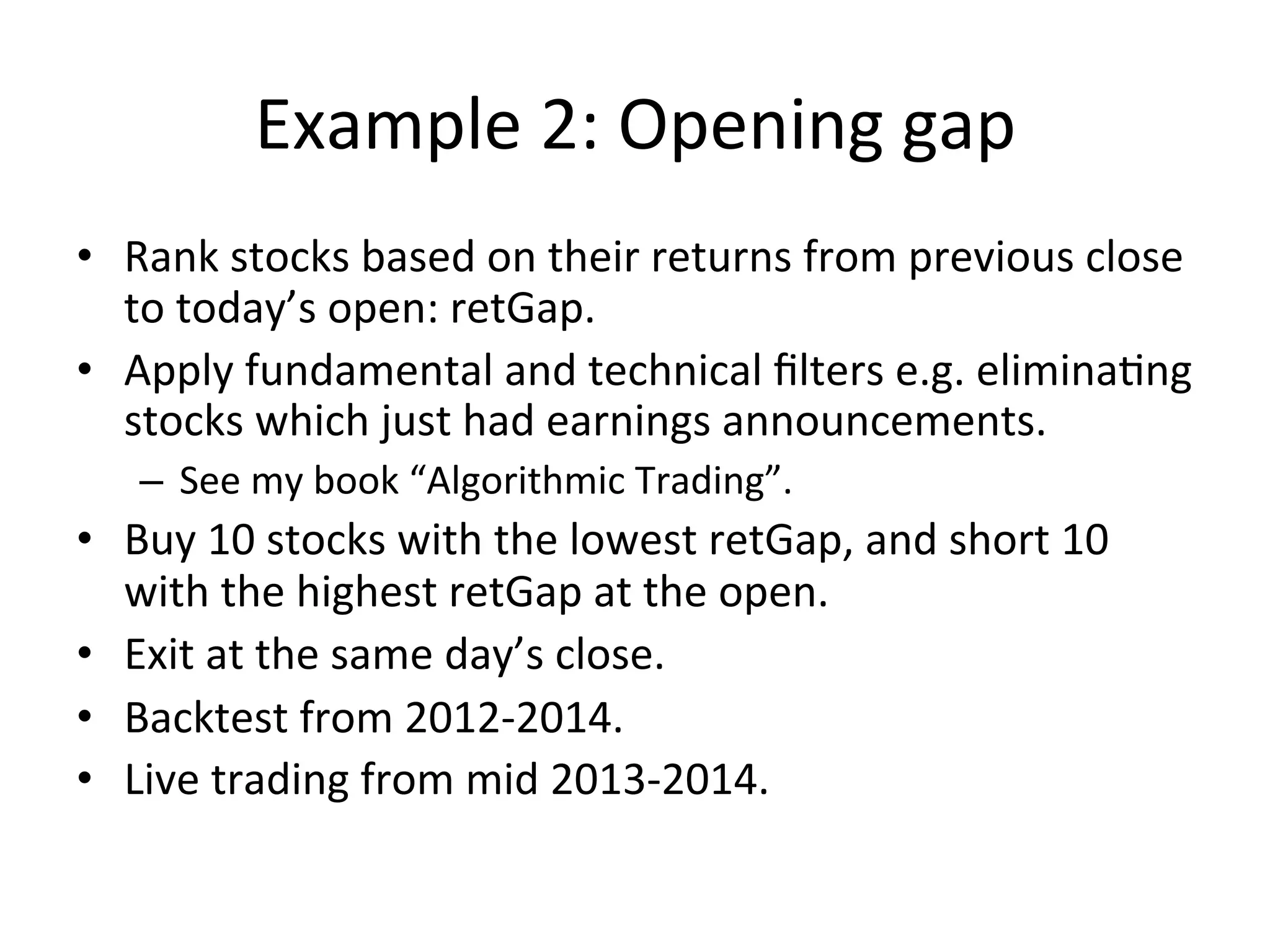
•  Rank	
  stocks	
  based	
  on	
  their	
  returns	
  from	
  previous	
  close	
  
to	
  today’s	
  open:	
  retGap.	
  
•  Apply	
  fundamental	
  and	
  technical	
  filters	
  e.g.	
  eliminaVng	
  
stocks	
  which	
  just	
  had	
  earnings	
  announcements.	
  
–  See	
  my	
  book	
  “Algorithmic	
  Trading”.	
  
•  Buy	
  10	
  stocks	
  with	
  the	
  lowest	
  retGap,	
  and	
  short	
  10	
  
with	
  the	
  highest	
  retGap	
  at	
  the	
  open.	
  
•  Exit	
  at	
  the	
  same	
  day’s	
  close.	
  
•  Backtest	
  from	
  2012-­‐2014.	
  
•  Live	
  trading	
  from	
  mid	
  2013-­‐2014.	


Opening	
  Gap:	
  Backtest	
  vs	
  Live	
  
2012/01 2013/01 2014/01
-0.05
0
0.05
0.1
0.15
0.2
0.25
0.3
0.35
Date
CumulativeReturns
Backtest with 5 bps cost
Live
What	
  happens	
  at	
  the	
  open?	
  
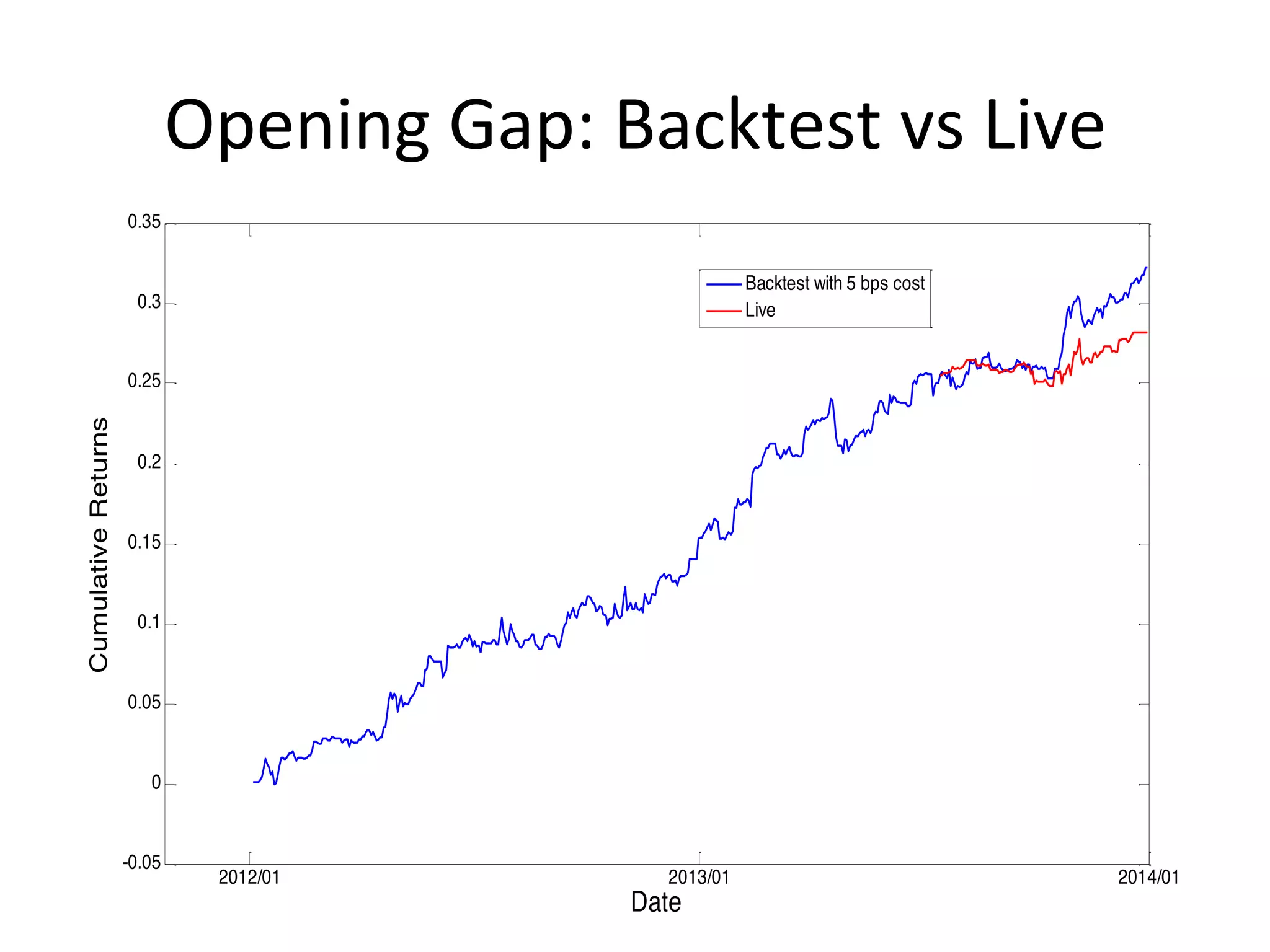
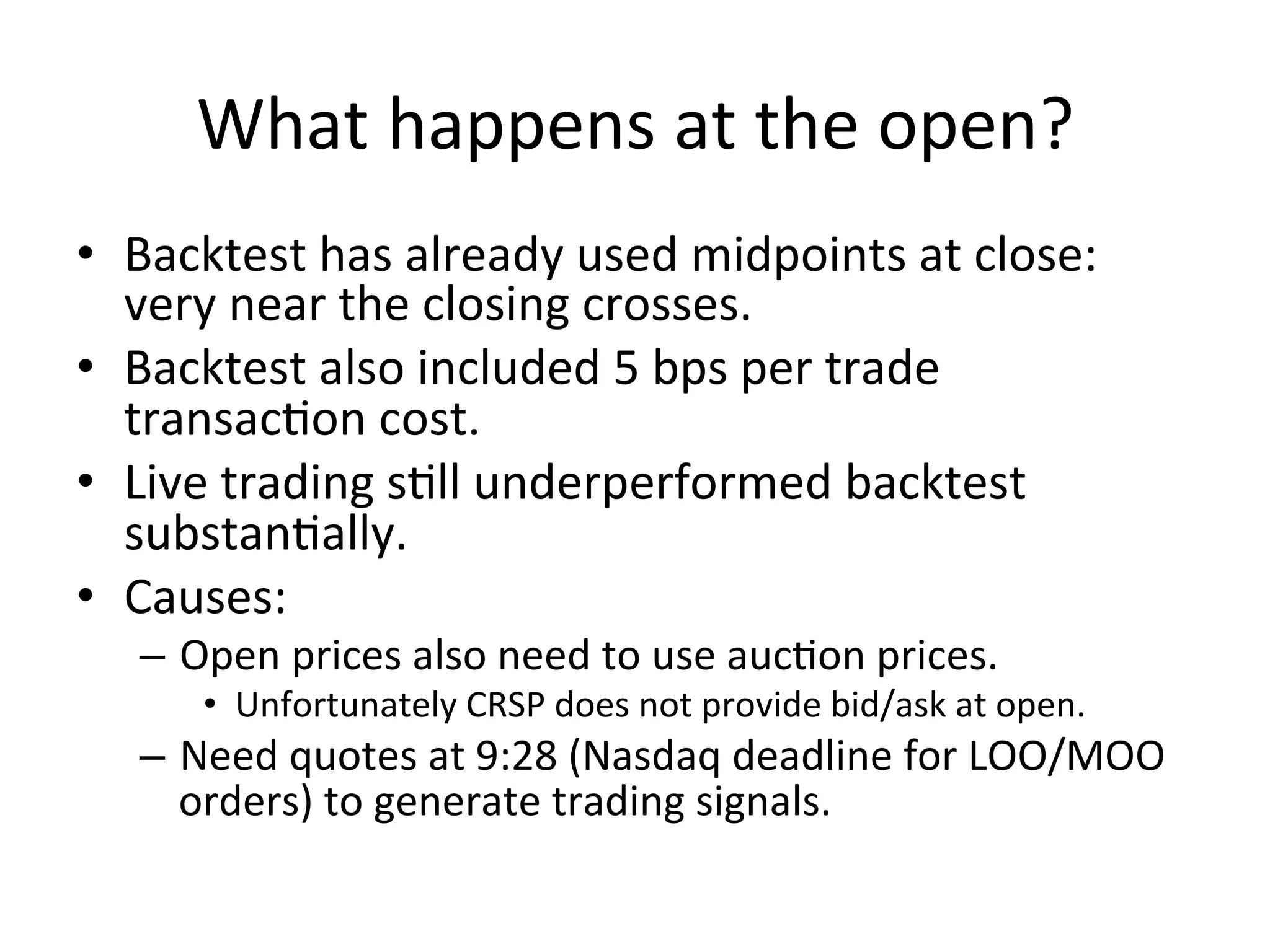
•  Backtest	
  has	
  already	
  used	
  midpoints	
  at	
  close:	
  
very	
  near	
  the	
  closing	
  crosses.	
  
•  Backtest	
  also	
  included	
  5	
  bps	
  per	
  trade	
  
transacVon	
  cost.	
  
•  Live	
  trading	
  sVll	
  underperformed	
  backtest	
  
substanVally.	
  
•  Causes:	
  
–  Open	
  prices	
  also	
  need	
  to	
  use	
  aucVon	
  prices.	
  
•  Unfortunately	
  CRSP	
  does	
  not	
  provide	
  bid/ask	
  at	
  open.	
  
–  Need	
  quotes	
  at	
  9:28	
  (Nasdaq	
  deadline	
  for	
  LOO/MOO	
  
orders)	
  to	
  generate	
  trading	
  signals.	


Example	
  3:	
  Futures	
  momentum	
  
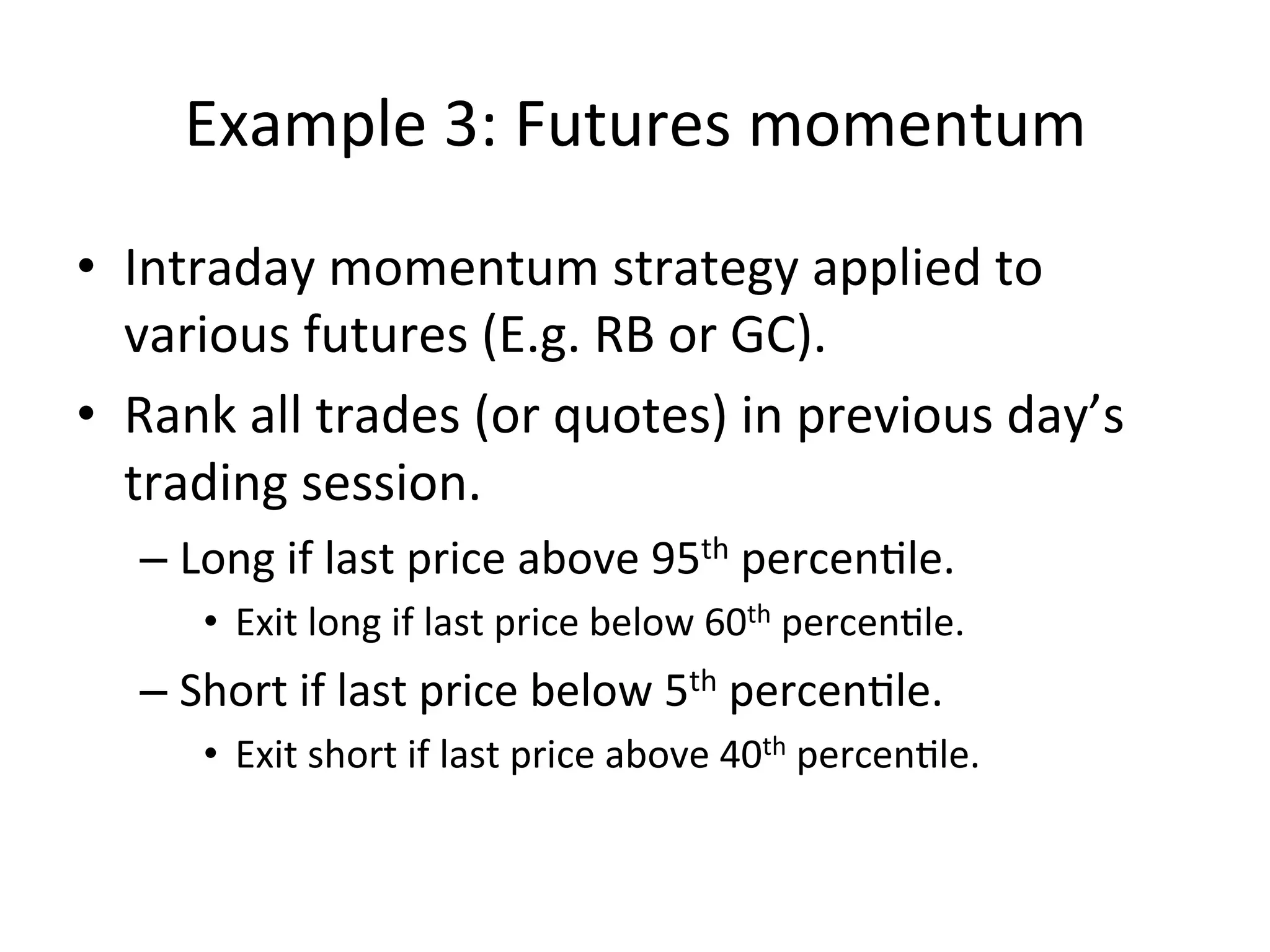
•  Intraday	
  momentum	
  strategy	
  applied	
  to	
  
various	
  futures	
  (E.g.	
  RB	
  or	
  GC).	
  
•  Rank	
  all	
  trades	
  (or	
  quotes)	
  in	
  previous	
  day’s	
  
trading	
  session.	
  
– Long	
  if	
  last	
  price	
  above	
  95th	
  percenVle.	
  
•  Exit	
  long	
  if	
  last	
  price	
  below	
  60th	
  percenVle.	
  
– Short	
  if	
  last	
  price	
  below	
  5th	
  percenVle.	
  	
  
•  Exit	
  short	
  if	
  last	
  price	
  above	
  40th	
  percenVle.	
  
Futures	
  momentum	
  
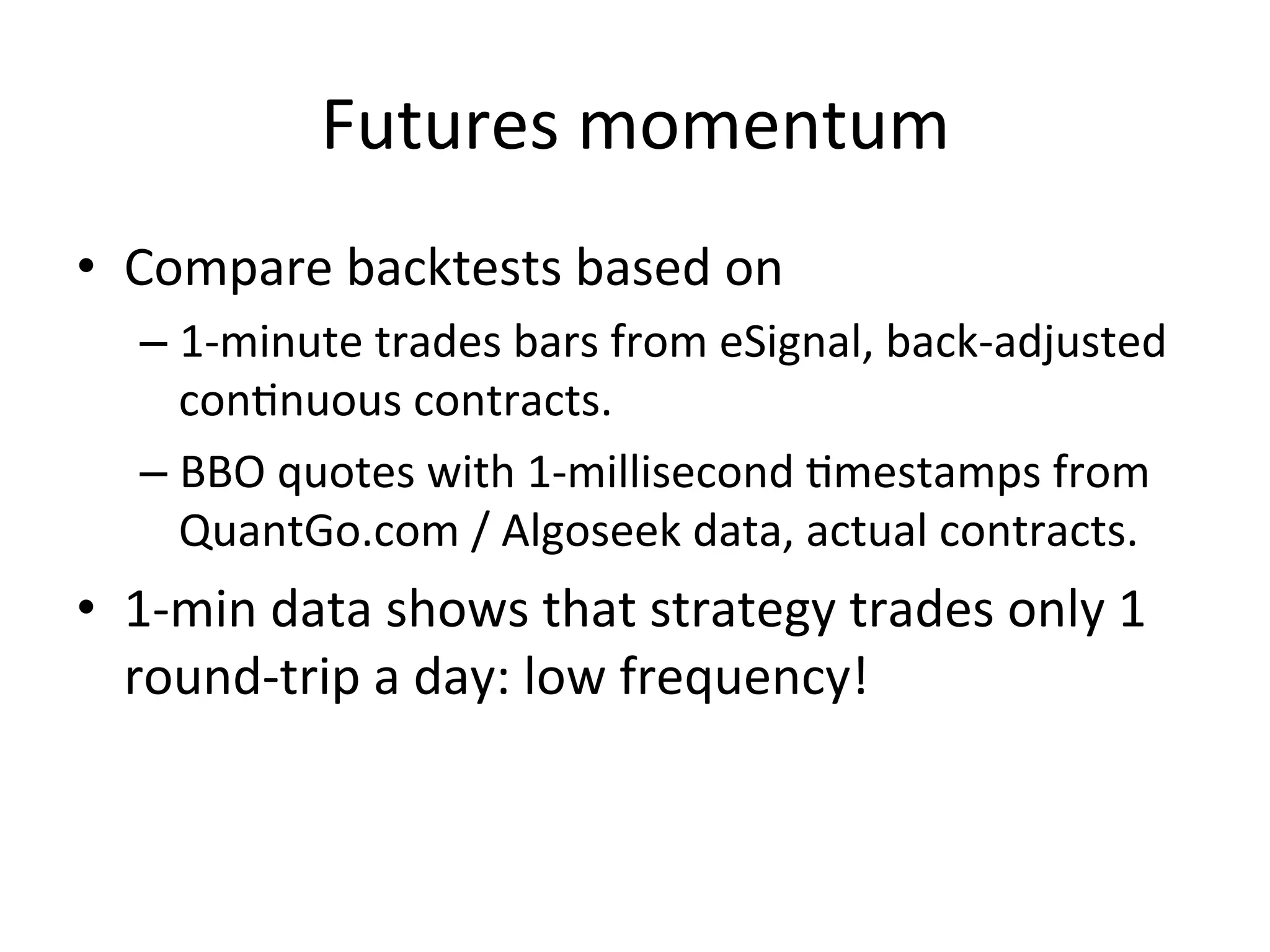
•  Compare	
  backtests	
  based	
  on	
  
– 1-­‐minute	
  trades	
  bars	
  from	
  eSignal,	
  back-­‐adjusted	
  
conVnuous	
  contracts.	
  
– BBO	
  quotes	
  with	
  1-­‐millisecond	
  Vmestamps	
  from	
  
QuantGo.com	
  /	
  Algoseek	
  data,	
  actual	
  contracts.	
  
•  1-­‐min	
  data	
  shows	
  that	
  strategy	
  trades	
  only	
  1	
  
round-­‐trip	
  a	
  day:	
  low	
  frequency!	
  
Futures	
  momentum	
  
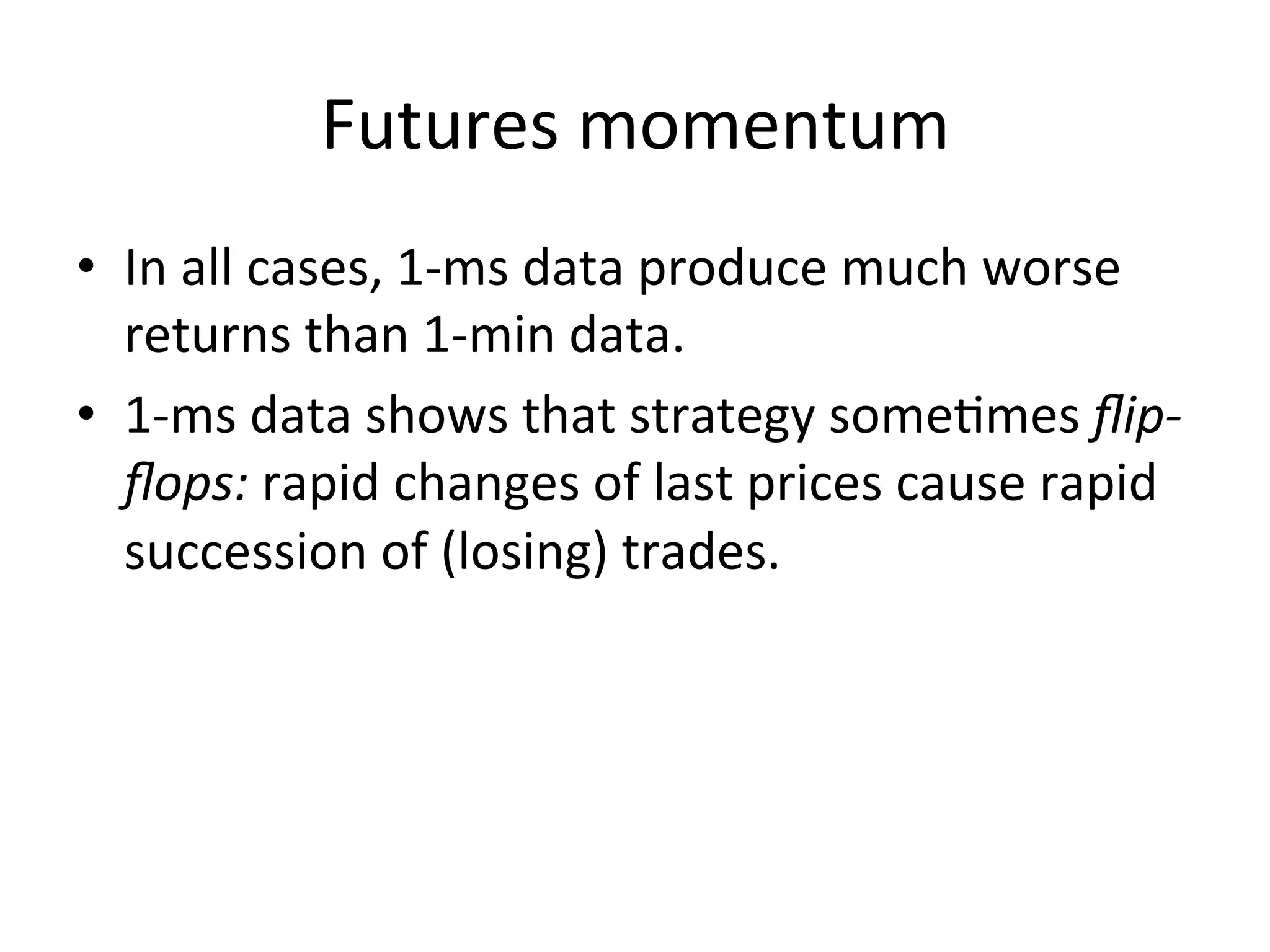
•  In	
  all	
  cases,	
  1-­‐ms	
  data	
  produce	
  much	
  worse	
  
returns	
  than	
  1-­‐min	
  data.	
  
•  1-­‐ms	
  data	
  shows	
  that	
  strategy	
  someVmes	
  flip-­‐
flops:	
  rapid	
  changes	
  of	
  last	
  prices	
  cause	
  rapid	
  
succession	
  of	
  (losing)	
  trades.	
  
Example	
  4:	
  Pair	
  trading	
  ETFs	
  
•  E.g.	
  ETFs	
  EWA	
  (Australian	
  stock	
  index)	
  and	
  EWC	
  
(Canadian	
  stock	
  index)	
  are	
  good	
  candidates	
  for	
  
mean-­‐reversion	
  pair	
  trading.	
  
•  Bollinger	
  band	
  strategy	
  applied	
  to	
  spread.	
  
•  Backtest	
  on	
  daily	
  closes	
  (aucVon	
  or	
  consolidated	
  
prices):	
  good	
  results.	
  
•  Why	
  not	
  live	
  trade	
  intraday,	
  using	
  Bollinger	
  
bands	
  to	
  set	
  limit	
  prices?	
  
–  Expect	
  more	
  trading	
  opportuniVes	
  and	
  more	
  profits!	
  
Pair	
  trading	
  ETFs	
  
•  Reality:	
  Intraday	
  live	
  trading	
  using	
  InteracVve	
  
Brokers	
  live	
  Vck	
  feed	
  (250ms	
  bars)	
  osen	
  suffers	
  
mysterious	
  losses	
  due	
  to	
  mysterious	
  trades.	
  
•  Culprit:	
  Flip-­‐flopping	
  due	
  to	
  order	
  book	
  “mini-­‐
flash	
  crashes”	
  
–  Small	
  change	
  in	
  price	
  on	
  one	
  leg	
  leads	
  to	
  large	
  %	
  error	
  
in	
  spread!	
  
•  These	
  flip-­‐flopping	
  and	
  losses	
  disappear	
  if	
  we	
  use	
  
Yahoo	
  RealTime	
  (1s	
  bars).	
  
Pair	
  trading	
  ETFs	
  
•  Moral	
  of	
  story:	
  if	
  you	
  want	
  to	
  trade	
  intraday,	
  
must	
  use	
  Vck	
  data	
  for	
  backtest,	
  even	
  if	
  holding	
  
period	
  is	
  long	
  (e.g.	
  hours).	
  
•  What	
  if	
  we	
  restrict	
  live	
  data	
  to	
  1-­‐sec	
  or	
  longer	
  
bars?	
  
– This	
  would	
  be	
  arVficial	
  and	
  nonsensical:	
  why	
  
should	
  we	
  only	
  trade	
  at	
  …	
  10:01,	
  10:02,	
  10:03,	
  …	
  
instead	
  of	
  …	
  10:01:01,	
  10:01:02,	
  10:01:03,	
  …?	
  
LF	
  backtest	
  requires	
  HF	
  historical	
  data	
  
•  CEF	
  monthly	
  rebalancing	
  →	
  need	
  Vck	
  data	
  to	
  find	
  
closing	
  crosses	
  (aucVon)	
  prices	
  (unless	
  you	
  have	
  
Bloomberg).	
  
•  Opening	
  gap	
  stocks	
  strategy	
  →	
  need	
  Vck	
  data	
  to	
  
find	
  NBBO	
  at	
  9:28	
  am	
  and	
  opening	
  crosses.	
  
•  Intraday	
  low-­‐frequency	
  futures	
  momentum	
  
strategy	
  →	
  need	
  Vck	
  data	
  to	
  check	
  for	
  intra-­‐1-­‐
min-­‐bar	
  flip-­‐flopping/mini-­‐flash	
  crashes.	
  
•  Intraday	
  low-­‐frequency	
  ETF	
  mean	
  reversion	
  pair	
  
trading	
  →	
  need	
  Vck	
  data	
  to	
  check	
  for	
  intra-­‐1-­‐sec-­‐
bar	
  flip-­‐flopping/mini-­‐flash	
  crashes.	
  
Conclusion	
  
•  Whether	
  a	
  trading	
  strategy	
  requires	
  low	
  or	
  
high	
  frequency	
  historical	
  data	
  depends	
  not	
  
only	
  on	
  holding	
  period,	
  but	
  also	
  on:	
  
– How	
  execuVon	
  prices	
  are	
  determined.	
  
– How	
  trading	
  signals	
  are	
  triggered.	
  
Thank	
  you	
  for	
  your	
  Vme!	
  
www.epchan.com	
  
Twiber:	
  @chanep	
  
Blog:	
  epchan.blogspot.com	
  

Beware of Low Frequency Data by Ernie Chan, Managing Member, QTS Capital Management, LLC.

  • 1.
    Beware  of  Low  Frequency  Data   Ernest  Chan,  Ph.D.   QTS  Capital  Management,  LLC.    
  • 2.
    •  Previously,  researcher  at  IBM  T.  J.  Watson  Lab  in  machine   learning,  researcher/trader  for  Morgan  Stanley,  Credit  Suisse,   and  various  hedge  funds.   •  Principal  of  QTS  Capital  Management,  a  commodity  pool   operator  and  trading  advisor.   •  Author:     –  Quan%ta%ve  Trading:  How  to  Build  Your  Own  Algorithmic   Trading  Business    (Wiley  2009).   –  Algorithmic  Trading:  Winning  Strategies  and  Their   Ra%onale  (Wiley  2013).   •  Blogger:  epchan.blogspot.com     About  Me   2  
  • 3.
    GIGO   •  Garbage  in,  garbage  out  is  well-­‐known  to   programmers.   •  Data  integrity  is  crucial  to  backtesVng  trading   strategies.   – Common  problem:  Historical  prices  backtested   weren’t  the  actual  prices  we  could  execute  at.     – Typical  outcome:  backtest  performance  is  greatly   inflated  compared  to  realisVc  historical   performance.  
  • 4.
    Example  1:  CEF  Premium  Reversion   •  Patro  et  al  published  a  paper  on  trading  the   mean  reversion  of  closed-­‐end  funds’  (CEF)   premium.   –  ssrn.com/abstract=2468061   •  CEFs  with  high  premium  (market  cap-­‐NAV)  will   have  negaVve  returns,  while  those  with  steep   discount  will  have  posiVve  returns.   •  Rank  CEFs  based  on  %  premium  and  buy  the   bobom  quinVle  and  short  the  top  quinVle  with   monthly  rebalancing.  
  • 5.
    Example  1:  CEF  Premium  Reversion   •  Authors  obtained  fund  price  and  shares   outstanding  data  from  CRSP,  and  fund  NAV   data  from  Bloomberg.   •  Sharpe  raVo  is  1.5  from  1998-­‐2011.   •  I  repeated  their  backtest  also  using  CRSP   prices,  and  fund  NAV  from  Computstat  from   2007-­‐2014.  
  • 6.
    CEF  Premium  Reversion:  closes   2008/01 2010/01 2012/01 2014/01 0 0.1 0.2 0.3 0.4 0.5 0.6 0.7 0.8 Date CumulativeReturns
  • 7.
    CEF  Premium  Reversion:  midpoints       2008/01 2010/01 2012/01 2014/01 -0.25 -0.2 -0.15 -0.1 -0.05 0 Date CumulativeReturns
  • 8.
    Midpoints  vs  closes   •  The  dramaVc  differences  in  performance  due  to  using   closing  prices  vs  midpoint  between  bid  and  ask  prices   at  the  close.   –  You  wouldn’t  think  bid  and  ask  prices  maber  for  strategies   that  rebalance  only  monthly!   •  Actual  execuVons  will  use  MOC  (Market-­‐on-­‐close)  or   LOC  (Limit-­‐on-­‐close)  orders.   •  Actual  execuVon  prices  will  be  the  close  price  (“closing   cross”)  at  primary  exchanges  where  aucVons  take   place,  not  consolidated  closing  prices  which  most   backtests  use.   –  Rf.  Prof.  Joel  Hasbrouck  “SecuriVes  Trading”  NYU  Teaching   Notes  
  • 9.
    Consolidated  closes   • Consolidated  closing  price  represents  the  last   execuVon  price  from  any  one  of  >  50  market   centers  at  which  a  stock,  ETF,  or  CEF  can  be   executed.   •  ExecuVon  can  take  place  in  a  dark  pool,  ECN,   or  the  primary  exchange.   •  If  we  send  a  LMT/MKT  order,  no  guarantee  it   will  be  routed  to  that  parVcular  market  center   and  filled  at  the  consolidated  closing  price.    
  • 10.
    Primary  closes   • Where  can  we  get  historical  primary  exchange   (“aucVon”,  “official”,  “crossing”)  close  prices?   – Buy  from  the  primary  exchanges.   – Subscribe  to  Bloomberg.     – EsVmate  using  midpoints  from  CRSP.     •  This  is  what  I  did.   – Use  Vck  data  and  select  the  trades  with  the  Cross   flag*.   *Hat-­‐Vp:  Chris  at  QuantGo.com  
  • 11.
    Example  2:  Opening  gap   •  Rank  stocks  based  on  their  returns  from  previous  close   to  today’s  open:  retGap.   •  Apply  fundamental  and  technical  filters  e.g.  eliminaVng   stocks  which  just  had  earnings  announcements.   –  See  my  book  “Algorithmic  Trading”.   •  Buy  10  stocks  with  the  lowest  retGap,  and  short  10   with  the  highest  retGap  at  the  open.   •  Exit  at  the  same  day’s  close.   •  Backtest  from  2012-­‐2014.   •  Live  trading  from  mid  2013-­‐2014.    
  • 12.
    Opening  Gap:  Backtest  vs  Live   2012/01 2013/01 2014/01 -0.05 0 0.05 0.1 0.15 0.2 0.25 0.3 0.35 Date CumulativeReturns Backtest with 5 bps cost Live
  • 13.
    What  happens  at  the  open?   •  Backtest  has  already  used  midpoints  at  close:   very  near  the  closing  crosses.   •  Backtest  also  included  5  bps  per  trade   transacVon  cost.   •  Live  trading  sVll  underperformed  backtest   substanVally.   •  Causes:   –  Open  prices  also  need  to  use  aucVon  prices.   •  Unfortunately  CRSP  does  not  provide  bid/ask  at  open.   –  Need  quotes  at  9:28  (Nasdaq  deadline  for  LOO/MOO   orders)  to  generate  trading  signals.    
  • 14.
    Example  3:  Futures  momentum   •  Intraday  momentum  strategy  applied  to   various  futures  (E.g.  RB  or  GC).   •  Rank  all  trades  (or  quotes)  in  previous  day’s   trading  session.   – Long  if  last  price  above  95th  percenVle.   •  Exit  long  if  last  price  below  60th  percenVle.   – Short  if  last  price  below  5th  percenVle.     •  Exit  short  if  last  price  above  40th  percenVle.  
  • 15.
    Futures  momentum   • Compare  backtests  based  on   – 1-­‐minute  trades  bars  from  eSignal,  back-­‐adjusted   conVnuous  contracts.   – BBO  quotes  with  1-­‐millisecond  Vmestamps  from   QuantGo.com  /  Algoseek  data,  actual  contracts.   •  1-­‐min  data  shows  that  strategy  trades  only  1   round-­‐trip  a  day:  low  frequency!  
  • 16.
    Futures  momentum   • In  all  cases,  1-­‐ms  data  produce  much  worse   returns  than  1-­‐min  data.   •  1-­‐ms  data  shows  that  strategy  someVmes  flip-­‐ flops:  rapid  changes  of  last  prices  cause  rapid   succession  of  (losing)  trades.  
  • 17.
    Example  4:  Pair  trading  ETFs   •  E.g.  ETFs  EWA  (Australian  stock  index)  and  EWC   (Canadian  stock  index)  are  good  candidates  for   mean-­‐reversion  pair  trading.   •  Bollinger  band  strategy  applied  to  spread.   •  Backtest  on  daily  closes  (aucVon  or  consolidated   prices):  good  results.   •  Why  not  live  trade  intraday,  using  Bollinger   bands  to  set  limit  prices?   –  Expect  more  trading  opportuniVes  and  more  profits!  
  • 18.
    Pair  trading  ETFs   •  Reality:  Intraday  live  trading  using  InteracVve   Brokers  live  Vck  feed  (250ms  bars)  osen  suffers   mysterious  losses  due  to  mysterious  trades.   •  Culprit:  Flip-­‐flopping  due  to  order  book  “mini-­‐ flash  crashes”   –  Small  change  in  price  on  one  leg  leads  to  large  %  error   in  spread!   •  These  flip-­‐flopping  and  losses  disappear  if  we  use   Yahoo  RealTime  (1s  bars).  
  • 19.
    Pair  trading  ETFs   •  Moral  of  story:  if  you  want  to  trade  intraday,   must  use  Vck  data  for  backtest,  even  if  holding   period  is  long  (e.g.  hours).   •  What  if  we  restrict  live  data  to  1-­‐sec  or  longer   bars?   – This  would  be  arVficial  and  nonsensical:  why   should  we  only  trade  at  …  10:01,  10:02,  10:03,  …   instead  of  …  10:01:01,  10:01:02,  10:01:03,  …?  
  • 20.
    LF  backtest  requires  HF  historical  data   •  CEF  monthly  rebalancing  →  need  Vck  data  to  find   closing  crosses  (aucVon)  prices  (unless  you  have   Bloomberg).   •  Opening  gap  stocks  strategy  →  need  Vck  data  to   find  NBBO  at  9:28  am  and  opening  crosses.   •  Intraday  low-­‐frequency  futures  momentum   strategy  →  need  Vck  data  to  check  for  intra-­‐1-­‐ min-­‐bar  flip-­‐flopping/mini-­‐flash  crashes.   •  Intraday  low-­‐frequency  ETF  mean  reversion  pair   trading  →  need  Vck  data  to  check  for  intra-­‐1-­‐sec-­‐ bar  flip-­‐flopping/mini-­‐flash  crashes.  
  • 21.
    Conclusion   •  Whether  a  trading  strategy  requires  low  or   high  frequency  historical  data  depends  not   only  on  holding  period,  but  also  on:   – How  execuVon  prices  are  determined.   – How  trading  signals  are  triggered.  
  • 22.
    Thank  you  for  your  Vme!   www.epchan.com   Twiber:  @chanep   Blog:  epchan.blogspot.com