1
For FREE Mobile CA ALERTS
SMS: ON CAsmsindia to 9870807070
Accounting Standard Notes
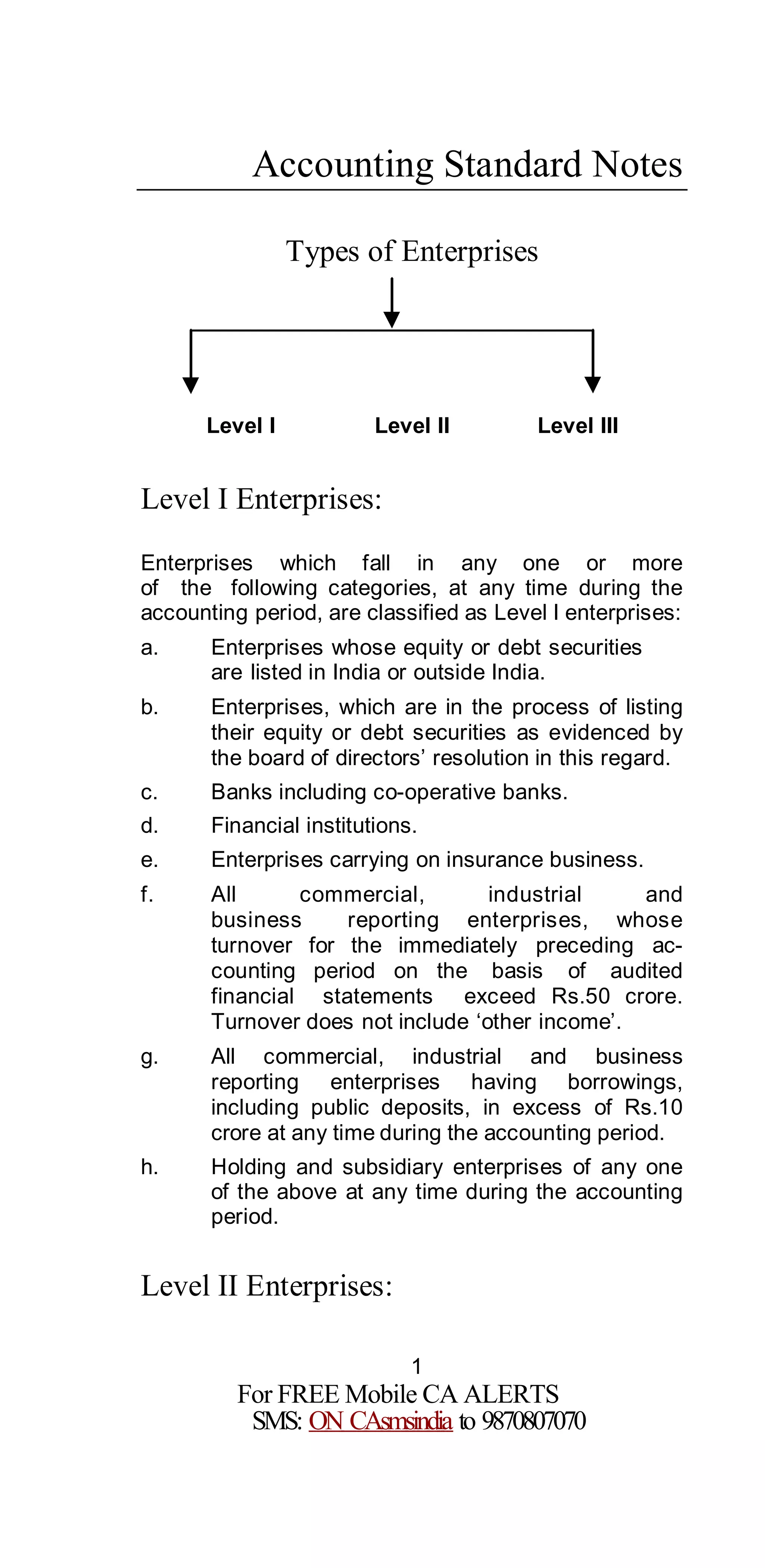
Types of Enterprises
Level I Level II Level III
Level I Enterprises:
Enterprises which fall in any one or more
of the following categories, at any time during the
accounting period, are classified as Level I enterprises:
a. Enterprises whose equity or debt securities
are listed in India or outside India.
b. Enterprises, which are in the process of listing
their equity or debt securities as evidenced by
the board of directors’ resolution in this regard.
c. Banks including co-operative banks.
d. Financial institutions.
e. Enterprises carrying on insurance business.
f. All commercial, industrial and
business reporting enterprises, whose
turnover for the immediately preceding ac-
counting period on the basis of audited
financial statements exceed Rs.50 crore.
Turnover does not include ‘other income’.
g. All commercial, industrial and business
reporting enterprises having borrowings,
including public deposits, in excess of Rs.10
crore at any time during the accounting period.
h. Holding and subsidiary enterprises of any one
of the above at any time during the accounting
period.
Level II Enterprises:
2
For FREE Mobile CA ALERTS
SMS: ON CAsmsindia to 9870807070
Enterprises which are not level I enterprises but fall
in any one or more of the follow-
ing categories are classified as level II enterprises:
a. All commercial, industrial and business reporting
enterprises, whose turnover for the im-
mediately preceding accounting period on
the basis of audited financial statements
exceed Rs.40 lakhs but does not exceed Rs.50
crores. Turnover does not include ‘other income’.
b. All commercial, industrial and business
reporting enterprises having borrowings,
including public deposits, in excess of
Rs.1 crore but not in excess of Rs. 10
crore at any time during the accounting period.
c. Holding and subsidiary enterprises of any one of
the above at any time during the accounting
period.
Level III Enterprises:
Enterprises, which are not covered under Level I and
Level II, are considered as Level III enterprises.
3
For FREE Mobile CA ALERTS
SMS: ON CAsmsindia to 9870807070
AS - 1
Disclosure of Accounting Policies
Number of Paragraphs 27
Applicable enterprise All
Background:
Financial statements should have minimum content
and the bases on which the figures are prepared
should be explained. There are many methods to
follow in applying accounting principles. Existence of
variety of methods will convey uniqueness of each
of those methods in the presentation of
financial statements. No one method can be
regarded as supreme for the accuracy of financial
figures reported in financial statements. Therefore it
becomes a basic precondition to declare the
significant accounting policies followed
in order to enable proper under-
standing for the end users of financial statements.
1. Only significant accounting policies adopted
in the preparation and
presentation of financial statements
should normally be disclosed in one place.
2. The primary consideration in the selection
of accounting policy is true and fair view and
the secondary considerations are
prudence, substance over form and materiality.
3. Changes in the accounting policy having
material effect, affect current period and the
future. To the extent determinable, the effect of
change in Accounting Policy shall be disclosed.
In case it is not ascertainable wholly or in part,
the fact should be indicated. If it expected
to affect the future, the fact should be disclosed.
4. Disclosure is not required if
fundamental accounting assumptions
viz going concern, consistency and
accrual are followed. Only when they
are not followed, the fact should be disclosed.
4
For FREE Mobile CA ALERTS
SMS: ON CAsmsindia to 9870807070
AS - 2
Valuation Of Inventories
Number of Paragraphs 27
Applicability of enterprises All
ASI reference ASI 2
Background:
Inventories are so critical to the reporting
of profits/losses at the correct amount, in the
correct period, that clear definition of terms
and defined accounting is required. It gives yet
another impression on the liquidity of the stock
maintained when it is reckoned for financial ratios.
1. Inventories would mean Raw material, Work in
progress, finished good and consumable/spares.
2. It does not include WIP under AS 7, WIP
arising in the ordinary course of business of
service providers, shares, securities held as
stock and inventories of livestock, ag-
ricultural, mineral products etc.,
3. Generally cost or NRV shall be scale
of valuation for finished stock. But in case of
raw materials, WIP and spares/consumables
cost is the basis of evaluation.
4. Cost includes cost of purchase, conversion cost
and other costs. It excludes abnor-
mal cost, storage cost, administrative
overheads and selling and distribution costs.
5. For the purpose of cost either FIFO method or
weighted average method shall be used.
6. Many industries would have their unique way
of identifying costs, as the items dealt are
huge and having frequent fluctuations. Either
standard cost shall be used taking normal
capacity in computation or retail method
of arriving at cost shall be used.
5
For FREE Mobile CA ALERTS
SMS: ON CAsmsindia to 9870807070
7. Standard cost formula method is often used in
manufacturing industry and retail
formula method is used in trading activity units.
8. NRV is the difference between the
normal selling price and the cost of com-
pleting the sale/cost of completing the job/work.
9. NRV question will arise if the selling
prices have declined or when the estimated
cost to complete the sale is increased.
10. If the inventory is damaged partially or wholly, it
may not fetch the normal selling
price. Therefore it is often that damaged
goods will be valued below cost i.e. at NRV.
11. Some of the items of inventory will be valued on
item by item basis. Sometimes it will be valued
on global basis or on a panel basis wherein
inventories may not be practically segmented.
12. If inventory is stocked for a particular contract,
then the price agreed in the contract is the
selling price for the arrival of NRV. For
the excess quantity stored if any, general
selling price shall be considered as the base.
13. Normally cost is the basis of valuation for Raw
material. There is no NRV concept in the
valuation of raw material. In case the
replacement cost of the raw material had fallen,
with finished goods (in which such raw material
is incorporated) are likely to be sold at a price
below cost, then the raw material should
be valued at replacement (as NRV) cost.
14. NRV should be computed at each balance sheet
date.
15. The financial statement should disclose the
accounting policies adopted in meas-
uring inventories including the cost formula
used and the total of carrying amount of
inventories and the appropriate classification.
6
For FREE Mobile CA ALERTS
SMS: ON CAsmsindia to 9870807070
AS - 3
Cash Flow Statements
Number of Paragraphs 48
Type of enterprises Level I
Appendix 2
Background:
Favourable cash flow is essential for the survival and
growth of any business. Cash flow
statement identifies how cash has flown through a
business and is very useful statement in
verifying a business performance for a period and
movement in net asset position over a period.
1. Simple financial statements are not at
all convincing the readers as to why the
enterprises are reporting huge profits but
struggling to meet the payment schedules
2. Cash flow statement will give the users of
financial statement a clue as to how the cash
is resourced and where they are being utilized.
3. Activities are classified as operating, invest-
ing and financing.
4. Cash flow statement should be
presented whenever financial statement is
prepared. This would mean that whenever
interim financial statement is to be reported,
cash flow statement should also be presented.
5. Cash would mean cash in hand, de-
mand deposits with bank etc.
6. Changes in cash and cash equivalents
are detailed in cash flow statement.
7. Cash equivalents are short term investments
which are having shorter maturity period
(say not greater than 3 months) held for real-
isation of definite cash with least amount of risk.
7
For FREE Mobile CA ALERTS
SMS: ON CAsmsindia to 9870807070
8. Non-cash items taken for the preparation
of financial statement shall be excluded
in the preparation of cash flow statement.
9. There are two methods of reporting. They are
direct method and indirect method.
10. What is considered as investing activity of
an item can be taken as an operating activity
for a different enterprise. Eg. Interest income
is an investing activity for a manufacturing
enterprise whereas the same item will be
operating activity for banking industry.
11. Cash flows associated with extraordinary items
are disclosed separately as arising from
operating, investing and financing in the cash
flow statement so as to have better
understanding of the nature and effect on the
present and future cash flows of the enterprise.
8
For FREE Mobile CA ALERTS
SMS: ON CAsmsindia to 9870807070
AS - 4
Contingencies & Events Occurring
After The Balance Sheet Date
Number of Paragraphs 17
Type of enterprises All
Part of AS related to contingencies is withdrawn
after the advent of AS29. The no. of paras given
above is inclusive of those withdrawn.
Background:
Not all the transactions related to a period would occur
on or before the year-end. Ignoring them from the
scope of reporting just because they have occurred
after the year-end would not be correct. There
are some transactions occurring after the end of the
year which have bearing on the results of the
enterprise requiring adjustment or a mere disclosure.
1. Only events occurring after balance sheet
date are taken up for discussion.
2. Events which take place after balance sheet
date have bearing on the balance sheet date
(condition/situation) but those occurring before
the approval of accounts shall be referred to
as Events occurring after balance sheet date.
3. They are classified as adjusting event and non-
adjusting events.
4. Adjusting events are those events that would
provide additional information materially
affecting the conditions prevailed on the balance
sheet date. E.g. loss of trade receivable
account, which is confirmed by the insolvency of
a customer, which occur after the balance sheet
date. 5.
Non-adjusting events are those events that do
not relate to the conditions existing on the
balance sheet date. Eg, decline in market value
of investments between the balance sheet date
and the date of approval having no bearing on
9
For FREE Mobile CA ALERTS
SMS: ON CAsmsindia to 9870807070
the value of investments on the balance
sheet date.
6. Disclosure is required for non-adjusting events.
7. Adjusting events are to be adjusted in the books of
accounts whereas non-adjusting events are not
to be adjusted in the books of account and are
to be disclosed in financial statements. How-
ever there is an exception to non-adjusting event,
i.e. proposed dividend though a non-adjust-
ing event requires an adjustment in the books.
8. In case of events occurring after balance sheet
date affecting the basic substratum of the
enterprise, it may be appropriate to consider
whether it is proper to use the
fundamental accounting assumption of going
concern in the preparation of financial statement.
10
For FREE Mobile CA ALERTS
SMS: ON CAsmsindia to 9870807070
AS - 5
Net Profit Or Loss For The Period, Prior
Period Items & Changes In Accounting
Policies
Number of Paragraphs 33
Applicable enterprise All
Background:
Businesses make profits or losses from their core,
continuing businesses, but also will have income from
exceptional, unusual or extraordinary sources. These
have to be distinguished, defined and
disclosed separately from other regular items. In
fact for some of the cases on ordinary items,
disclosure gives better understanding on the sub-
ject matter for the users of financial statements.
11.. There are five items dealt in
this accounting standard. They are ordinary
item, extraordinary item, prior period item,
effect of changes in the accounting estimate
and effect of changes in the accounting policy.
22.. Ordinary items, which are related to the activities
of the enterprise, include items which
are incidental to the activities of the
enterprise. Disclosure of ordinary items shall
be taken up only to place a better
understanding about the performance of the
enterprise. Eg writing down of inventories
as well as reversals, reversals of provisions.
33.. Extraordinary items are distinctly different
from ordinary activities, which are not
expected to recur frequently or regularly. Eg
Grant received from Government
towards meeting revenue expenditure,
loss of asset on account of earth quake.
44.. Prior period items are matters related to one or
more previous years arising on account of
omission/commission in the preparation of
financial statements affecting the current year’s
profit and loss account. Eg error in the stock
11
For FREE Mobile CA ALERTS
SMS: ON CAsmsindia to 9870807070
sheet of the previous year, total omission of
credit purchases/sales of the preceding year.
55.. Certain items of expenditure may not be exactly
known at the time of preparation of financial
statements, requiring estimates. When they are
met subsequently there will be difference
between the estimates and the actuals. The
difference will be referred to as changes in
accounting estimates. Such differences shall not
be considered as prior period items though
it may relate to one or more previous years.
They are purely judgment/estimate errors.
They cannot be classified as prior period
items. Eg Changes in the rate of de-
preciation (method followed shall be regarded
as the same). The effect of changes in ac-
counting estimate shall be applied prospectively.
66.. Different methods are adopted in fol-
lowing principles of accounting. Such adop-
tion of a method of accounting is
referred to as accounting policy.
Eg. WDV method of accounting
depreciation. Enterprise need not
follow the method of depreciation
throughout its lifetime what it had
chosen at the initial stage.
Circumstances, statutes and other
factors will be considered in adoption
and following of a policy. Therefore
an enterprise might change the policy
after some point of time. Such
changes shall be taken up as changes
in accounting policy. The change in
accounting policy shall have
retrospective effect.
12
ForFREEMobileCAALERTS
SMS: ON CAsmsindia to 9870807070
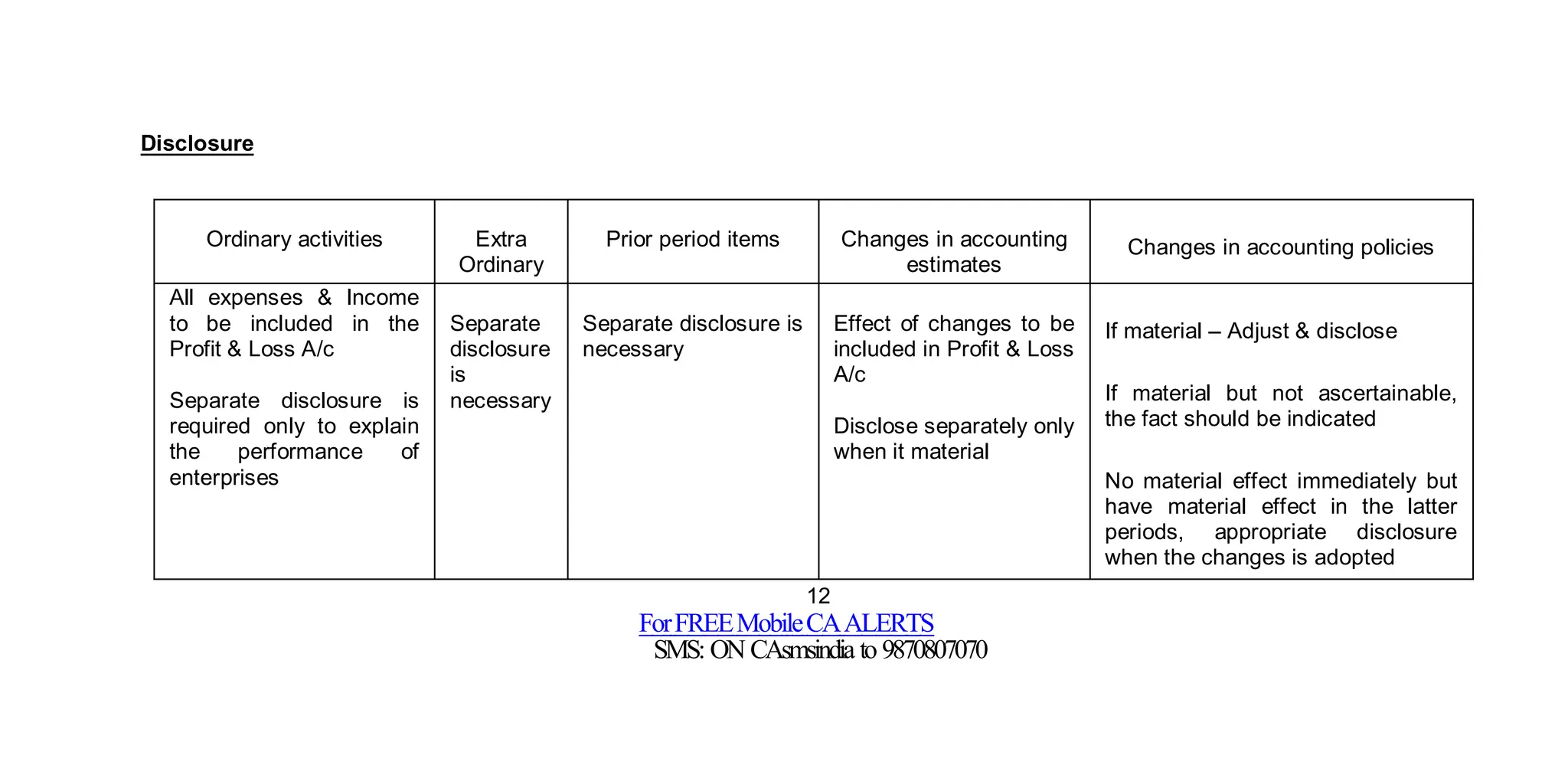
Disclosure
Ordinary activities Extra
Ordinary
Prior period items Changes in accounting
estimates
Changes in accounting policies
All expenses & Income
to be included in the
Profit & Loss A/c
Separate disclosure is
required only to explain
the performance of
enterprises
Separate
disclosure
is
necessary
Separate disclosure is
necessary
Effect of changes to be
included in Profit & Loss
A/c
Disclose separately only
when it material
If material – Adjust & disclose
If material but not ascertainable,
the fact should be indicated
No material effect immediately but
have material effect in the latter
periods, appropriate disclosure
when the changes is adopted
13
For FREE Mobile CA ALERTS
SMS: ON CAsmsindia to 9870807070
AS - 6
Depreciation Accounting
Number of Paragraphs 29
Applicable enterprise All
Background:
Usage of assets in the generation of income
is omnipresent. Measuring and accounting the
cost of such usage is the rationale of this study.
1. Depreciation is a measure of diminution in
the value of depreciable assets on account
of wear and tear, efflux of time,
obsolescence, etc., tried on an estimated basis.
2. For the computation of depreciation,
the following factors are very im-
portant: cost, estimated residual value and life.
3. There can be reviews of depreciable age of the
asset, estimated residual value, cost
which would change the amount of depreciation.
4. When there is a change in the rate of
depreciation, then it can be taken up as changes
in accounting estimates. The effect of change
should be accounted on a prospective basis
5. If changes are witnessed in the method of
charging depreciation, then the same shall be
taken up as changes in accounting policy.
It should be accounted on a retrospective basis.
6. Addition/extension to the existing asset will
qualify for depreciation either on the remaining
useful life of the existing asset or based on the
independent life of the added/extended asset.
7. In case the depreciation has material effect on
the amount of depreciation because
of revaluation made on the asset,
then disclosure is to be made separately.
14
For FREE Mobile CA ALERTS
SMS: ON CAsmsindia to 9870807070
AS - 7
Construction Contracts
Number of Paragraphs 44
Applicable enterprise All
Appendix 1
ASI 29
Background:
Construction projects are generally WIP figures. They
are often material balance sheet items and are also
critical to the reporting of profits or losses at the
correct amount and in the correct period. Nature of
construction contracts encompass many account-
ing periods, often requiring allocation of contract
revenue and costs to the accounting periods
in which construction contracts are performed.
1. Construction of assets is given to spe-
cialists called as contractors by contractees.
2. In the books of contractor, revenue, costs and
disclosure in financial statements, are given
importance for both types of contracts such
as cost plus contracts and fixed price contracts.
3. Revenue includes contract price, variations,
incentives, claims etc., and cost includes dir-
ect cost, attributable cost
and specifically chargeable to the customer.
4. Revenue and costs are recognised based on
the % of completion and completed
contract method is not at all recommended.
5. Percentage completion shall be computed
in three different methods:
(a) Total cost incurred/Total cost incurred +
estimated cost to complete the contract.
(b) Physical measurement
(c) Survey method
6. Proportionate to the completion, revenue, cost
and profits are recognised during a period
after considering recognised revenue, cost and
profits of earlier years when the contract scales
through more than one accounting period.
7. If the cost to date plus estimated cost
to complete the contract exceed the
contract revenue, then the difference will be
considered as loss, which shall be
accounted as expenditure immediately.
8. Receivable/payable to the contractee shall be
arrived by adjusting recognised profits/losses
(cumulative to date) to the cost incurred to date.
Progress payments received and retention
15
For FREE Mobile CA ALERTS
SMS: ON CAsmsindia to 9870807070
money shall be considered in the above
exercise.
16
For FREE Mobile CA ALERTS
SMS: ON CAsmsindia to 9870807070
AS - 9
Revenue Recognition
Number of Paragraphs 14
Applicable enterprise All
Appendix 1
ASI 14
Background:
Revenue is the source of income, the recognition of
which is so important in the reporting of Income, EPS,
and Market price of shares and so on. Recognition
of revenue will give the right to recover the eco-
nomic resources which are created by an enterprise.
1. Revenue arising out of ordinary activities
of the enterprise from (a) sale of goods,
(b) rendering of services and (c)
yielding interest, royalties and di-
vidends are covered in revenue recognition.
2. Revenue should be recognised imme-
diately after the rendering service or
the delivery of products if it is
not unreasonable to expect ultimate collection.
3. If there is no reasonability in the ultimate
collection upon rendering services or delivery of
products, then recognition should be postponed
until the collectability takes shape of certainty.
4. In the above points, it is assumed that the
revenue can be measured at the time of delivery
of products or rendering of services.
If the measurability is not determin-
able, then recognition will be
postponed until the measurability is spotted.
5. Three important factors are to be seen
to recognise revenue. They are
performance of act of sale/rendering
of services, measurability of revenue
and reasonability of ultimate collection.
6. After recognising the revenue, if collect-
ability factor turns doubtful, then it is not
appropriate to reverse the recognised reven-
ue. It is more appropriate to create pro-
vision for doubtfulness in the collectability factor.
17
For FREE Mobile CA ALERTS
SMS: ON CAsmsindia to 9870807070
AS - 10
Accounting For Fixed Assets
Number of Paragraphs 39
Applicable enterprise All
ASI 2
Certain portions are withdrawn after the
advent of AS 16,19 and AS 26
Background:
The principle issues in accounting for fixed assets are
the timing of recognition of the assets, the
determination of their carrying amount and the
depreciation charges to be recognised in relation to
them. Stating how the fixed assets are valued is
essential to an understanding of balance sheet worth.
1. Fixed assets shall be accounted either at cost or at
revalued amount. Such revalued amount shall
not exceed the recoverable amount of the asset
2. Fixed assets shall be accounted initially at cost if
purchased by payment of money or money’s
worth. If money’s worth is provided, fixed assets
shall be accounted at its fair value of the asset
or at the value of the securities issued or assets
exchanged whichever is more clearly evident.
3. Downward revaluation of fixed assets shall be
debited to profit and loss account or to
revaluation reserve created if any on an earlier
upward revaluation of the concerned fixed asset.
4. Upward revaluation of fixed assets shall be
credited to revaluation reserve.
5. In case the present upward revaluation results
as a reversal of previously
recognised downward revaluation, then the
present increase shall be credited only to profit
and loss account because the previ-
ous downward revaluation would have
been accounted through profit and loss account.
6. Self-constructed assets shall be accounted at
cost, which are directly related to the spe-
cific asset and those that are attributable to the
18
For FREE Mobile CA ALERTS
SMS: ON CAsmsindia to 9870807070
construction activity in general and can
be allocated to the specific asset.
7. Subsequent expenses on existing assets shall
be capitalised only when there is an increase
in the future benefits beyond
their previously assessed performance.
8. When fixed assets are held for disposal after
their usage, they shall be taken up at lower
of the carrying amount or net realizable value.
9. Profit or loss on disposal of fixed assets
shall be adjusted in profit and loss account
and/ or in revaluation reserve account if any.
19
For FREE Mobile CA ALERTS
SMS: ON CAsmsindia to 9870807070
AS - 11
The Effects Of Changes In Foreign
Exchange Rates
Number of Paragraphs 45
Applicable enterprise All
Appendix 1
Background:
Business across borders is the order of the day. This
would involve dealing of transactions more than in one
currency. But reporting is carried out only in
one currency. Recording foreign currency trans-
actions and subsequently translating them for
reporting purposes will result in differences. When
foreign operations are to be incorporated for
consolidation then translation too will result
in differences. How to deal with such differ-
ences is the main focus in this accounting standard.
1. It involves accounting of differences arising
on account of foreign currency transactions
as well as their translations.
2. The ultimate treatment of exchange difference
is primarily dependent on the type of
operations an enterprise resorts to.
3. There are two types of operations. They
are Integral Foreign operations (IFO) and
Non-integral Foreign operations (NIFO).
4. Monetary items are cash, bank
balance, receivables and payables. The
remaining items are non-monetary items.
5. In case of IFO, exchange differences arising on
account of monetary items are to be transferred
to profit and loss account. Monetary items
are translated using closing rates and non-
monetary items are translated using actual rates.
6. In case of NIFO, exchange differences will arise
on account of balance sheet items and profit and
loss account items. Balance sheet items will be
translated using closing exchange rate and profit
and loss items shall be translated using average
20
For FREE Mobile CA ALERTS
SMS: ON CAsmsindia to 9870807070
rate. The difference shall be taken into foreign
currency translation reserve until the disposal
of NIFO. Upon disposal of
NIFO investments, exchange difference
shall be transferred to profit and loss account.
7. Forward contract entered will result in discount
or premium. Discount or premium shall be
accounted as gain/loss during the period of
forward contract and not as expenses/income
during the period of entering the contract in case
of hedging contracts. In case of spec-
ulative contracts, premium/discount is ignored.
8. Change in the forward contract rates will
result in loss/gain. Such loss/gain shall be
transferred to profit and loss account immediately.
21
For FREE Mobile CA ALERTS
SMS: ON CAsmsindia to 9870807070
AS - 12
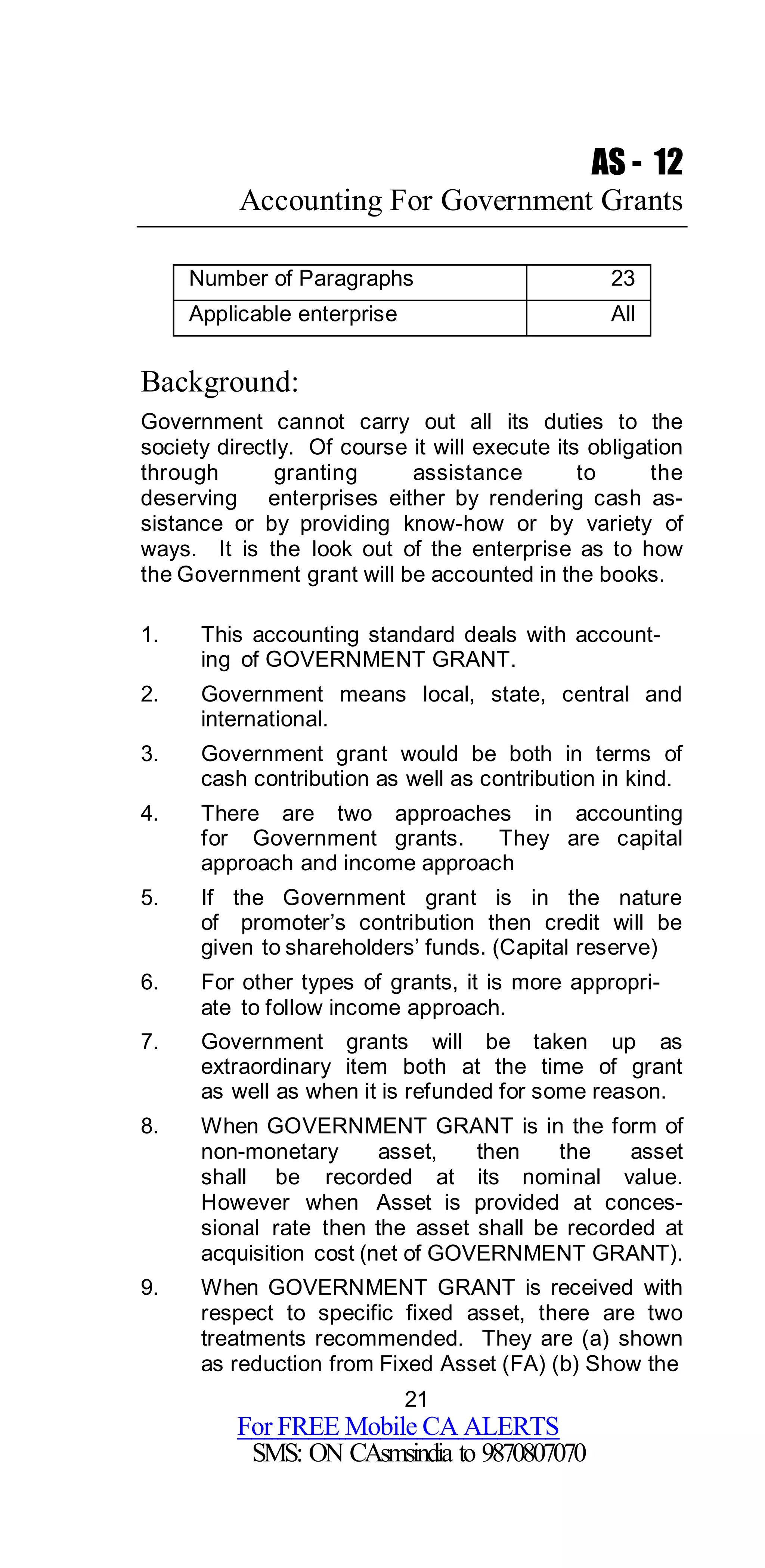
Accounting For Government Grants
Number of Paragraphs 23
Applicable enterprise All
Background:
Government cannot carry out all its duties to the
society directly. Of course it will execute its obligation
through granting assistance to the
deserving enterprises either by rendering cash as-
sistance or by providing know-how or by variety of
ways. It is the look out of the enterprise as to how
the Government grant will be accounted in the books.
1. This accounting standard deals with account-
ing of GOVERNMENT GRANT.
2. Government means local, state, central and
international.
3. Government grant would be both in terms of
cash contribution as well as contribution in kind.
4. There are two approaches in accounting
for Government grants. They are capital
approach and income approach
5. If the Government grant is in the nature
of promoter’s contribution then credit will be
given to shareholders’ funds. (Capital reserve)
6. For other types of grants, it is more appropri-
ate to follow income approach.
7. Government grants will be taken up as
extraordinary item both at the time of grant
as well as when it is refunded for some reason.
8. When GOVERNMENT GRANT is in the form of
non-monetary asset, then the asset
shall be recorded at its nominal value.
However when Asset is provided at conces-
sional rate then the asset shall be recorded at
acquisition cost (net of GOVERNMENT GRANT).
9. When GOVERNMENT GRANT is received with
respect to specific fixed asset, there are two
treatments recommended. They are (a) shown
as reduction from Fixed Asset (FA) (b) Show the
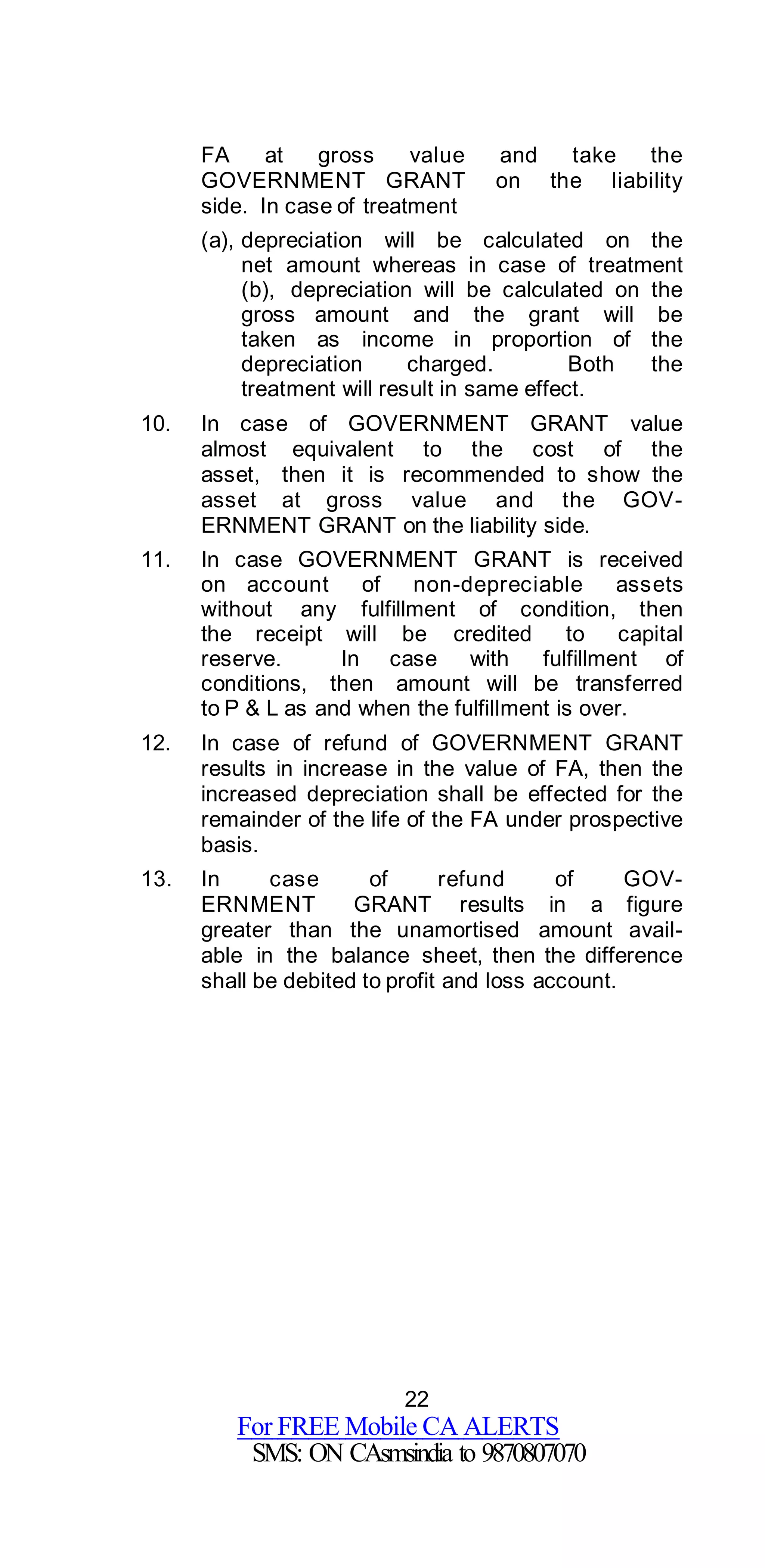
22
For FREE Mobile CA ALERTS
SMS: ON CAsmsindia to 9870807070
FA at gross value and take the
GOVERNMENT GRANT on the liability
side. In case of treatment
(a), depreciation will be calculated on the
net amount whereas in case of treatment
(b), depreciation will be calculated on the
gross amount and the grant will be
taken as income in proportion of the
depreciation charged. Both the
treatment will result in same effect.
10. In case of GOVERNMENT GRANT value
almost equivalent to the cost of the
asset, then it is recommended to show the
asset at gross value and the GOV-
ERNMENT GRANT on the liability side.
11. In case GOVERNMENT GRANT is received
on account of non-depreciable assets
without any fulfillment of condition, then
the receipt will be credited to capital
reserve. In case with fulfillment of
conditions, then amount will be transferred
to P & L as and when the fulfillment is over.
12. In case of refund of GOVERNMENT GRANT
results in increase in the value of FA, then the
increased depreciation shall be effected for the
remainder of the life of the FA under prospective
basis.
13. In case of refund of GOV-
ERNMENT GRANT results in a figure
greater than the unamortised amount avail-
able in the balance sheet, then the difference
shall be debited to profit and loss account.
23
For FREE Mobile CA ALERTS
SMS: ON CAsmsindia to 9870807070
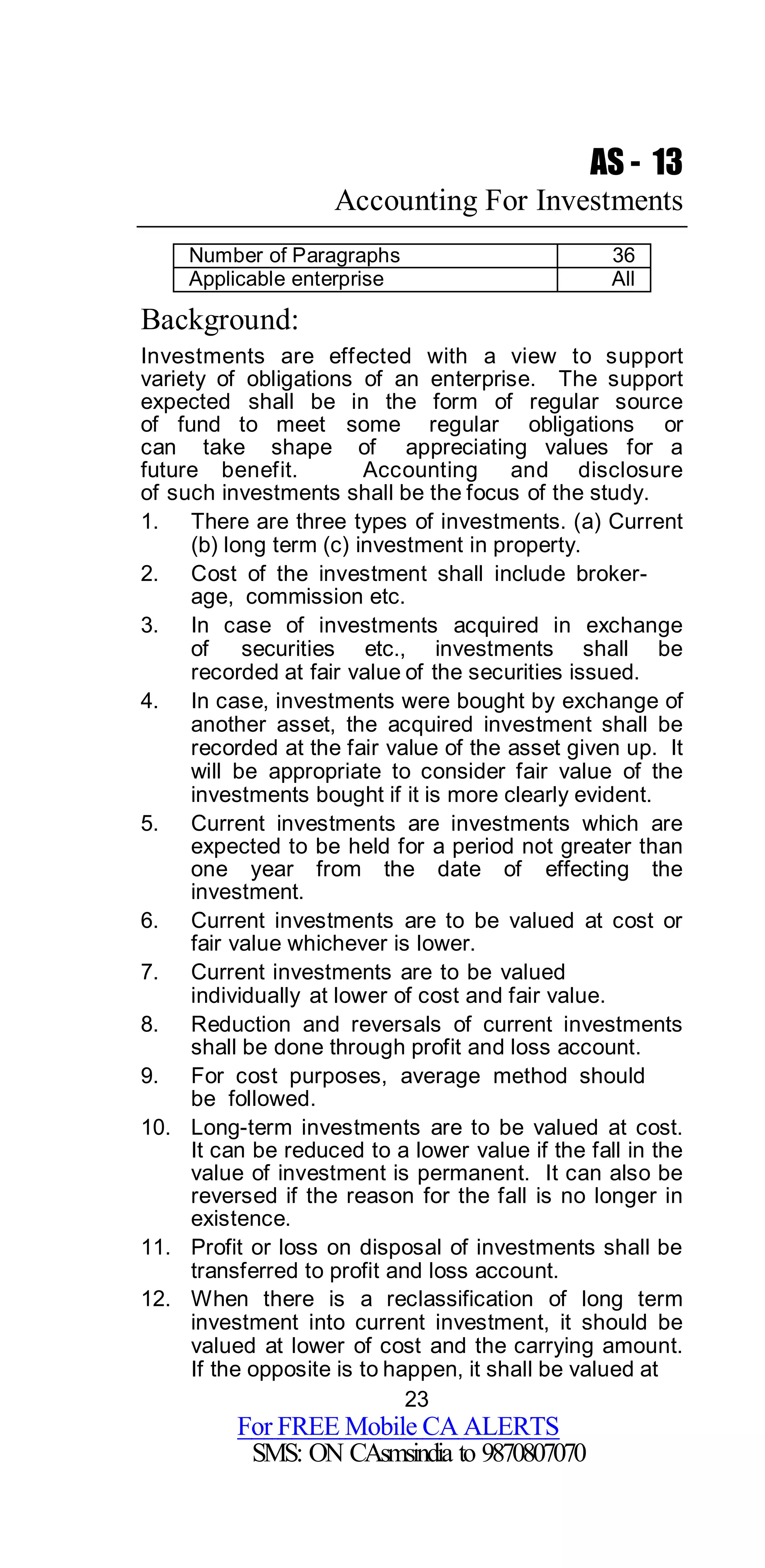
AS - 13
Accounting For Investments
Number of Paragraphs 36
Applicable enterprise All
Background:
Investments are effected with a view to support
variety of obligations of an enterprise. The support
expected shall be in the form of regular source
of fund to meet some regular obligations or
can take shape of appreciating values for a
future benefit. Accounting and disclosure
of such investments shall be the focus of the study.
1. There are three types of investments. (a) Current
(b) long term (c) investment in property.
2. Cost of the investment shall include broker-
age, commission etc.
3. In case of investments acquired in exchange
of securities etc., investments shall be
recorded at fair value of the securities issued.
4. In case, investments were bought by exchange of
another asset, the acquired investment shall be
recorded at the fair value of the asset given up. It
will be appropriate to consider fair value of the
investments bought if it is more clearly evident.
5. Current investments are investments which are
expected to be held for a period not greater than
one year from the date of effecting the
investment.
6. Current investments are to be valued at cost or
fair value whichever is lower.
7. Current investments are to be valued
individually at lower of cost and fair value.
8. Reduction and reversals of current investments
shall be done through profit and loss account.
9. For cost purposes, average method should
be followed.
10. Long-term investments are to be valued at cost.
It can be reduced to a lower value if the fall in the
value of investment is permanent. It can also be
reversed if the reason for the fall is no longer in
existence.
11. Profit or loss on disposal of investments shall be
transferred to profit and loss account.
12. When there is a reclassification of long term
investment into current investment, it should be
valued at lower of cost and the carrying amount.
If the opposite is to happen, it shall be valued at
24
For FREE Mobile CA ALERTS
SMS: ON CAsmsindia to 9870807070
lower of cost and the fair value whichever is
lesser on the date of reclassification.
25
For FREE Mobile CA ALERTS
SMS: ON CAsmsindia to 9870807070
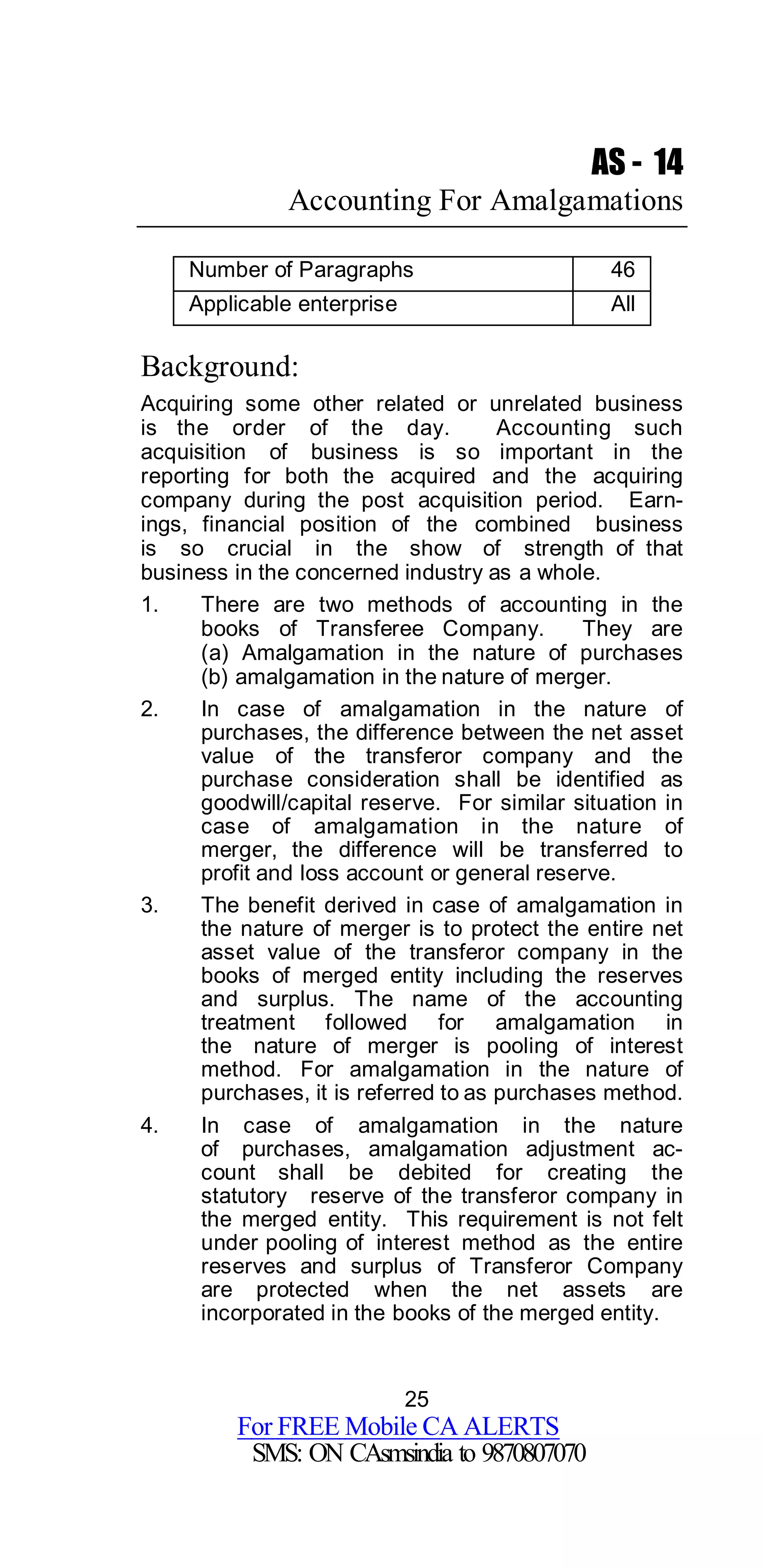
AS - 14
Accounting For Amalgamations
Number of Paragraphs 46
Applicable enterprise All
Background:
Acquiring some other related or unrelated business
is the order of the day. Accounting such
acquisition of business is so important in the
reporting for both the acquired and the acquiring
company during the post acquisition period. Earn-
ings, financial position of the combined business
is so crucial in the show of strength of that
business in the concerned industry as a whole.
1. There are two methods of accounting in the
books of Transferee Company. They are
(a) Amalgamation in the nature of purchases
(b) amalgamation in the nature of merger.
2. In case of amalgamation in the nature of
purchases, the difference between the net asset
value of the transferor company and the
purchase consideration shall be identified as
goodwill/capital reserve. For similar situation in
case of amalgamation in the nature of
merger, the difference will be transferred to
profit and loss account or general reserve.
3. The benefit derived in case of amalgamation in
the nature of merger is to protect the entire net
asset value of the transferor company in the
books of merged entity including the reserves
and surplus. The name of the accounting
treatment followed for amalgamation in
the nature of merger is pooling of interest
method. For amalgamation in the nature of
purchases, it is referred to as purchases method.
4. In case of amalgamation in the nature
of purchases, amalgamation adjustment ac-
count shall be debited for creating the
statutory reserve of the transferor company in
the merged entity. This requirement is not felt
under pooling of interest method as the entire
reserves and surplus of Transferor Company
are protected when the net assets are
incorporated in the books of the merged entity.
26
For FREE Mobile CA ALERTS
SMS: ON CAsmsindia to 9870807070
AS 15
Employees Benefits (Revised)
Number of Paragraphs 146
Applicable enterprise All
Appendix 3
Background:
Paying for the period of engagement is not employees’
cost. The right to receive beyond the pay packet
either immediately or later has become legitim-
ate. Recognition of such cost during the
period of employment is considered appropriate.
Some of the benefits accruing to the employees
which are payable at the time of termination and
beyond termination are expected to be estimated
for accounting during the period of engagement.
1. It involves accounting and disclosure
of employees’ benefits.
2. Employees’ benefits would mean all sorts
of consideration paid/payable by an enterprise
for the services rendered by em-
ployees either within twelve months or beyond.
3. Employees include permanent, tem-
porary, casual, full time, part time, whole
time director and other management personnel.
4. Employees’ benefits are classified into four
types. They are short term, long
term, termination and post employment benefits.
5. Short-term benefits are payable monetarily or
otherwise, within twelve months from the end of
the period in which the services were rendered
by the employees. No actuarial
assumptions are required to measure
the obligation as the discharge is
expected to be made within 12 months.
6. Short-term benefits include wages, salaries,
short-term compensated absences (leaves),
profit sharing, Medicare, car, housing etc.
27
For FREE Mobile CA ALERTS
SMS: ON CAsmsindia to 9870807070
7. Compensated absences are of two types.
They are accumulating and non-accumulating.
8. Accumulating compensated absences are of
two types. They are vesting and non
-vesting. Vested compensating absences
are ‘absences not availed’ which will
be encashed by the employees.
The employees’ cost would include thesepayments/obligations. Non-vesting
absences will have no financial impact and
hence are to be ignored.
9. Profit sharing and bonus plans which
are payable wholly within twelve months will
come under short term benefits and
payments to be made beyond twelve
months will be covered under long term benefits.
10. Short term benefits are payable within twelve
months requiring no specif-
ic disclosure excepting in case
of payments to Key Management
Personnel under AS 18. No actuarial
computations are required for short-term benefits.
11. Post employment benefits are of two
types. They are defined contribution plan and
defined benefit plan.
12. Defined contribution plan would limit the
obligation of the enterprise only to the extent of
contribution. Beyond the contribution, no
obligation would follow the enterprise employer.
13. In defined contribution plan, liabilities and assets
are identified based on the actual contri-
bution versus due for services. Mar-
ket yields on government bonds on the
balance sheet date shall be the discount
rate to be used for identifying liability or asset.
14. In Defined benefit plan, the obligation would
follow the employer beyond the con-
tribution whenever actuarial and investment
experience different pattern than expected.
15. Obligations are to be discharged with timely
investments made each year. The investments
are referred to as plan assets. Plan assets are
shown as deduction from the estimated liability.
16. The return on plan assets is not
shown as income but shown as
deduction from employees’ cost.
28
For FREE Mobile CA ALERTS
SMS: ON CAsmsindia to 9870807070
17. There will be some changes in liability
on account of introduction/amendment in
post employees’ benefits. Increase in liability
shall be recognised either immediately
or later depending upon the
application of vesting period.
18. Such of those increases in liability figures for the
period not vested, recognition of liability will be
done on piecemeal basis (SLM) over the
remaining period until vesting is effective. Such
items of liability not recognised shall
be deducted from the estimated total liability
when presented in the balance sheet. This
increase in liability not recognised shall be
referred to as past service cost not recognised.
19. Such of those increases in liability figures for
the periods already vested, liability
shall be recognised immediately.
20. Other long term benefits and termination
benefits shall be accounted as expenditure with
corresponding liability as done in any other
case. If payments are to be effected beyond 12
months, then present value computation should
be made for its measurement and disclosure.
29
For FREE Mobile CA ALERTS
SMS: ON CAsmsindia to 9870807070
AS - 16
Borrowing Costs
Number of Paragraphs 23
Applicable enterprise All
ASI 1 & 10
Appendix 1
Background:
When assets are taking substantial period of time
before they are made ready for use, it may not be fair
to charge interest on the loan taken to create the asset
to the profit and loss account. It
is considered appropriate to capitalise such
borrowing costs as part of the cost of the asset.
1. Not all assets can be bought. Some of the
assets will be developed captively requiring
substantial period of time to bring them into
existence.
2. Such assets would require huge
capital. Borrowed capital will constitute major
source of funding such assets. This would
result in borrowing cost for the enterprise.
3. It will be unfair to debit the profit and
loss account for the borrowing cost incurred
during the period of development of the assets.
4. Therefore it is considered appropriate to
capitalise such borrowing cost during the course
of development. This accounting standard
prescribes the procedure of capitalization,
suspension and cessation of borrowing cost.
5. Importantly borrowing cost shall be capitalised
only for assets that require substantial period of
development and not applicable for assets that
can be put to use immediately upon purchases.
6. There are two types of borrowings. They are
Specific borrowing and general borrowing
7. Borrowing costs incurred on specific bor-
rowings shall be capitalised fully after
considering the income from investments
(investments made out of unutilized borrowings)
30
For FREE Mobile CA ALERTS
SMS: ON CAsmsindia to 9870807070
8. Borrowing costs incurred on general bor-
rowings shall be capitalised using cap-
italization rate based on the actual
expenses incurred. In no case capitalised
sum shall exceed actual borrowing cost.
9. Process of capitalization shall be suspended if
the development of assets is
interrupted. However if the suspension of
activity is part of developmental process
then suspension of capitalization should
not be recommended. In simple terms,
if the interruption is part of develop-
ment process, capitalization should continue.
10. Once the development process
is completed substantially, capitalization
process will be ceased.
11. What is substantial period of time for
development is generally indicated as 12
months, which can differ from enterprise to
enterprise. Therefore it is a matter of accounting
policy to be disclosed along with the
amount capitalised during the accounting period.
31
For FREE Mobile CA ALERTS
SMS: ON CAsmsindia to 9870807070
AS - 17
Segment Reporting
Number of Paragraphs 59
Applicable enterprise Level I
ASI 20 &22
Appendix 4
Background:
Consolidated income statement and balance sheet are
not often exposing the weak and strong points of
enterprises when they engage in variety of sectors.
Detailed score card is not required but at the same
time some valuable information is considered as a
basic necessity for the investors to decide
as to continue or quit from the company’s holding.
1. Income and expenditure statement and Balance
sheet in case of SFS and CFS will hardly
provide any information regarding
the strength/weakness of an organ-
ization as areas/segments really contrib-
ute or cause of detriment to the enterprise.
2. Meaningful information is the order of the
day, be that a financial statement or scorecard
of a team performance. These segments
wise information will help the investor to
think of continuation/migration of investment.
3. Management would be in a better position to
spot segments as reportable or otherwise.
4. The basis of identifying segments shall either be
business product/service or
geographical location of assets or customers.
5. Quantitative threshold limits were
prescribed based on revenue, result
(profit/loss) and assets. 10% of the total
revenue, 10% of the total profit and loss
and 10% of the total assets of the enterprise
are the minimum threshold limits indicated.
6. Management is also having the prerogative of
nominating some segments as reportable
32
For FREE Mobile CA ALERTS
SMS: ON CAsmsindia to 9870807070
segments even though they do not satisfy
the 10% limit.
7. If the total revenue of all reportable
segments aggregates lesser than 75%
of the total enterprise revenue, addi-
tional segments shall be identified as re-
portable segments until the 75% limit is achieved.
8. There are two reporting formats of expressing
segmental reporting. They are primary reporting
segments and secondary reporting segments.
9. If the primary reporting format is based
on business segments, then secondary
reporting shall be on geographical base and
vice versa holds good.
33
For FREE Mobile CA ALERTS
SMS: ON CAsmsindia to 9870807070
AS - 18
Related Party Disclosures
Number of Paragraphs 27
Applicable enterprise Level I
ASI 13,14,19,21 & 23
Appendix 1
Background:
All stakeholders have the right to know about all
the transactions of an enterprise especially when
there is a transaction between related party and the
reporting enterprises. A relationship at any time
during a reporting period itself is sufficient to be
attracted for the disclosure of relationship and the
transactions inter se. This accounting standard is
introduced as a matter of compliance to Companies
act requirements as well as to gain better image
about the enterprise in the eyes of stakeholders.
1. This accounting standard deals with
identifying related party relationship and the
disclosure aspects of related party transactions.
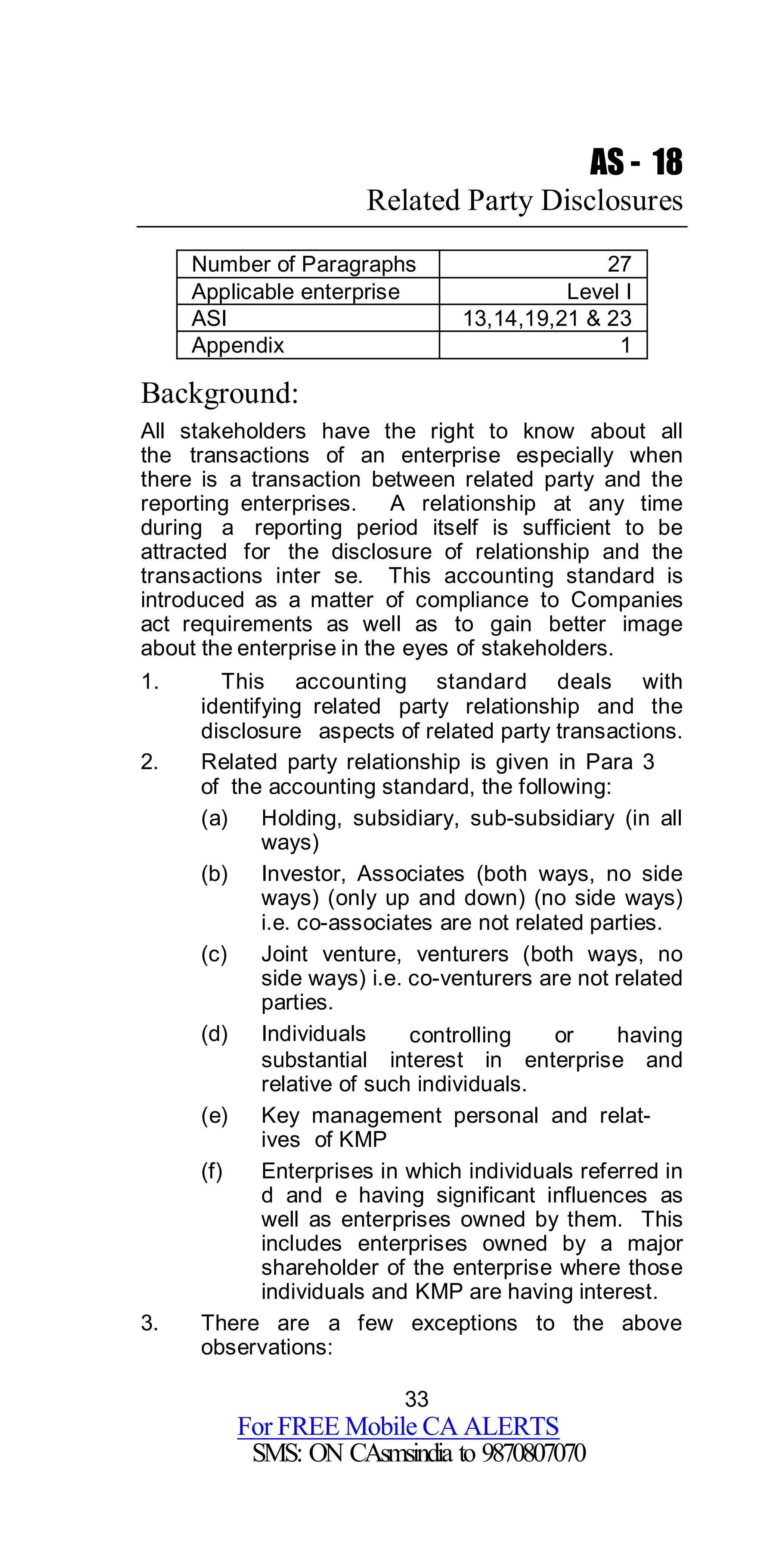
2. Related party relationship is given in Para 3
of the accounting standard, the following:
(a) Holding, subsidiary, sub-subsidiary (in all
ways)
(b) Investor, Associates (both ways, no side
ways) (only up and down) (no side ways)
i.e. co-associates are not related parties.
(c) Joint venture, venturers (both ways, no
side ways) i.e. co-venturers are not related
parties.
(d) Individuals controlling or having
substantial interest in enterprise and
relative of such individuals.
(e) Key management personal and relat-
ives of KMP
(f) Enterprises in which individuals referred in
d and e having significant influences as
well as enterprises owned by them. This
includes enterprises owned by a major
shareholder of the enterprise where those
individuals and KMP are having interest.
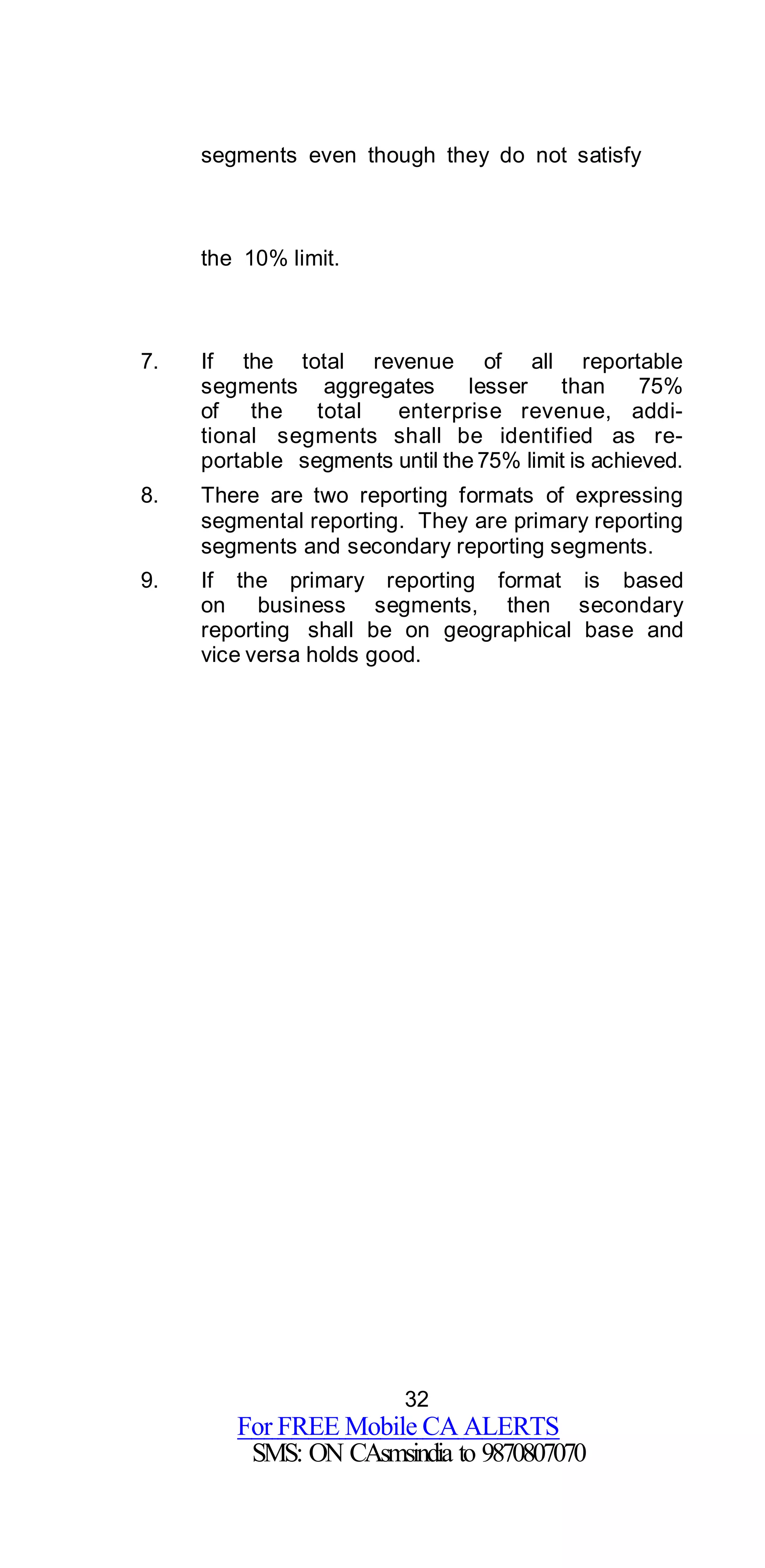
3. There are a few exceptions to the above
observations:
34
For FREE Mobile CA ALERTS
SMS: ON CAsmsindia to 9870807070
4. The above is not applicable to enterprises that
are expected to disclose details owing to
the duty of confidentiality conflicting with this AS
5. The above is not applicable in case of CFS as
far as the intra group transactions are
concerned.
6. Just because two or more enterprises are
having something in common such as directors
(who cannot affect the policies of an enterprise),
suppliers, customer, public utilities, bankers
etc., cannot be regarded as related parties.
7. PSUs are out of the radar so far as
the transactions with other PSUs.
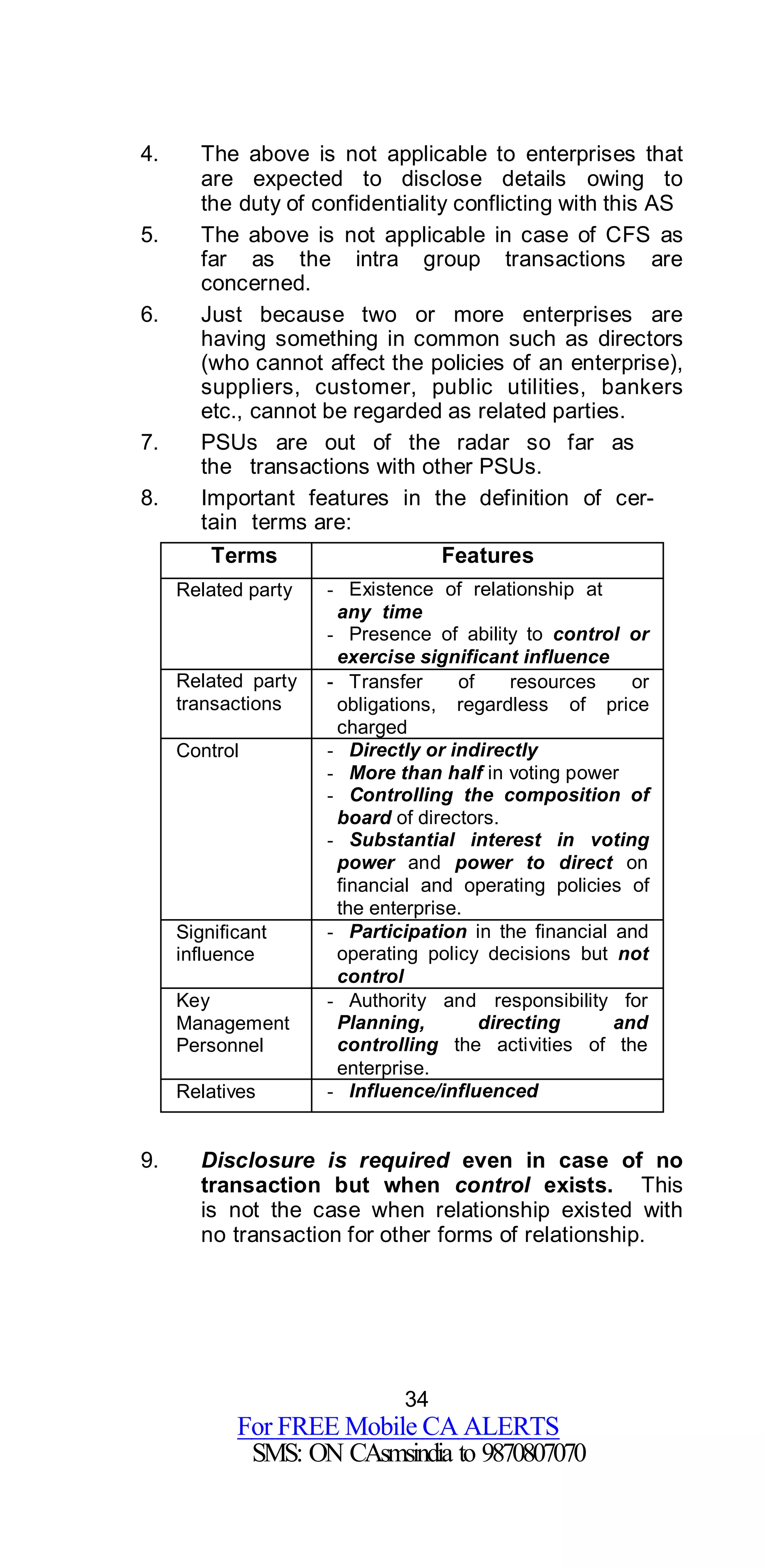
8. Important features in the definition of cer-
tain terms are:
Terms Features
Related party - Existence of relationship at
any time
- Presence of ability to control or
exercise significant influence
Related party
transactions
- Transfer of resources or
obligations, regardless of price
charged
Control - Directly or indirectly
- More than half in voting power
- Controlling the composition of
board of directors.
- Substantial interest in voting
power and power to direct on
financial and operating policies of
the enterprise.
Significant
influence
- Participation in the financial and
operating policy decisions but not
control
Key
Management
Personnel
- Authority and responsibility for
Planning, directing and
controlling the activities of the
enterprise.
Relatives - Influence/influenced
9. Disclosure is required even in case of no
transaction but when control exists. This
is not the case when relationship existed with
no transaction for other forms of relationship.
35
For FREE Mobile CA ALERTS
SMS: ON CAsmsindia to 9870807070
AS - 19
Leases
Number of Paragraphs 55
Applicable enterprise All
Appendix 1
Background:
All the assets required in the carrying of busi-
ness cannot be bought or owned. There can be
cases of renting the assets for a period of
time for a consideration. If the period of renting
or the value of rent paid during the life of the asset
were substantial to the life of the asset or the
value respectively then renting is only a form but
the substance is indirect ownership. Study of
accounting and disclosure in the books of parties is
the hallmark of this accounting standard.
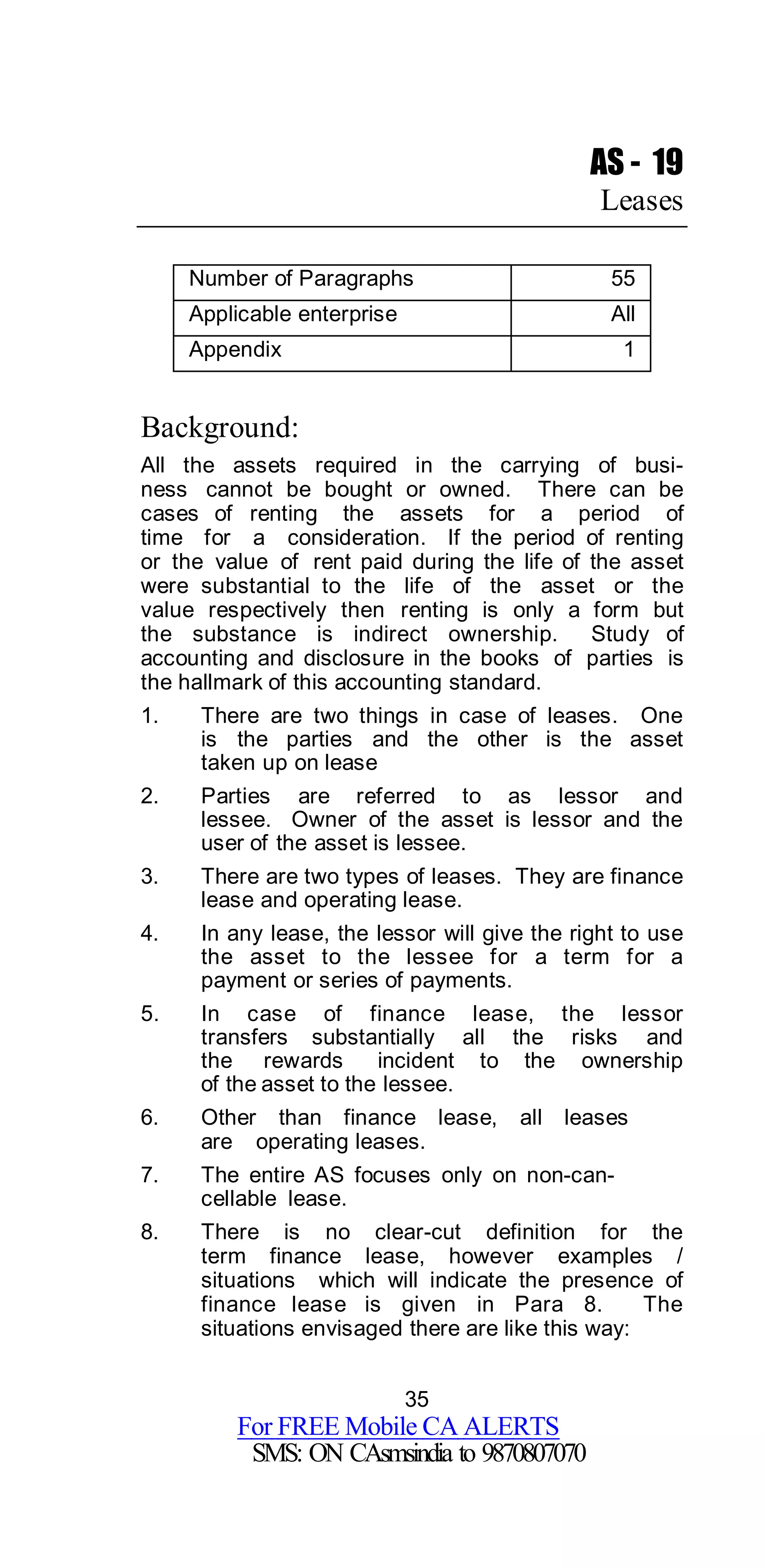
1. There are two things in case of leases. One
is the parties and the other is the asset
taken up on lease
2. Parties are referred to as lessor and
lessee. Owner of the asset is lessor and the
user of the asset is lessee.
3. There are two types of leases. They are finance
lease and operating lease.
4. In any lease, the lessor will give the right to use
the asset to the lessee for a term for a
payment or series of payments.
5. In case of finance lease, the lessor
transfers substantially all the risks and
the rewards incident to the ownership
of the asset to the lessee.
6. Other than finance lease, all leases
are operating leases.
7. The entire AS focuses only on non-can-
cellable lease.
8. There is no clear-cut definition for the
term finance lease, however examples /
situations which will indicate the presence of
finance lease is given in Para 8. The
situations envisaged there are like this way:
36
For FREE Mobile CA ALERTS
SMS: ON CAsmsindia to 9870807070
(a) The lessee should automatically get
the asset at the end of the lease term.
(b) The lease term covers major portion of
the useful life of the asset.
(c) The lessor could recover major cost of
the asset through lease.
(d) The lessee is given the option to
purchase at a substantially lower price at
the end of the lease when compared to the
fair value of the asset by then.
(e) The leased asset can never be used by any
other person after the lease term.
9. These are indicative situations and not to
be employed as cumulative conditions. In
USA, finance lease is referred to as Capital
lease. US GAAP specifies 75% of the useful
life if covered, then it is taken as capital lease.
Similarly if 90% of the cost if recovered, then
the lease can be taken up as capital lease.
10. So one need to look for those
example situations to take up the lease as
finance lease. If those situations were absent
then it will be handled as operating lease.
11. Finance lease in the books of lessee shall
be recorded as asset as well as liability. The
cost at which it shall be recorded shall not
exceed the fair value of the asset. However
if the Minimum Lease Payment (MLP) at
PV terms were to be lower than the fair
value, then MLP at PV terms will be recorded.
12. MLP has different meaning for lessee
and lessor. The meaning for lessee
is narrower than that for lessor.
13. MLP includes the regular lease rental
payment plus guaranteed residual value
14. This guaranteed residual value is the bone
of contention between the parties. For lessee
it is the amount directly guaranteed or
given guarantee on behalf by other party.
Whereas from the lessor’ point of view it
includes besides the above, the choice of
guarantee provided by third party inde-
pendently having such financial capability to
guarantee the leased asset at the end of the term.
15. Sometimes the lessee is given the option to
take the asset at the end of the lease term
for a substantially lower price than the fair value
37
For FREE Mobile CA ALERTS
SMS: ON CAsmsindia to 9870807070
prevailing at the end of the term. This
would definitely an incentive for the lessee to
take the asset at the end of the term. On such
occasions the MLP will never have
GRV but only this purchase option price.
Consequently there will be no conflict in
the meaning of MLP between the parties.
16. Finance lease shall appear on the asset side
of the lessee and depreciation will be provided
just like in any other owned asset. The lease
rental payments will be split into principal and
interest components. The interest portion will
be debited to profit and loss account and
the principal amount will be shown
as deduction from the liability.
17. The remaining amount of liability after the
deduction of principal amount shall be
reconciled each year as one, outstanding within
one year and above, more one and but less than
five year and above five years. The
reconciliation shall be done with MLP
at absolute terms as well as MLP at PV
terms generated by using cost of capital
implicit in the lease agreement with the
outstanding figure shown in the balance sheet.
18. Mostly lessor will be financiers operating the
business only for the interest content in the
LR as income. Besides that Tax benefit they
would be claiming on depreciation because
they are the legal owner from the de-
partment’s point of view. If the lessor is
a manufacturer, then the source of income
shall be two. They are interest income
and the profit on account of outright sale.
19. There are occasions of manufacturer lessor
charging artificially low rate of interest
to lure/promote volume of business. If such
were the case then there would be tend-
ency of recognizing the majority of the mar-
gin as profit rather than allocating to interest
income. AS conveys it very clearly that the
interest income should be reckoned as if the
normal commercial rate of interest is applied
and the balance shall be taken up as profit.
20. Sale and lease back is a situation through which
the owner of an asset can effect a sale and take
money on account of that and use the asset by
taking back on lease. This is what it is termed
as sale and lease back. People might be asking
38
For FREE Mobile CA ALERTS
SMS: ON CAsmsindia to 9870807070
as why the owner of the asset had chosen
this way of financing and not the way people
would mortgage a property and get money but
still use the asset. In case of mortgage the
owner would get only a maximum offer price as
its sale price or fair value whereas in case of
sale and lease back he would get unrealistic
price for the deal. Basically it is intended
to source a big requirement that is
not possible through mortgage.
21. Since the price is artificially fixed to make
a convenient deal between the parties, the
selling price agreed upon may not reflect
the true value/fair value; separate exercise
is to be made to arrive at the profit or loss.
Treatment of initial Indirect Cost
Finance Lease Operating
Lease
Lessee Capitalise
[Para 15]
Expense
[No reference]
Lessor Capitalise or
Expense
[Para 31]
Capitalise or
Expense
[Para 42]
Manufacturer
Lessor
Expense
[Para 36]
NA
39
For FREE Mobile CA ALERTS
SMS: ON CAsmsindia to 9870807070
AS - 20
Earnings Per Share
Number of Paragraphs 51
Applicable enterprise All
Appendix 7
ASI 12
Background:
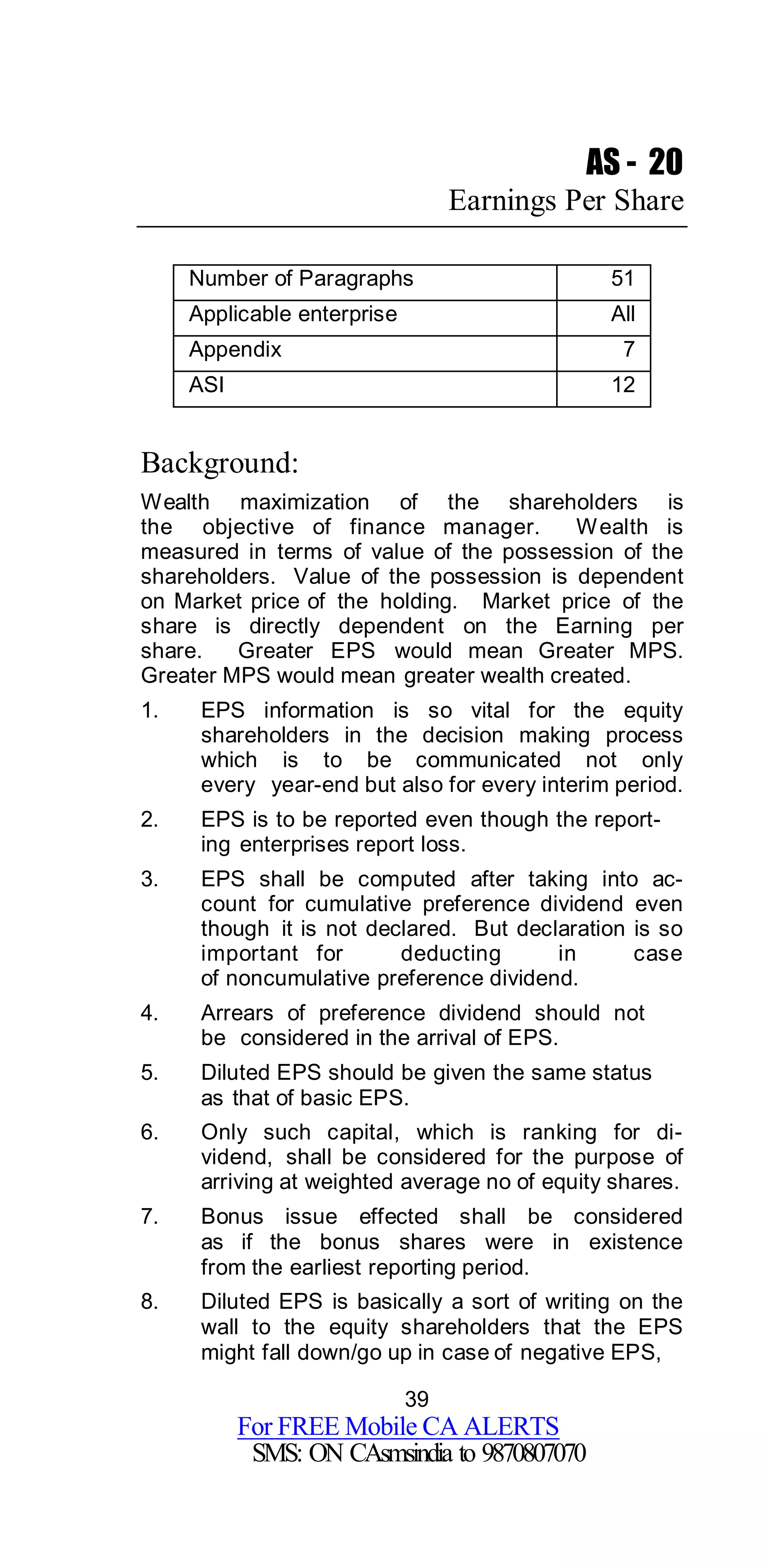
Wealth maximization of the shareholders is
the objective of finance manager. Wealth is
measured in terms of value of the possession of the
shareholders. Value of the possession is dependent
on Market price of the holding. Market price of the
share is directly dependent on the Earning per
share. Greater EPS would mean Greater MPS.
Greater MPS would mean greater wealth created.
1. EPS information is so vital for the equity
shareholders in the decision making process
which is to be communicated not only
every year-end but also for every interim period.
2. EPS is to be reported even though the report-
ing enterprises report loss.
3. EPS shall be computed after taking into ac-
count for cumulative preference dividend even
though it is not declared. But declaration is so
important for deducting in case
of noncumulative preference dividend.
4. Arrears of preference dividend should not
be considered in the arrival of EPS.
5. Diluted EPS should be given the same status
as that of basic EPS.
6. Only such capital, which is ranking for di-
vidend, shall be considered for the purpose of
arriving at weighted average no of equity shares.
7. Bonus issue effected shall be considered
as if the bonus shares were in existence
from the earliest reporting period.
8. Diluted EPS is basically a sort of writing on the
wall to the equity shareholders that the EPS
might fall down/go up in case of negative EPS,
40
For FREE Mobile CA ALERTS
SMS: ON CAsmsindia to 9870807070
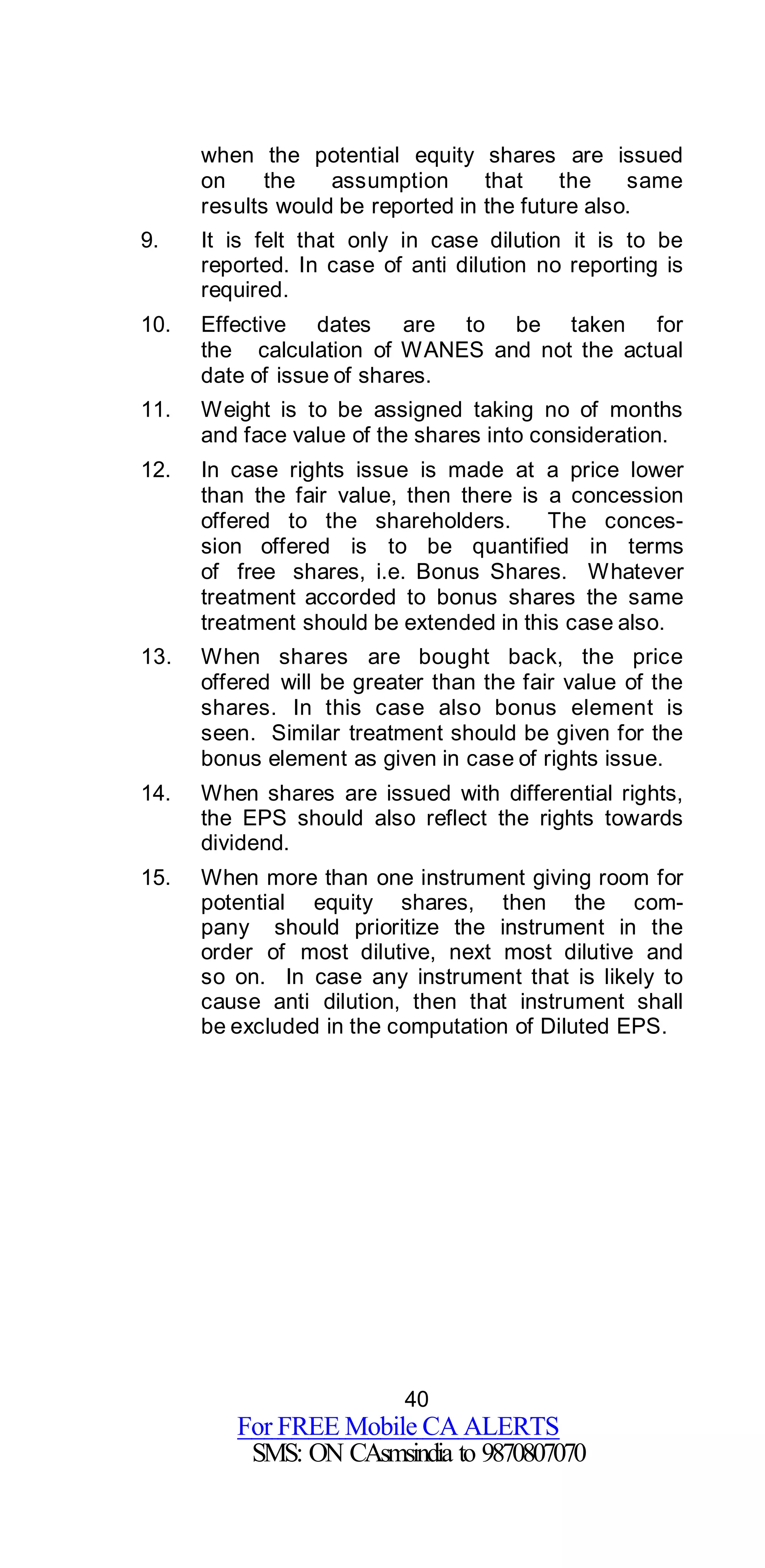
when the potential equity shares are issued
on the assumption that the same
results would be reported in the future also.
9. It is felt that only in case dilution it is to be
reported. In case of anti dilution no reporting is
required.
10. Effective dates are to be taken for
the calculation of WANES and not the actual
date of issue of shares.
11. Weight is to be assigned taking no of months
and face value of the shares into consideration.
12. In case rights issue is made at a price lower
than the fair value, then there is a concession
offered to the shareholders. The conces-
sion offered is to be quantified in terms
of free shares, i.e. Bonus Shares. Whatever
treatment accorded to bonus shares the same
treatment should be extended in this case also.
13. When shares are bought back, the price
offered will be greater than the fair value of the
shares. In this case also bonus element is
seen. Similar treatment should be given for the
bonus element as given in case of rights issue.
14. When shares are issued with differential rights,
the EPS should also reflect the rights towards
dividend.
15. When more than one instrument giving room for
potential equity shares, then the com-
pany should prioritize the instrument in the
order of most dilutive, next most dilutive and
so on. In case any instrument that is likely to
cause anti dilution, then that instrument shall
be excluded in the computation of Diluted EPS.
41
For FREE Mobile CA ALERTS
SMS: ON CAsmsindia to 9870807070
AS - 21
Consolidated Financial Statements
Number of Paragraphs 30
Applicable enterprise Level I
ASI 8,15,24,25,26 & 28
Background:
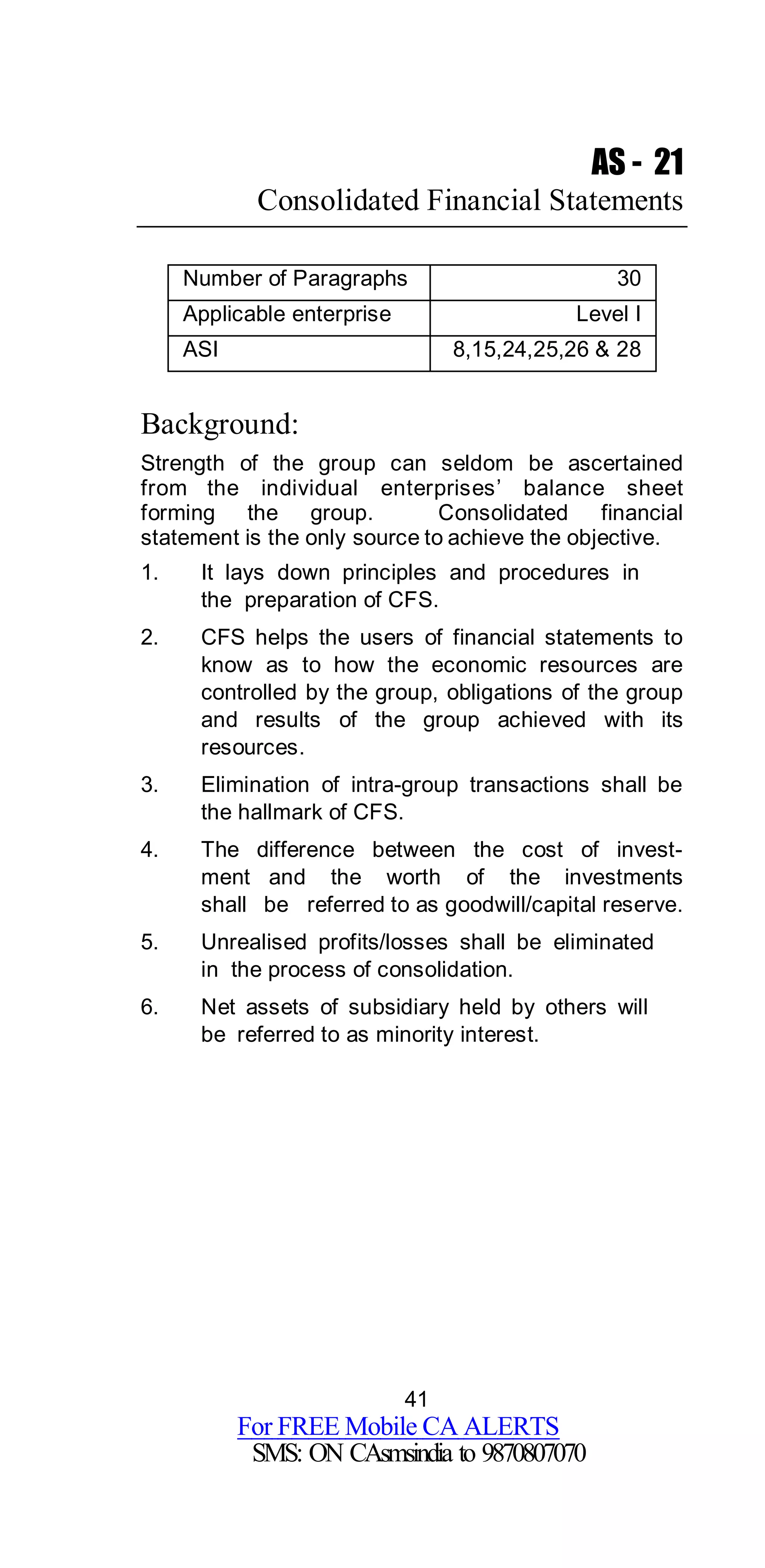
Strength of the group can seldom be ascertained
from the individual enterprises’ balance sheet
forming the group. Consolidated financial
statement is the only source to achieve the objective.
1. It lays down principles and procedures in
the preparation of CFS.
2. CFS helps the users of financial statements to
know as to how the economic resources are
controlled by the group, obligations of the group
and results of the group achieved with its
resources.
3. Elimination of intra-group transactions shall be
the hallmark of CFS.
4. The difference between the cost of invest-
ment and the worth of the investments
shall be referred to as goodwill/capital reserve.
5. Unrealised profits/losses shall be eliminated
in the process of consolidation.
6. Net assets of subsidiary held by others will
be referred to as minority interest.
42
For FREE Mobile CA ALERTS
SMS: ON CAsmsindia to 9870807070
AS - 22
Accounting for Taxes on Income
Number of Paragraphs 34
Applicable enterprise All
ASI 3,4,5,6,7,9 & 11
Appendix 3
Background:
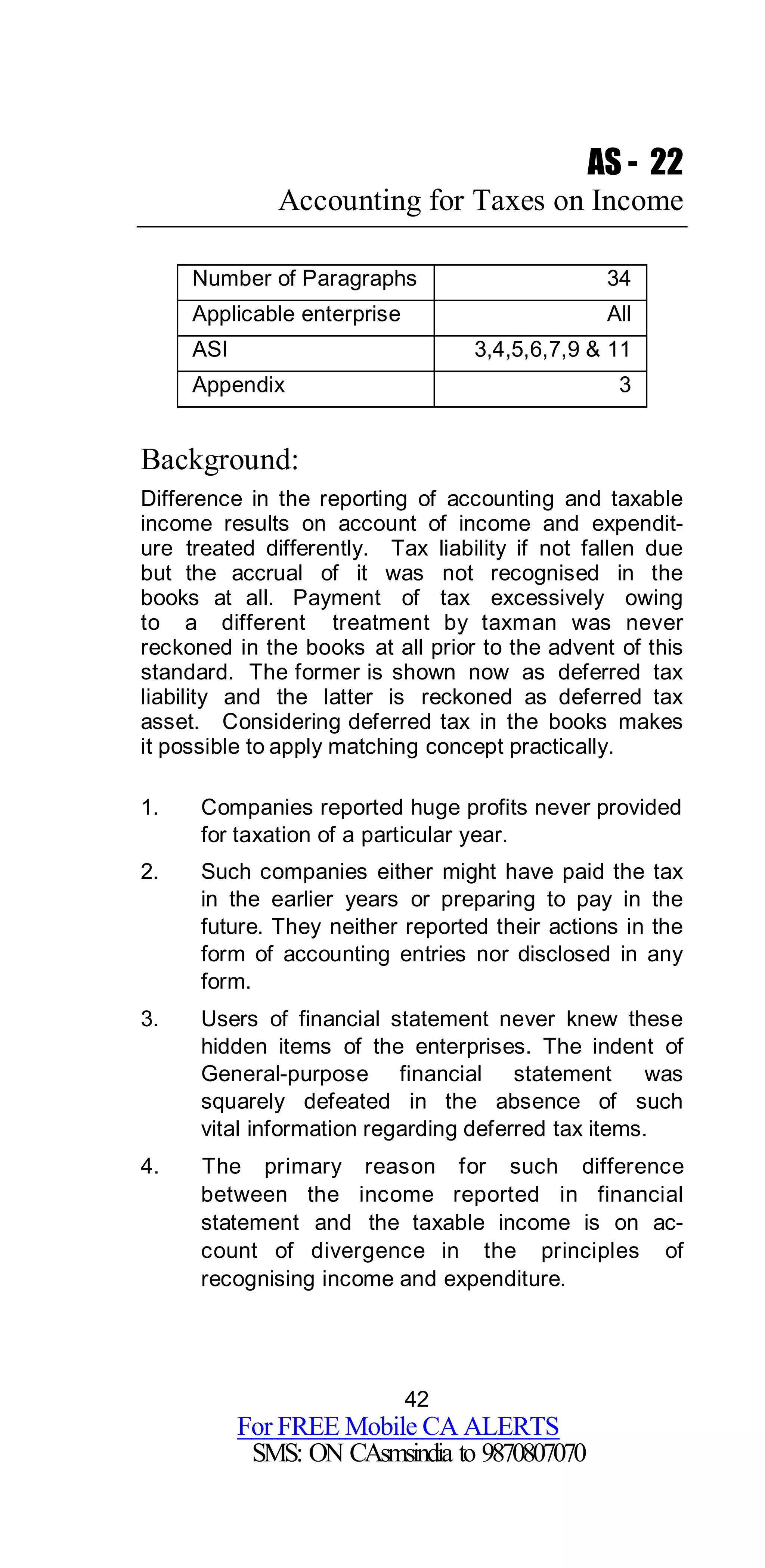
Difference in the reporting of accounting and taxable
income results on account of income and expendit-
ure treated differently. Tax liability if not fallen due
but the accrual of it was not recognised in the
books at all. Payment of tax excessively owing
to a different treatment by taxman was never
reckoned in the books at all prior to the advent of this
standard. The former is shown now as deferred tax
liability and the latter is reckoned as deferred tax
asset. Considering deferred tax in the books makes
it possible to apply matching concept practically.
1. Companies reported huge profits never provided
for taxation of a particular year.
2. Such companies either might have paid the tax
in the earlier years or preparing to pay in the
future. They neither reported their actions in the
form of accounting entries nor disclosed in any
form.
3. Users of financial statement never knew these
hidden items of the enterprises. The indent of
General-purpose financial statement was
squarely defeated in the absence of such
vital information regarding deferred tax items.
4. The primary reason for such difference
between the income reported in financial
statement and the taxable income is on ac-
count of divergence in the principles of
recognising income and expenditure.
43
For FREE Mobile CA ALERTS
SMS: ON CAsmsindia to 9870807070
5. The difference between financial and
taxation principles are identified
as permanent and temporary difference.
6. AS 22 prescribed the accounting
of matching concept that paved way for
accounting of tax liability of the past and
the future in the name of deferred tax.
Until such time tax provision effected
in the books were only the current taxation
7. Deferred tax shall be accounted only
for timing differences. Permanent
differences shall be ignored totally.
8. Deferred tax shall not be discounted though it
may relate to future tax payments / recovery.
9. Reversal of deferred tax of a year is a mat-
ter related to earlier years of timing differ-
ence getting reversed during the current period.
10. Deferred tax asset shall appear in the balance
sheet immediately after Investment but
before current assets, loans and advances
11. Deferred tax liability shall appear in the balance
sheet immediately after unsecured loan but
before considering current liabilities and
provision.
44
For FREE Mobile CA ALERTS
SMS: ON CAsmsindia to 9870807070
AS - 23
Accounting For Investments In Associates In
Consolidated Financial Statements
Number of Paragraphs 26
Applicable enterprise Level I
ASI 8,16,17 &18
Background:
Investments before attaining the status of control
would have had a better status than a
passive investment. Such a status shall be in
the form of significant influence. Investments are
expected to be reported at the incremental net
asset value of the investee company since
acquisition. This is referred to as equity method
of accounting. Equity method shall be adopted in
the preparation of consolidated financial statement.
1. There are two types of parties in this set
up. They are investor and investee (associate)
2. The company that has significant influence on
another enterprise is referred to as investor and
the influenced one is referred to as investee or
associate.
3. Significant influence can be measured
by holding 20% or above and upto 50%
of the equity capital of the other
enterprise, or by agreement.
4. The investor participating in the operating and
financial policies of the company
will have greater impact in its working
results either directly or indirectly.
5. Investment in associate company shall be
disclosed in CFS of the investor under equity
method.
6. The investor can hold such investment
in associate company directly or the subsi-
diary of the investor can hold the investment
to qualify the disclosure under equity method.
45
For FREE Mobile CA ALERTS
SMS: ON CAsmsindia to 9870807070
7. If investor has no requirement of preparing
CFS, the investments shall figure at cost
price as prescribed in AS 13.
8. If the associate had prepared CFS, then
equity method shall be used keeping CFS
has the base.
9. Goodwill/capital reserve for such in-
vestment shall be ascertained the
same way as investment in subsidiary.
10. The goodwill/capital reserve shall be
disclosed as part of the cost of investment,
and the share in the revenue profit shall
be added both in investments account as
well as consolidated profit and loss account
11. Change in Revaluation reserve account in
associate company will not influence the
consolidated profit and loss ac-
count but investment account in the
hands of Investor Company with
corresponding credit to Revaluation account.
12. Unrealised profit or loss on transaction
with associate company effected by the
investor or subsidiary of the investor shall be
eliminated to the extent of investor’s share.
13. In case the associate had proposed dividend,
then such a dividend is not recognised as a
debit in Profit and loss account. The share in
profit and loss account of associate company
shall be reckoned ignoring proposed dividend.
14. If the investments were kept purely for a
temporary purposes or when the associate is
operating under severe financial long-term
restrictions, equity method will not be followed.
15. Investments shall appear in CFS as long-
term investments separately.
46
For FREE Mobile CA ALERTS
SMS: ON CAsmsindia to 9870807070
AS - 24
Discontinuing Operations
Number of Paragraphs 36
Applicable enterprise Level I
Appendix 2
Background:
Specifically if a business disposes of activities how is
the underlying core business doing? Without the
discontinuing business what might future profits be?
All these questions to be raised by all concerned shall
be answered with the help of this accounting standard.
1. The objectives in store when reporting
is required on segmental basis are not
fully achieved if the enterprise had
negotiated for disposal/discontinuing some of
the operations of the company when it is
not disclosed. In simple words, the ob-
jectives of segmental reporting and discon-
tinuing operations are more or less the same.
2. It is not uncommon that in a business, frequently
abandoning products/services, change in
the work force size would be result-
ing. Such changes can never
be construed as discontinuing operations.
3. It is writing on the wall to the investors
that the revenue, results, assets and liabilit-
ies are not to be there in the fold of the
company from the future on ac-
count of discontinuance of operations.
4. The enterprise shall update the
discontinuing operations significant
changes since the initial disclosure is made.
5. Disclosure is required every reporting
period since the initial disclosure is made
until the discontinuance is completed.
6. If enterprise abandons or withdraws from a
discontinuance plan, then the fact, reas-
ons therefore and its effect should be disclosed.
47
For FREE Mobile CA ALERTS
SMS: ON CAsmsindia to 9870807070
7. Disclosure is required not only an annual routine
but should be carried out for every interim
period.
48
For FREE Mobile CA ALERTS
SMS: ON CAsmsindia to 9870807070
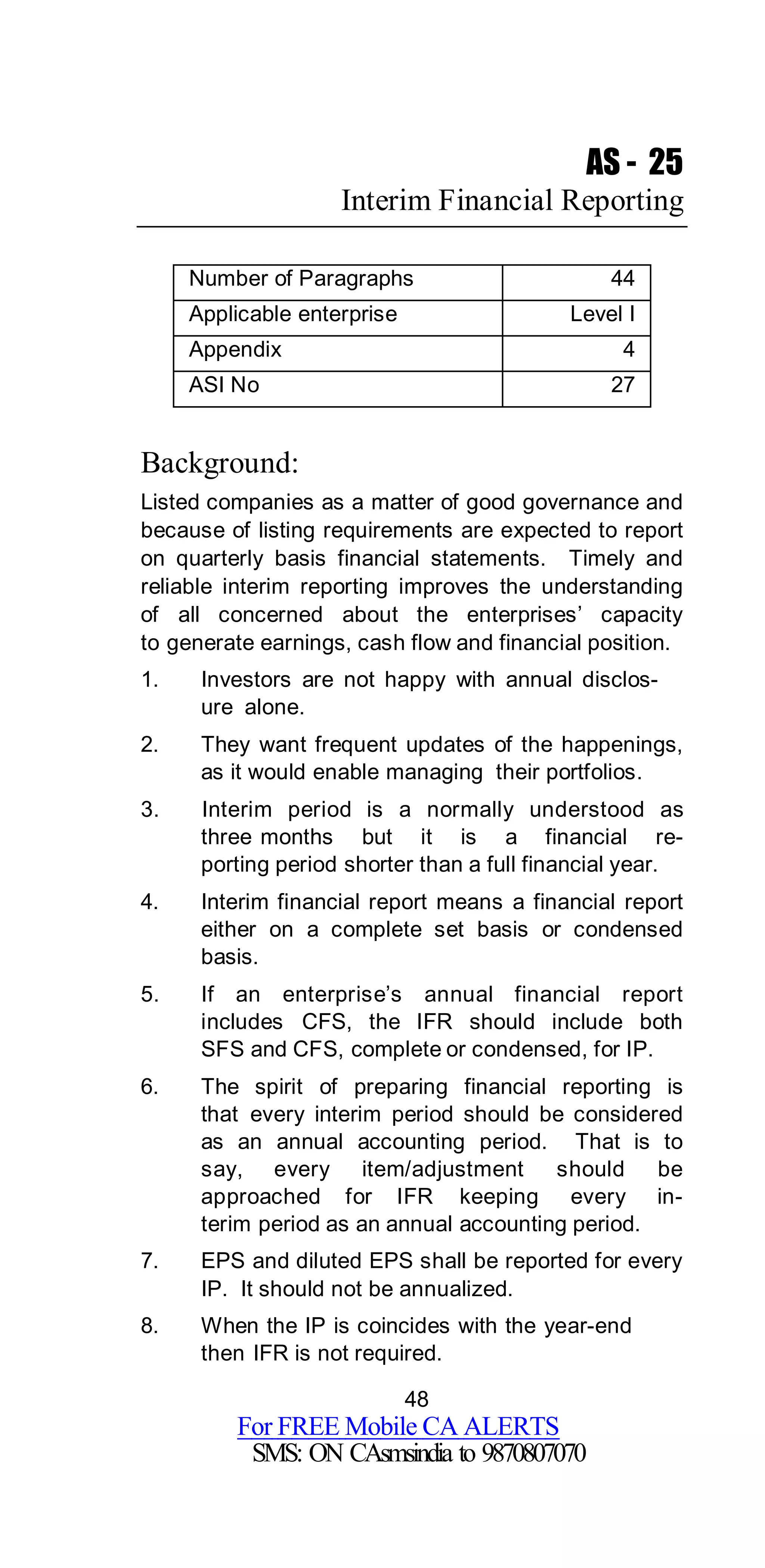
AS - 25
Interim Financial Reporting
Number of Paragraphs 44
Applicable enterprise Level I
Appendix 4
ASI No 27
Background:
Listed companies as a matter of good governance and
because of listing requirements are expected to report
on quarterly basis financial statements. Timely and
reliable interim reporting improves the understanding
of all concerned about the enterprises’ capacity
to generate earnings, cash flow and financial position.
1. Investors are not happy with annual disclos-
ure alone.
2. They want frequent updates of the happenings,
as it would enable managing their portfolios.
3. Interim period is a normally understood as
three months but it is a financial re-
porting period shorter than a full financial year.
4. Interim financial report means a financial report
either on a complete set basis or condensed
basis.
5. If an enterprise’s annual financial report
includes CFS, the IFR should include both
SFS and CFS, complete or condensed, for IP.
6. The spirit of preparing financial reporting is
that every interim period should be considered
as an annual accounting period. That is to
say, every item/adjustment should be
approached for IFR keeping every in-
terim period as an annual accounting period.
7. EPS and diluted EPS shall be reported for every
IP. It should not be annualized.
8. When the IP is coincides with the year-end
then IFR is not required.
49
For FREE Mobile CA ALERTS
SMS: ON CAsmsindia to 9870807070
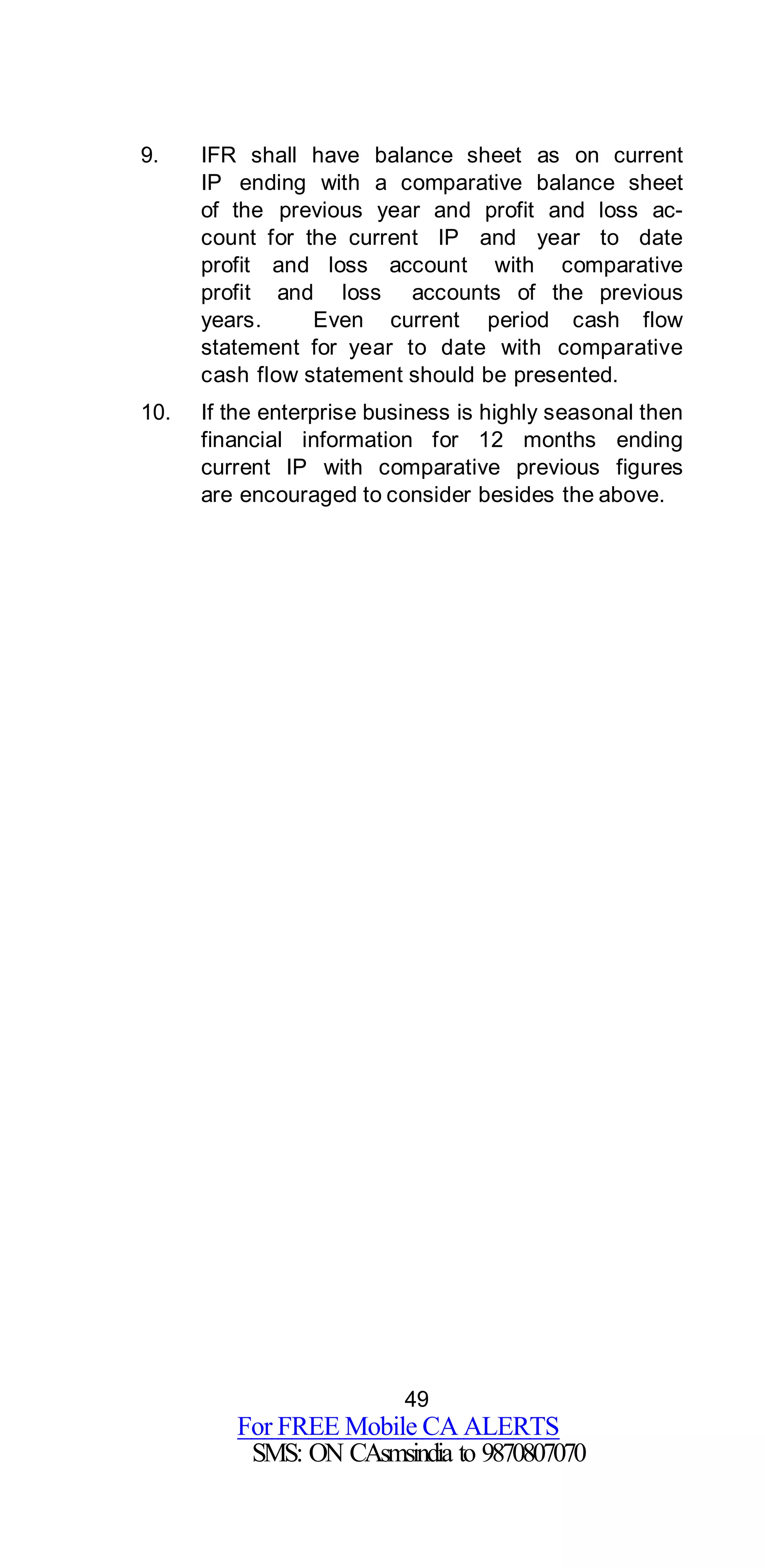
9. IFR shall have balance sheet as on current
IP ending with a comparative balance sheet
of the previous year and profit and loss ac-
count for the current IP and year to date
profit and loss account with comparative
profit and loss accounts of the previous
years. Even current period cash flow
statement for year to date with comparative
cash flow statement should be presented.
10. If the enterprise business is highly seasonal then
financial information for 12 months ending
current IP with comparative previous figures
are encouraged to consider besides the above.
50
For FREE Mobile CA ALERTS
SMS: ON CAsmsindia to 9870807070
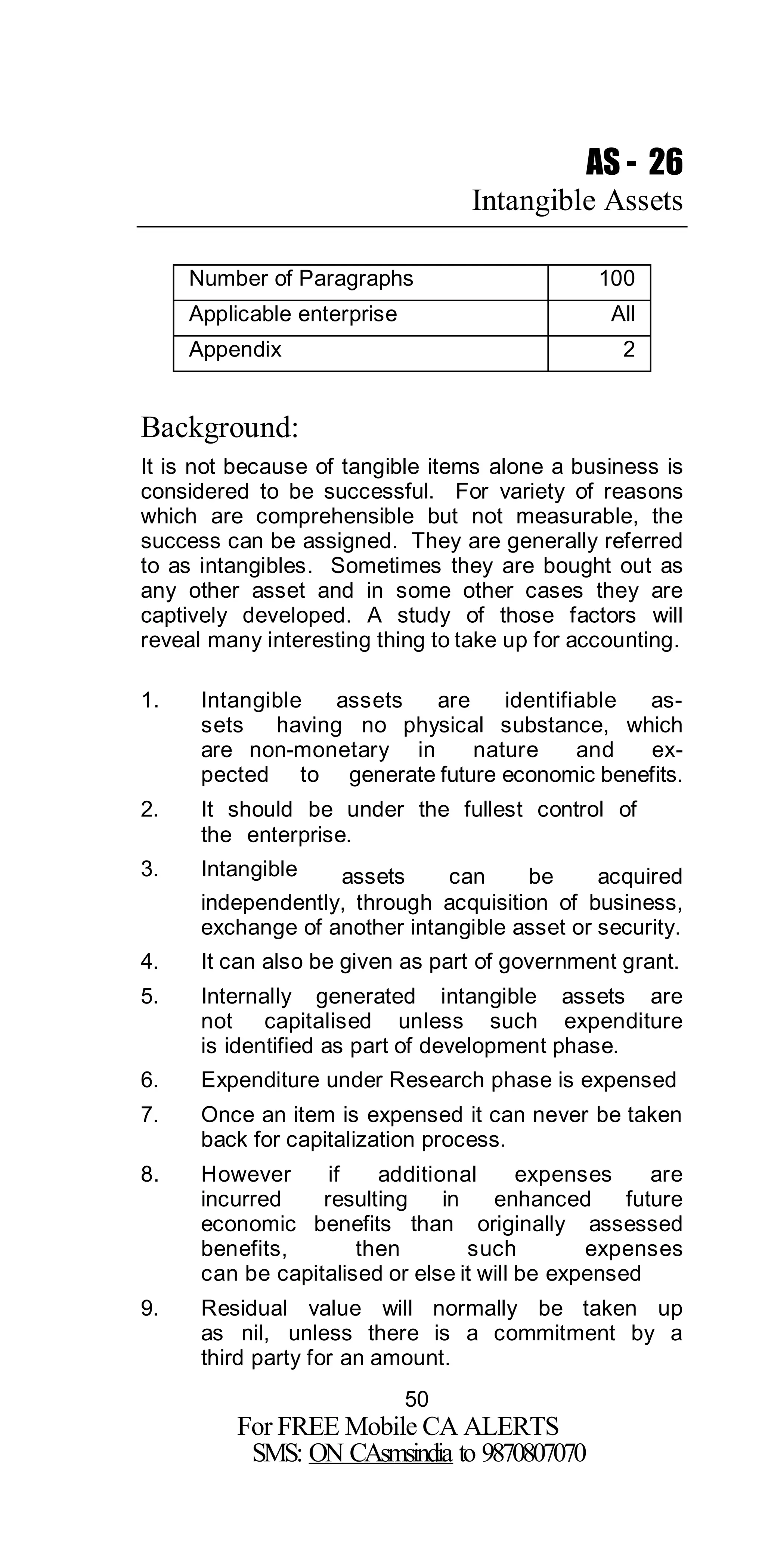
AS - 26
Intangible Assets
Number of Paragraphs 100
Applicable enterprise All
Appendix 2
Background:
It is not because of tangible items alone a business is
considered to be successful. For variety of reasons
which are comprehensible but not measurable, the
success can be assigned. They are generally referred
to as intangibles. Sometimes they are bought out as
any other asset and in some other cases they are
captively developed. A study of those factors will
reveal many interesting thing to take up for accounting.
1. Intangible assets are identifiable as-
sets having no physical substance, which
are non-monetary in nature and ex-
pected to generate future economic benefits.
2. It should be under the fullest control of
the enterprise.
3. Intangible assets can be acquired
independently, through acquisition of business,
exchange of another intangible asset or security.
4. It can also be given as part of government grant.
5. Internally generated intangible assets are
not capitalised unless such expenditure
is identified as part of development phase.
6. Expenditure under Research phase is expensed
7. Once an item is expensed it can never be taken
back for capitalization process.
8. However if additional expenses are
incurred resulting in enhanced future
economic benefits than originally assessed
benefits, then such expenses
can be capitalised or else it will be expensed
9. Residual value will normally be taken up
as nil, unless there is a commitment by a
third party for an amount.
51
For FREE Mobile CA ALERTS
SMS: ON CAsmsindia to 9870807070
10. Intangible assets are normally amortised during
its best estimate of useful life not exceeding ten
year. In case the life is contractually decided
as greater than ten years then, such
number of years can be used for amortisation.
11. Amortisation method shall reflect the pattern in
which the asset’s economic
benefits are consumed by the enterprise.
12. Development expenditure is not capitalised
immediately. It is deferred before it
is capitalised. Until the capitalization stage is
over, it shall appear under the head Miscel-
laneous expenditure. Once the capitalization
process is over, it is taken under Fixed assets.
13. Normally recoverable amount is determined for
assets that are tested for impairment at
every balance sheet date. In the cases of
intangible asset that are in the stage of devel-
opment and intangible assets whose costs are
amortised for a period exceeding ten years,
an enterprise should estimate the recover-
able amount even though there is no
indication of the asset is impaired
52
For FREE Mobile CA ALERTS
SMS: ON CAsmsindia to 9870807070
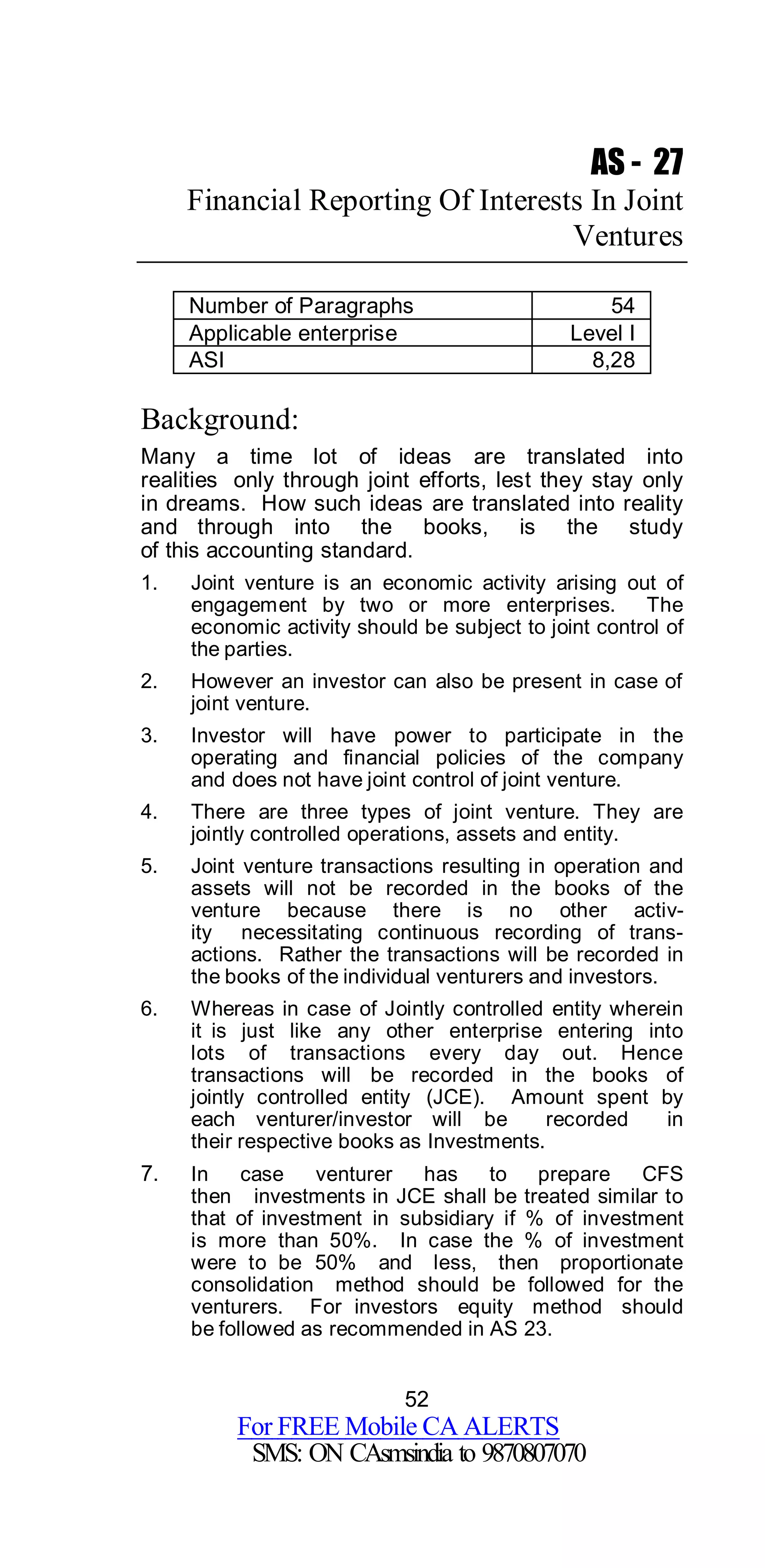
AS - 27
Financial Reporting Of Interests In Joint
Ventures
Number of Paragraphs 54
Applicable enterprise Level I
ASI 8,28
Background:
Many a time lot of ideas are translated into
realities only through joint efforts, lest they stay only
in dreams. How such ideas are translated into reality
and through into the books, is the study
of this accounting standard.
1. Joint venture is an economic activity arising out of
engagement by two or more enterprises. The
economic activity should be subject to joint control of
the parties.
2. However an investor can also be present in case of
joint venture.
3. Investor will have power to participate in the
operating and financial policies of the company
and does not have joint control of joint venture.
4. There are three types of joint venture. They are
jointly controlled operations, assets and entity.
5. Joint venture transactions resulting in operation and
assets will not be recorded in the books of the
venture because there is no other activ-
ity necessitating continuous recording of trans-
actions. Rather the transactions will be recorded in
the books of the individual venturers and investors.
6. Whereas in case of Jointly controlled entity wherein
it is just like any other enterprise entering into
lots of transactions every day out. Hence
transactions will be recorded in the books of
jointly controlled entity (JCE). Amount spent by
each venturer/investor will be recorded in
their respective books as Investments.
7. In case venturer has to prepare CFS
then investments in JCE shall be treated similar to
that of investment in subsidiary if % of investment
is more than 50%. In case the % of investment
were to be 50% and less, then proportionate
consolidation method should be followed for the
venturers. For investors equity method should
be followed as recommended in AS 23.
53
For FREE Mobile CA ALERTS
SMS: ON CAsmsindia to 9870807070
54
For FREE Mobile CA ALERTS
SMS: ON CAsmsindia to 9870807070
AS - 28
Impairment Of Assets
Number of Paragraphs 125
Applicable enterprise All
Appendix 1
Background:
Sickness of an enterprise can be detected through
variety of ways. But remedial measures were absent
prior to the advent of this accounting standard. This
accounting standard is a path breaking in the finan-
cial reporting standards globally. The ap-
plication of accounting standard would be
great boon for industries to take up case
of preventive measures instead of curative measures.
1. Impairment indicates defect in financial value of
assets on account of many factors beyond
normal recognition of depreciation/amortisation.
2. All assets except inventories, construction WIP,
investments and deferred tax asset are
covered under this AS.
3. Impairment loss shall be identified at
every balance sheet date.
4. The test of impairment can be classified
as external and internal.
5. If the test indicates positive, then recover-
able amount is to be estimated
6. Recoverable amount is the higher of the net
selling price and value in use.
7. Net selling price is the difference
between normal selling price and in-
cremental disposal value. It reflects the im-
mediate net sale value if the asset is disposed of.
8. Value in use is the present value of future
cash flows arising on account of continued
use of asset and on disposal of asset.
9. To identify the present value factor, WACC
should be computed at pretax stage
using CAPM approach.
55
For FREE Mobile CA ALERTS
SMS: ON CAsmsindia to 9870807070
10. The cash flow should not be devoid of tax and
financial items.
11. Impairment loss is the difference
between the carrying amount and
recoverable amount, provided carrying
amount is greater than recoverable amount
12. Carrying amount is the difference between
the cost and the accumulated
depreciation and impairment losses
13. Impairment losses can be even greater than
the carrying amount of the asset.
14. Recoverable amount can also be in the negative
when the incremental disposal cost is greater
than the normal selling price and when the
future cash flows are in the negative (outflows).
15. Not all assets would have the attribute of having
NSP and VIU. Some assets would realise very
much a nominal NSP or VIU, when compared
to their huge carrying amounts.
On such occasions, individually
identifying assets for impairment
purposes will defeat the objective of this AS.
16. Block of such assets can conveniently be taken
as a group for the purpose of testing
impairment. Such group of assets would
be referred to as Cash Generating Unit. (CGU).
17. CGU should have these attributes: (a)
Cash inflow should be present (b)
operationally it should be independent when
compared to other assets and CGUs.
18. Impairment losses shall be debited to profit and
loss account and /or revaluation reserve if any.
19. When assets or CGUs emerge at the time of
acquisition of some business, goodwill might
have also emerged. When a few of those assets
are taken up for the purpose of test-
ing impairment, cost of the asset shall
be its individual cost plus the share of goodwill.
20. Goodwill shall be distributed to those as-
sets and CGUs either under bottom up
approach or if it fails, then top down approach.
21. Corporate assets are assets that are not used
directly or indirectly to a particular asset or CGU
in the generation of cash but would be helpful for
56
For FREE Mobile CA ALERTS
SMS: ON CAsmsindia to 9870807070
the company as a whole. The cost
of corporate assets should also be
distributed like the one suggested for Goodwill.
22. On such occasions, impairment
loss should firstly be adjusted
against the share of goodwill/corporate
assets and then to the individual assets.
23. Impairment losses can be reversed. But in no
case, the reversal should result in a
figure greater than the figure had there
been no impairment loss at the first stage.
24. In the process of reversal,
individual assets/CGUs should be
brought back firstly and then goodwill.
But goodwill cannot be restored just like that.
25. On account t of impairment/reversal
of impairment, depreciation for the
remaining period shall be recomputed
keeping the newer information as the base.
57
For FREE Mobile CA ALERTS
SMS: ON CAsmsindia to 9870807070
AS - 29
Provisions, Contingent Liabilities & Assets
Number of Paragraphs 72
Applicable enterprise All
Appendix 5
ASI 30
Background:
It will be inappropriate to account an item of
expenditure in the following year when the benefit
of income is derived in the year of sale. Even if
the amount of impending expenditure is unknown
it is considered prudent to account the expenditure
when income is booked. If not done, it will amount
to total mismatch of income and expenditure. If the
amount of expenditure is unascertainable, the fact
is to be disclosed as contingent liability.
1. All events are not qualifying for a place
of recording in the books of accounts either in
the form of adjustment in the books or disclosure
2. Only obligating event will be taken up for
consideration. Non-obligating event will be
ignored.
3. Obligating event is the one that has no oth-
er realistic way of settlement except to honor
the obligation that includes onerous contracts
4. Obligation events will be classified as (a)
Present obligation and (b) possible obligation
5. Liability is a present obligation on the re-
porting date that arose on account of past
events, which would result in outflow
of resources embodying economic benefits.
6. Provision is also a liability that is computed with
a fair degree of estimation.
7. If estimation of outflow of resources
becoming difficult then the event shall
be taken up as contingent liability.
8. Similarly when the obligating event is classified
as possible and that event is not likely to result
in outflow of resources at all or the chances of
58
For FREE Mobile CA ALERTS
SMS: ON CAsmsindia to 9870807070
outflow is remote, then, contingent liability need
not be disclosed. If this is not the case,
then disclose as contingent liability. But at the
same time if the possible obligation
is identified as persisting but the outflow is
not determinable, continue to disclose as
contingent liability with all the facts of the case.
9. In case a company had undertaken joint and
several liability, contingent liability shall
be disclosed only to the extent of other
parties share in the joint and several liability.
10. Contingent asset shall be recognized only when
it is virtually certain of recovery
11. In the event of contingent asset arising out
of counter party commitment, it shall be
recorded only when it is virtually certain, only to
the extent of provision created for our obligation
to another third party.
12. No provision should be created for fu-
ture operating losses.
13. Provision for loss shall be made on account
of restructuring only when there is a
binding agreement made on restructuring.
Good Luck

29 as notes_for_ca_ipcc__final

  • 1.
    1 For FREE MobileCA ALERTS SMS: ON CAsmsindia to 9870807070 Accounting Standard Notes Types of Enterprises Level I Level II Level III Level I Enterprises: Enterprises which fall in any one or more of the following categories, at any time during the accounting period, are classified as Level I enterprises: a. Enterprises whose equity or debt securities are listed in India or outside India. b. Enterprises, which are in the process of listing their equity or debt securities as evidenced by the board of directors’ resolution in this regard. c. Banks including co-operative banks. d. Financial institutions. e. Enterprises carrying on insurance business. f. All commercial, industrial and business reporting enterprises, whose turnover for the immediately preceding ac- counting period on the basis of audited financial statements exceed Rs.50 crore. Turnover does not include ‘other income’. g. All commercial, industrial and business reporting enterprises having borrowings, including public deposits, in excess of Rs.10 crore at any time during the accounting period. h. Holding and subsidiary enterprises of any one of the above at any time during the accounting period. Level II Enterprises:
  • 2.
    2 For FREE MobileCA ALERTS SMS: ON CAsmsindia to 9870807070 Enterprises which are not level I enterprises but fall in any one or more of the follow- ing categories are classified as level II enterprises: a. All commercial, industrial and business reporting enterprises, whose turnover for the im- mediately preceding accounting period on the basis of audited financial statements exceed Rs.40 lakhs but does not exceed Rs.50 crores. Turnover does not include ‘other income’. b. All commercial, industrial and business reporting enterprises having borrowings, including public deposits, in excess of Rs.1 crore but not in excess of Rs. 10 crore at any time during the accounting period. c. Holding and subsidiary enterprises of any one of the above at any time during the accounting period. Level III Enterprises: Enterprises, which are not covered under Level I and Level II, are considered as Level III enterprises.
  • 3.
    3 For FREE MobileCA ALERTS SMS: ON CAsmsindia to 9870807070 AS - 1 Disclosure of Accounting Policies Number of Paragraphs 27 Applicable enterprise All Background: Financial statements should have minimum content and the bases on which the figures are prepared should be explained. There are many methods to follow in applying accounting principles. Existence of variety of methods will convey uniqueness of each of those methods in the presentation of financial statements. No one method can be regarded as supreme for the accuracy of financial figures reported in financial statements. Therefore it becomes a basic precondition to declare the significant accounting policies followed in order to enable proper under- standing for the end users of financial statements. 1. Only significant accounting policies adopted in the preparation and presentation of financial statements should normally be disclosed in one place. 2. The primary consideration in the selection of accounting policy is true and fair view and the secondary considerations are prudence, substance over form and materiality. 3. Changes in the accounting policy having material effect, affect current period and the future. To the extent determinable, the effect of change in Accounting Policy shall be disclosed. In case it is not ascertainable wholly or in part, the fact should be indicated. If it expected to affect the future, the fact should be disclosed. 4. Disclosure is not required if fundamental accounting assumptions viz going concern, consistency and accrual are followed. Only when they are not followed, the fact should be disclosed.
  • 4.
    4 For FREE MobileCA ALERTS SMS: ON CAsmsindia to 9870807070 AS - 2 Valuation Of Inventories Number of Paragraphs 27 Applicability of enterprises All ASI reference ASI 2 Background: Inventories are so critical to the reporting of profits/losses at the correct amount, in the correct period, that clear definition of terms and defined accounting is required. It gives yet another impression on the liquidity of the stock maintained when it is reckoned for financial ratios. 1. Inventories would mean Raw material, Work in progress, finished good and consumable/spares. 2. It does not include WIP under AS 7, WIP arising in the ordinary course of business of service providers, shares, securities held as stock and inventories of livestock, ag- ricultural, mineral products etc., 3. Generally cost or NRV shall be scale of valuation for finished stock. But in case of raw materials, WIP and spares/consumables cost is the basis of evaluation. 4. Cost includes cost of purchase, conversion cost and other costs. It excludes abnor- mal cost, storage cost, administrative overheads and selling and distribution costs. 5. For the purpose of cost either FIFO method or weighted average method shall be used. 6. Many industries would have their unique way of identifying costs, as the items dealt are huge and having frequent fluctuations. Either standard cost shall be used taking normal capacity in computation or retail method of arriving at cost shall be used.
  • 5.
    5 For FREE MobileCA ALERTS SMS: ON CAsmsindia to 9870807070 7. Standard cost formula method is often used in manufacturing industry and retail formula method is used in trading activity units. 8. NRV is the difference between the normal selling price and the cost of com- pleting the sale/cost of completing the job/work. 9. NRV question will arise if the selling prices have declined or when the estimated cost to complete the sale is increased. 10. If the inventory is damaged partially or wholly, it may not fetch the normal selling price. Therefore it is often that damaged goods will be valued below cost i.e. at NRV. 11. Some of the items of inventory will be valued on item by item basis. Sometimes it will be valued on global basis or on a panel basis wherein inventories may not be practically segmented. 12. If inventory is stocked for a particular contract, then the price agreed in the contract is the selling price for the arrival of NRV. For the excess quantity stored if any, general selling price shall be considered as the base. 13. Normally cost is the basis of valuation for Raw material. There is no NRV concept in the valuation of raw material. In case the replacement cost of the raw material had fallen, with finished goods (in which such raw material is incorporated) are likely to be sold at a price below cost, then the raw material should be valued at replacement (as NRV) cost. 14. NRV should be computed at each balance sheet date. 15. The financial statement should disclose the accounting policies adopted in meas- uring inventories including the cost formula used and the total of carrying amount of inventories and the appropriate classification.
  • 6.
    6 For FREE MobileCA ALERTS SMS: ON CAsmsindia to 9870807070 AS - 3 Cash Flow Statements Number of Paragraphs 48 Type of enterprises Level I Appendix 2 Background: Favourable cash flow is essential for the survival and growth of any business. Cash flow statement identifies how cash has flown through a business and is very useful statement in verifying a business performance for a period and movement in net asset position over a period. 1. Simple financial statements are not at all convincing the readers as to why the enterprises are reporting huge profits but struggling to meet the payment schedules 2. Cash flow statement will give the users of financial statement a clue as to how the cash is resourced and where they are being utilized. 3. Activities are classified as operating, invest- ing and financing. 4. Cash flow statement should be presented whenever financial statement is prepared. This would mean that whenever interim financial statement is to be reported, cash flow statement should also be presented. 5. Cash would mean cash in hand, de- mand deposits with bank etc. 6. Changes in cash and cash equivalents are detailed in cash flow statement. 7. Cash equivalents are short term investments which are having shorter maturity period (say not greater than 3 months) held for real- isation of definite cash with least amount of risk.
  • 7.
    7 For FREE MobileCA ALERTS SMS: ON CAsmsindia to 9870807070 8. Non-cash items taken for the preparation of financial statement shall be excluded in the preparation of cash flow statement. 9. There are two methods of reporting. They are direct method and indirect method. 10. What is considered as investing activity of an item can be taken as an operating activity for a different enterprise. Eg. Interest income is an investing activity for a manufacturing enterprise whereas the same item will be operating activity for banking industry. 11. Cash flows associated with extraordinary items are disclosed separately as arising from operating, investing and financing in the cash flow statement so as to have better understanding of the nature and effect on the present and future cash flows of the enterprise.
  • 8.
    8 For FREE MobileCA ALERTS SMS: ON CAsmsindia to 9870807070 AS - 4 Contingencies & Events Occurring After The Balance Sheet Date Number of Paragraphs 17 Type of enterprises All Part of AS related to contingencies is withdrawn after the advent of AS29. The no. of paras given above is inclusive of those withdrawn. Background: Not all the transactions related to a period would occur on or before the year-end. Ignoring them from the scope of reporting just because they have occurred after the year-end would not be correct. There are some transactions occurring after the end of the year which have bearing on the results of the enterprise requiring adjustment or a mere disclosure. 1. Only events occurring after balance sheet date are taken up for discussion. 2. Events which take place after balance sheet date have bearing on the balance sheet date (condition/situation) but those occurring before the approval of accounts shall be referred to as Events occurring after balance sheet date. 3. They are classified as adjusting event and non- adjusting events. 4. Adjusting events are those events that would provide additional information materially affecting the conditions prevailed on the balance sheet date. E.g. loss of trade receivable account, which is confirmed by the insolvency of a customer, which occur after the balance sheet date. 5. Non-adjusting events are those events that do not relate to the conditions existing on the balance sheet date. Eg, decline in market value of investments between the balance sheet date and the date of approval having no bearing on
  • 9.
    9 For FREE MobileCA ALERTS SMS: ON CAsmsindia to 9870807070 the value of investments on the balance sheet date. 6. Disclosure is required for non-adjusting events. 7. Adjusting events are to be adjusted in the books of accounts whereas non-adjusting events are not to be adjusted in the books of account and are to be disclosed in financial statements. How- ever there is an exception to non-adjusting event, i.e. proposed dividend though a non-adjust- ing event requires an adjustment in the books. 8. In case of events occurring after balance sheet date affecting the basic substratum of the enterprise, it may be appropriate to consider whether it is proper to use the fundamental accounting assumption of going concern in the preparation of financial statement.
  • 10.
    10 For FREE MobileCA ALERTS SMS: ON CAsmsindia to 9870807070 AS - 5 Net Profit Or Loss For The Period, Prior Period Items & Changes In Accounting Policies Number of Paragraphs 33 Applicable enterprise All Background: Businesses make profits or losses from their core, continuing businesses, but also will have income from exceptional, unusual or extraordinary sources. These have to be distinguished, defined and disclosed separately from other regular items. In fact for some of the cases on ordinary items, disclosure gives better understanding on the sub- ject matter for the users of financial statements. 11.. There are five items dealt in this accounting standard. They are ordinary item, extraordinary item, prior period item, effect of changes in the accounting estimate and effect of changes in the accounting policy. 22.. Ordinary items, which are related to the activities of the enterprise, include items which are incidental to the activities of the enterprise. Disclosure of ordinary items shall be taken up only to place a better understanding about the performance of the enterprise. Eg writing down of inventories as well as reversals, reversals of provisions. 33.. Extraordinary items are distinctly different from ordinary activities, which are not expected to recur frequently or regularly. Eg Grant received from Government towards meeting revenue expenditure, loss of asset on account of earth quake. 44.. Prior period items are matters related to one or more previous years arising on account of omission/commission in the preparation of financial statements affecting the current year’s profit and loss account. Eg error in the stock
  • 11.
    11 For FREE MobileCA ALERTS SMS: ON CAsmsindia to 9870807070 sheet of the previous year, total omission of credit purchases/sales of the preceding year. 55.. Certain items of expenditure may not be exactly known at the time of preparation of financial statements, requiring estimates. When they are met subsequently there will be difference between the estimates and the actuals. The difference will be referred to as changes in accounting estimates. Such differences shall not be considered as prior period items though it may relate to one or more previous years. They are purely judgment/estimate errors. They cannot be classified as prior period items. Eg Changes in the rate of de- preciation (method followed shall be regarded as the same). The effect of changes in ac- counting estimate shall be applied prospectively. 66.. Different methods are adopted in fol- lowing principles of accounting. Such adop- tion of a method of accounting is referred to as accounting policy. Eg. WDV method of accounting depreciation. Enterprise need not follow the method of depreciation throughout its lifetime what it had chosen at the initial stage. Circumstances, statutes and other factors will be considered in adoption and following of a policy. Therefore an enterprise might change the policy after some point of time. Such changes shall be taken up as changes in accounting policy. The change in accounting policy shall have retrospective effect.
  • 12.
    12 ForFREEMobileCAALERTS SMS: ON CAsmsindiato 9870807070 Disclosure Ordinary activities Extra Ordinary Prior period items Changes in accounting estimates Changes in accounting policies All expenses & Income to be included in the Profit & Loss A/c Separate disclosure is required only to explain the performance of enterprises Separate disclosure is necessary Separate disclosure is necessary Effect of changes to be included in Profit & Loss A/c Disclose separately only when it material If material – Adjust & disclose If material but not ascertainable, the fact should be indicated No material effect immediately but have material effect in the latter periods, appropriate disclosure when the changes is adopted
  • 13.
    13 For FREE MobileCA ALERTS SMS: ON CAsmsindia to 9870807070 AS - 6 Depreciation Accounting Number of Paragraphs 29 Applicable enterprise All Background: Usage of assets in the generation of income is omnipresent. Measuring and accounting the cost of such usage is the rationale of this study. 1. Depreciation is a measure of diminution in the value of depreciable assets on account of wear and tear, efflux of time, obsolescence, etc., tried on an estimated basis. 2. For the computation of depreciation, the following factors are very im- portant: cost, estimated residual value and life. 3. There can be reviews of depreciable age of the asset, estimated residual value, cost which would change the amount of depreciation. 4. When there is a change in the rate of depreciation, then it can be taken up as changes in accounting estimates. The effect of change should be accounted on a prospective basis 5. If changes are witnessed in the method of charging depreciation, then the same shall be taken up as changes in accounting policy. It should be accounted on a retrospective basis. 6. Addition/extension to the existing asset will qualify for depreciation either on the remaining useful life of the existing asset or based on the independent life of the added/extended asset. 7. In case the depreciation has material effect on the amount of depreciation because of revaluation made on the asset, then disclosure is to be made separately.
  • 14.
    14 For FREE MobileCA ALERTS SMS: ON CAsmsindia to 9870807070 AS - 7 Construction Contracts Number of Paragraphs 44 Applicable enterprise All Appendix 1 ASI 29 Background: Construction projects are generally WIP figures. They are often material balance sheet items and are also critical to the reporting of profits or losses at the correct amount and in the correct period. Nature of construction contracts encompass many account- ing periods, often requiring allocation of contract revenue and costs to the accounting periods in which construction contracts are performed. 1. Construction of assets is given to spe- cialists called as contractors by contractees. 2. In the books of contractor, revenue, costs and disclosure in financial statements, are given importance for both types of contracts such as cost plus contracts and fixed price contracts. 3. Revenue includes contract price, variations, incentives, claims etc., and cost includes dir- ect cost, attributable cost and specifically chargeable to the customer. 4. Revenue and costs are recognised based on the % of completion and completed contract method is not at all recommended. 5. Percentage completion shall be computed in three different methods: (a) Total cost incurred/Total cost incurred + estimated cost to complete the contract. (b) Physical measurement (c) Survey method 6. Proportionate to the completion, revenue, cost and profits are recognised during a period after considering recognised revenue, cost and profits of earlier years when the contract scales through more than one accounting period. 7. If the cost to date plus estimated cost to complete the contract exceed the contract revenue, then the difference will be considered as loss, which shall be accounted as expenditure immediately. 8. Receivable/payable to the contractee shall be arrived by adjusting recognised profits/losses (cumulative to date) to the cost incurred to date. Progress payments received and retention
  • 15.
    15 For FREE MobileCA ALERTS SMS: ON CAsmsindia to 9870807070 money shall be considered in the above exercise.
  • 16.
    16 For FREE MobileCA ALERTS SMS: ON CAsmsindia to 9870807070 AS - 9 Revenue Recognition Number of Paragraphs 14 Applicable enterprise All Appendix 1 ASI 14 Background: Revenue is the source of income, the recognition of which is so important in the reporting of Income, EPS, and Market price of shares and so on. Recognition of revenue will give the right to recover the eco- nomic resources which are created by an enterprise. 1. Revenue arising out of ordinary activities of the enterprise from (a) sale of goods, (b) rendering of services and (c) yielding interest, royalties and di- vidends are covered in revenue recognition. 2. Revenue should be recognised imme- diately after the rendering service or the delivery of products if it is not unreasonable to expect ultimate collection. 3. If there is no reasonability in the ultimate collection upon rendering services or delivery of products, then recognition should be postponed until the collectability takes shape of certainty. 4. In the above points, it is assumed that the revenue can be measured at the time of delivery of products or rendering of services. If the measurability is not determin- able, then recognition will be postponed until the measurability is spotted. 5. Three important factors are to be seen to recognise revenue. They are performance of act of sale/rendering of services, measurability of revenue and reasonability of ultimate collection. 6. After recognising the revenue, if collect- ability factor turns doubtful, then it is not appropriate to reverse the recognised reven- ue. It is more appropriate to create pro- vision for doubtfulness in the collectability factor.
  • 17.
    17 For FREE MobileCA ALERTS SMS: ON CAsmsindia to 9870807070 AS - 10 Accounting For Fixed Assets Number of Paragraphs 39 Applicable enterprise All ASI 2 Certain portions are withdrawn after the advent of AS 16,19 and AS 26 Background: The principle issues in accounting for fixed assets are the timing of recognition of the assets, the determination of their carrying amount and the depreciation charges to be recognised in relation to them. Stating how the fixed assets are valued is essential to an understanding of balance sheet worth. 1. Fixed assets shall be accounted either at cost or at revalued amount. Such revalued amount shall not exceed the recoverable amount of the asset 2. Fixed assets shall be accounted initially at cost if purchased by payment of money or money’s worth. If money’s worth is provided, fixed assets shall be accounted at its fair value of the asset or at the value of the securities issued or assets exchanged whichever is more clearly evident. 3. Downward revaluation of fixed assets shall be debited to profit and loss account or to revaluation reserve created if any on an earlier upward revaluation of the concerned fixed asset. 4. Upward revaluation of fixed assets shall be credited to revaluation reserve. 5. In case the present upward revaluation results as a reversal of previously recognised downward revaluation, then the present increase shall be credited only to profit and loss account because the previ- ous downward revaluation would have been accounted through profit and loss account. 6. Self-constructed assets shall be accounted at cost, which are directly related to the spe- cific asset and those that are attributable to the
  • 18.
    18 For FREE MobileCA ALERTS SMS: ON CAsmsindia to 9870807070 construction activity in general and can be allocated to the specific asset. 7. Subsequent expenses on existing assets shall be capitalised only when there is an increase in the future benefits beyond their previously assessed performance. 8. When fixed assets are held for disposal after their usage, they shall be taken up at lower of the carrying amount or net realizable value. 9. Profit or loss on disposal of fixed assets shall be adjusted in profit and loss account and/ or in revaluation reserve account if any.
  • 19.
    19 For FREE MobileCA ALERTS SMS: ON CAsmsindia to 9870807070 AS - 11 The Effects Of Changes In Foreign Exchange Rates Number of Paragraphs 45 Applicable enterprise All Appendix 1 Background: Business across borders is the order of the day. This would involve dealing of transactions more than in one currency. But reporting is carried out only in one currency. Recording foreign currency trans- actions and subsequently translating them for reporting purposes will result in differences. When foreign operations are to be incorporated for consolidation then translation too will result in differences. How to deal with such differ- ences is the main focus in this accounting standard. 1. It involves accounting of differences arising on account of foreign currency transactions as well as their translations. 2. The ultimate treatment of exchange difference is primarily dependent on the type of operations an enterprise resorts to. 3. There are two types of operations. They are Integral Foreign operations (IFO) and Non-integral Foreign operations (NIFO). 4. Monetary items are cash, bank balance, receivables and payables. The remaining items are non-monetary items. 5. In case of IFO, exchange differences arising on account of monetary items are to be transferred to profit and loss account. Monetary items are translated using closing rates and non- monetary items are translated using actual rates. 6. In case of NIFO, exchange differences will arise on account of balance sheet items and profit and loss account items. Balance sheet items will be translated using closing exchange rate and profit and loss items shall be translated using average
  • 20.
    20 For FREE MobileCA ALERTS SMS: ON CAsmsindia to 9870807070 rate. The difference shall be taken into foreign currency translation reserve until the disposal of NIFO. Upon disposal of NIFO investments, exchange difference shall be transferred to profit and loss account. 7. Forward contract entered will result in discount or premium. Discount or premium shall be accounted as gain/loss during the period of forward contract and not as expenses/income during the period of entering the contract in case of hedging contracts. In case of spec- ulative contracts, premium/discount is ignored. 8. Change in the forward contract rates will result in loss/gain. Such loss/gain shall be transferred to profit and loss account immediately.
  • 21.
    21 For FREE MobileCA ALERTS SMS: ON CAsmsindia to 9870807070 AS - 12 Accounting For Government Grants Number of Paragraphs 23 Applicable enterprise All Background: Government cannot carry out all its duties to the society directly. Of course it will execute its obligation through granting assistance to the deserving enterprises either by rendering cash as- sistance or by providing know-how or by variety of ways. It is the look out of the enterprise as to how the Government grant will be accounted in the books. 1. This accounting standard deals with account- ing of GOVERNMENT GRANT. 2. Government means local, state, central and international. 3. Government grant would be both in terms of cash contribution as well as contribution in kind. 4. There are two approaches in accounting for Government grants. They are capital approach and income approach 5. If the Government grant is in the nature of promoter’s contribution then credit will be given to shareholders’ funds. (Capital reserve) 6. For other types of grants, it is more appropri- ate to follow income approach. 7. Government grants will be taken up as extraordinary item both at the time of grant as well as when it is refunded for some reason. 8. When GOVERNMENT GRANT is in the form of non-monetary asset, then the asset shall be recorded at its nominal value. However when Asset is provided at conces- sional rate then the asset shall be recorded at acquisition cost (net of GOVERNMENT GRANT). 9. When GOVERNMENT GRANT is received with respect to specific fixed asset, there are two treatments recommended. They are (a) shown as reduction from Fixed Asset (FA) (b) Show the
  • 22.
    22 For FREE MobileCA ALERTS SMS: ON CAsmsindia to 9870807070 FA at gross value and take the GOVERNMENT GRANT on the liability side. In case of treatment (a), depreciation will be calculated on the net amount whereas in case of treatment (b), depreciation will be calculated on the gross amount and the grant will be taken as income in proportion of the depreciation charged. Both the treatment will result in same effect. 10. In case of GOVERNMENT GRANT value almost equivalent to the cost of the asset, then it is recommended to show the asset at gross value and the GOV- ERNMENT GRANT on the liability side. 11. In case GOVERNMENT GRANT is received on account of non-depreciable assets without any fulfillment of condition, then the receipt will be credited to capital reserve. In case with fulfillment of conditions, then amount will be transferred to P & L as and when the fulfillment is over. 12. In case of refund of GOVERNMENT GRANT results in increase in the value of FA, then the increased depreciation shall be effected for the remainder of the life of the FA under prospective basis. 13. In case of refund of GOV- ERNMENT GRANT results in a figure greater than the unamortised amount avail- able in the balance sheet, then the difference shall be debited to profit and loss account.
  • 23.
    23 For FREE MobileCA ALERTS SMS: ON CAsmsindia to 9870807070 AS - 13 Accounting For Investments Number of Paragraphs 36 Applicable enterprise All Background: Investments are effected with a view to support variety of obligations of an enterprise. The support expected shall be in the form of regular source of fund to meet some regular obligations or can take shape of appreciating values for a future benefit. Accounting and disclosure of such investments shall be the focus of the study. 1. There are three types of investments. (a) Current (b) long term (c) investment in property. 2. Cost of the investment shall include broker- age, commission etc. 3. In case of investments acquired in exchange of securities etc., investments shall be recorded at fair value of the securities issued. 4. In case, investments were bought by exchange of another asset, the acquired investment shall be recorded at the fair value of the asset given up. It will be appropriate to consider fair value of the investments bought if it is more clearly evident. 5. Current investments are investments which are expected to be held for a period not greater than one year from the date of effecting the investment. 6. Current investments are to be valued at cost or fair value whichever is lower. 7. Current investments are to be valued individually at lower of cost and fair value. 8. Reduction and reversals of current investments shall be done through profit and loss account. 9. For cost purposes, average method should be followed. 10. Long-term investments are to be valued at cost. It can be reduced to a lower value if the fall in the value of investment is permanent. It can also be reversed if the reason for the fall is no longer in existence. 11. Profit or loss on disposal of investments shall be transferred to profit and loss account. 12. When there is a reclassification of long term investment into current investment, it should be valued at lower of cost and the carrying amount. If the opposite is to happen, it shall be valued at
  • 24.
    24 For FREE MobileCA ALERTS SMS: ON CAsmsindia to 9870807070 lower of cost and the fair value whichever is lesser on the date of reclassification.
  • 25.
    25 For FREE MobileCA ALERTS SMS: ON CAsmsindia to 9870807070 AS - 14 Accounting For Amalgamations Number of Paragraphs 46 Applicable enterprise All Background: Acquiring some other related or unrelated business is the order of the day. Accounting such acquisition of business is so important in the reporting for both the acquired and the acquiring company during the post acquisition period. Earn- ings, financial position of the combined business is so crucial in the show of strength of that business in the concerned industry as a whole. 1. There are two methods of accounting in the books of Transferee Company. They are (a) Amalgamation in the nature of purchases (b) amalgamation in the nature of merger. 2. In case of amalgamation in the nature of purchases, the difference between the net asset value of the transferor company and the purchase consideration shall be identified as goodwill/capital reserve. For similar situation in case of amalgamation in the nature of merger, the difference will be transferred to profit and loss account or general reserve. 3. The benefit derived in case of amalgamation in the nature of merger is to protect the entire net asset value of the transferor company in the books of merged entity including the reserves and surplus. The name of the accounting treatment followed for amalgamation in the nature of merger is pooling of interest method. For amalgamation in the nature of purchases, it is referred to as purchases method. 4. In case of amalgamation in the nature of purchases, amalgamation adjustment ac- count shall be debited for creating the statutory reserve of the transferor company in the merged entity. This requirement is not felt under pooling of interest method as the entire reserves and surplus of Transferor Company are protected when the net assets are incorporated in the books of the merged entity.
  • 26.
    26 For FREE MobileCA ALERTS SMS: ON CAsmsindia to 9870807070 AS 15 Employees Benefits (Revised) Number of Paragraphs 146 Applicable enterprise All Appendix 3 Background: Paying for the period of engagement is not employees’ cost. The right to receive beyond the pay packet either immediately or later has become legitim- ate. Recognition of such cost during the period of employment is considered appropriate. Some of the benefits accruing to the employees which are payable at the time of termination and beyond termination are expected to be estimated for accounting during the period of engagement. 1. It involves accounting and disclosure of employees’ benefits. 2. Employees’ benefits would mean all sorts of consideration paid/payable by an enterprise for the services rendered by em- ployees either within twelve months or beyond. 3. Employees include permanent, tem- porary, casual, full time, part time, whole time director and other management personnel. 4. Employees’ benefits are classified into four types. They are short term, long term, termination and post employment benefits. 5. Short-term benefits are payable monetarily or otherwise, within twelve months from the end of the period in which the services were rendered by the employees. No actuarial assumptions are required to measure the obligation as the discharge is expected to be made within 12 months. 6. Short-term benefits include wages, salaries, short-term compensated absences (leaves), profit sharing, Medicare, car, housing etc.
  • 27.
    27 For FREE MobileCA ALERTS SMS: ON CAsmsindia to 9870807070 7. Compensated absences are of two types. They are accumulating and non-accumulating. 8. Accumulating compensated absences are of two types. They are vesting and non -vesting. Vested compensating absences are ‘absences not availed’ which will be encashed by the employees. The employees’ cost would include thesepayments/obligations. Non-vesting absences will have no financial impact and hence are to be ignored. 9. Profit sharing and bonus plans which are payable wholly within twelve months will come under short term benefits and payments to be made beyond twelve months will be covered under long term benefits. 10. Short term benefits are payable within twelve months requiring no specif- ic disclosure excepting in case of payments to Key Management Personnel under AS 18. No actuarial computations are required for short-term benefits. 11. Post employment benefits are of two types. They are defined contribution plan and defined benefit plan. 12. Defined contribution plan would limit the obligation of the enterprise only to the extent of contribution. Beyond the contribution, no obligation would follow the enterprise employer. 13. In defined contribution plan, liabilities and assets are identified based on the actual contri- bution versus due for services. Mar- ket yields on government bonds on the balance sheet date shall be the discount rate to be used for identifying liability or asset. 14. In Defined benefit plan, the obligation would follow the employer beyond the con- tribution whenever actuarial and investment experience different pattern than expected. 15. Obligations are to be discharged with timely investments made each year. The investments are referred to as plan assets. Plan assets are shown as deduction from the estimated liability. 16. The return on plan assets is not shown as income but shown as deduction from employees’ cost.
  • 28.
    28 For FREE MobileCA ALERTS SMS: ON CAsmsindia to 9870807070 17. There will be some changes in liability on account of introduction/amendment in post employees’ benefits. Increase in liability shall be recognised either immediately or later depending upon the application of vesting period. 18. Such of those increases in liability figures for the period not vested, recognition of liability will be done on piecemeal basis (SLM) over the remaining period until vesting is effective. Such items of liability not recognised shall be deducted from the estimated total liability when presented in the balance sheet. This increase in liability not recognised shall be referred to as past service cost not recognised. 19. Such of those increases in liability figures for the periods already vested, liability shall be recognised immediately. 20. Other long term benefits and termination benefits shall be accounted as expenditure with corresponding liability as done in any other case. If payments are to be effected beyond 12 months, then present value computation should be made for its measurement and disclosure.
  • 29.
    29 For FREE MobileCA ALERTS SMS: ON CAsmsindia to 9870807070 AS - 16 Borrowing Costs Number of Paragraphs 23 Applicable enterprise All ASI 1 & 10 Appendix 1 Background: When assets are taking substantial period of time before they are made ready for use, it may not be fair to charge interest on the loan taken to create the asset to the profit and loss account. It is considered appropriate to capitalise such borrowing costs as part of the cost of the asset. 1. Not all assets can be bought. Some of the assets will be developed captively requiring substantial period of time to bring them into existence. 2. Such assets would require huge capital. Borrowed capital will constitute major source of funding such assets. This would result in borrowing cost for the enterprise. 3. It will be unfair to debit the profit and loss account for the borrowing cost incurred during the period of development of the assets. 4. Therefore it is considered appropriate to capitalise such borrowing cost during the course of development. This accounting standard prescribes the procedure of capitalization, suspension and cessation of borrowing cost. 5. Importantly borrowing cost shall be capitalised only for assets that require substantial period of development and not applicable for assets that can be put to use immediately upon purchases. 6. There are two types of borrowings. They are Specific borrowing and general borrowing 7. Borrowing costs incurred on specific bor- rowings shall be capitalised fully after considering the income from investments (investments made out of unutilized borrowings)
  • 30.
    30 For FREE MobileCA ALERTS SMS: ON CAsmsindia to 9870807070 8. Borrowing costs incurred on general bor- rowings shall be capitalised using cap- italization rate based on the actual expenses incurred. In no case capitalised sum shall exceed actual borrowing cost. 9. Process of capitalization shall be suspended if the development of assets is interrupted. However if the suspension of activity is part of developmental process then suspension of capitalization should not be recommended. In simple terms, if the interruption is part of develop- ment process, capitalization should continue. 10. Once the development process is completed substantially, capitalization process will be ceased. 11. What is substantial period of time for development is generally indicated as 12 months, which can differ from enterprise to enterprise. Therefore it is a matter of accounting policy to be disclosed along with the amount capitalised during the accounting period.
  • 31.
    31 For FREE MobileCA ALERTS SMS: ON CAsmsindia to 9870807070 AS - 17 Segment Reporting Number of Paragraphs 59 Applicable enterprise Level I ASI 20 &22 Appendix 4 Background: Consolidated income statement and balance sheet are not often exposing the weak and strong points of enterprises when they engage in variety of sectors. Detailed score card is not required but at the same time some valuable information is considered as a basic necessity for the investors to decide as to continue or quit from the company’s holding. 1. Income and expenditure statement and Balance sheet in case of SFS and CFS will hardly provide any information regarding the strength/weakness of an organ- ization as areas/segments really contrib- ute or cause of detriment to the enterprise. 2. Meaningful information is the order of the day, be that a financial statement or scorecard of a team performance. These segments wise information will help the investor to think of continuation/migration of investment. 3. Management would be in a better position to spot segments as reportable or otherwise. 4. The basis of identifying segments shall either be business product/service or geographical location of assets or customers. 5. Quantitative threshold limits were prescribed based on revenue, result (profit/loss) and assets. 10% of the total revenue, 10% of the total profit and loss and 10% of the total assets of the enterprise are the minimum threshold limits indicated. 6. Management is also having the prerogative of nominating some segments as reportable
  • 32.
    32 For FREE MobileCA ALERTS SMS: ON CAsmsindia to 9870807070 segments even though they do not satisfy the 10% limit. 7. If the total revenue of all reportable segments aggregates lesser than 75% of the total enterprise revenue, addi- tional segments shall be identified as re- portable segments until the 75% limit is achieved. 8. There are two reporting formats of expressing segmental reporting. They are primary reporting segments and secondary reporting segments. 9. If the primary reporting format is based on business segments, then secondary reporting shall be on geographical base and vice versa holds good.
  • 33.
    33 For FREE MobileCA ALERTS SMS: ON CAsmsindia to 9870807070 AS - 18 Related Party Disclosures Number of Paragraphs 27 Applicable enterprise Level I ASI 13,14,19,21 & 23 Appendix 1 Background: All stakeholders have the right to know about all the transactions of an enterprise especially when there is a transaction between related party and the reporting enterprises. A relationship at any time during a reporting period itself is sufficient to be attracted for the disclosure of relationship and the transactions inter se. This accounting standard is introduced as a matter of compliance to Companies act requirements as well as to gain better image about the enterprise in the eyes of stakeholders. 1. This accounting standard deals with identifying related party relationship and the disclosure aspects of related party transactions. 2. Related party relationship is given in Para 3 of the accounting standard, the following: (a) Holding, subsidiary, sub-subsidiary (in all ways) (b) Investor, Associates (both ways, no side ways) (only up and down) (no side ways) i.e. co-associates are not related parties. (c) Joint venture, venturers (both ways, no side ways) i.e. co-venturers are not related parties. (d) Individuals controlling or having substantial interest in enterprise and relative of such individuals. (e) Key management personal and relat- ives of KMP (f) Enterprises in which individuals referred in d and e having significant influences as well as enterprises owned by them. This includes enterprises owned by a major shareholder of the enterprise where those individuals and KMP are having interest. 3. There are a few exceptions to the above observations:
  • 34.
    34 For FREE MobileCA ALERTS SMS: ON CAsmsindia to 9870807070 4. The above is not applicable to enterprises that are expected to disclose details owing to the duty of confidentiality conflicting with this AS 5. The above is not applicable in case of CFS as far as the intra group transactions are concerned. 6. Just because two or more enterprises are having something in common such as directors (who cannot affect the policies of an enterprise), suppliers, customer, public utilities, bankers etc., cannot be regarded as related parties. 7. PSUs are out of the radar so far as the transactions with other PSUs. 8. Important features in the definition of cer- tain terms are: Terms Features Related party - Existence of relationship at any time - Presence of ability to control or exercise significant influence Related party transactions - Transfer of resources or obligations, regardless of price charged Control - Directly or indirectly - More than half in voting power - Controlling the composition of board of directors. - Substantial interest in voting power and power to direct on financial and operating policies of the enterprise. Significant influence - Participation in the financial and operating policy decisions but not control Key Management Personnel - Authority and responsibility for Planning, directing and controlling the activities of the enterprise. Relatives - Influence/influenced 9. Disclosure is required even in case of no transaction but when control exists. This is not the case when relationship existed with no transaction for other forms of relationship.
  • 35.
    35 For FREE MobileCA ALERTS SMS: ON CAsmsindia to 9870807070 AS - 19 Leases Number of Paragraphs 55 Applicable enterprise All Appendix 1 Background: All the assets required in the carrying of busi- ness cannot be bought or owned. There can be cases of renting the assets for a period of time for a consideration. If the period of renting or the value of rent paid during the life of the asset were substantial to the life of the asset or the value respectively then renting is only a form but the substance is indirect ownership. Study of accounting and disclosure in the books of parties is the hallmark of this accounting standard. 1. There are two things in case of leases. One is the parties and the other is the asset taken up on lease 2. Parties are referred to as lessor and lessee. Owner of the asset is lessor and the user of the asset is lessee. 3. There are two types of leases. They are finance lease and operating lease. 4. In any lease, the lessor will give the right to use the asset to the lessee for a term for a payment or series of payments. 5. In case of finance lease, the lessor transfers substantially all the risks and the rewards incident to the ownership of the asset to the lessee. 6. Other than finance lease, all leases are operating leases. 7. The entire AS focuses only on non-can- cellable lease. 8. There is no clear-cut definition for the term finance lease, however examples / situations which will indicate the presence of finance lease is given in Para 8. The situations envisaged there are like this way:
  • 36.
    36 For FREE MobileCA ALERTS SMS: ON CAsmsindia to 9870807070 (a) The lessee should automatically get the asset at the end of the lease term. (b) The lease term covers major portion of the useful life of the asset. (c) The lessor could recover major cost of the asset through lease. (d) The lessee is given the option to purchase at a substantially lower price at the end of the lease when compared to the fair value of the asset by then. (e) The leased asset can never be used by any other person after the lease term. 9. These are indicative situations and not to be employed as cumulative conditions. In USA, finance lease is referred to as Capital lease. US GAAP specifies 75% of the useful life if covered, then it is taken as capital lease. Similarly if 90% of the cost if recovered, then the lease can be taken up as capital lease. 10. So one need to look for those example situations to take up the lease as finance lease. If those situations were absent then it will be handled as operating lease. 11. Finance lease in the books of lessee shall be recorded as asset as well as liability. The cost at which it shall be recorded shall not exceed the fair value of the asset. However if the Minimum Lease Payment (MLP) at PV terms were to be lower than the fair value, then MLP at PV terms will be recorded. 12. MLP has different meaning for lessee and lessor. The meaning for lessee is narrower than that for lessor. 13. MLP includes the regular lease rental payment plus guaranteed residual value 14. This guaranteed residual value is the bone of contention between the parties. For lessee it is the amount directly guaranteed or given guarantee on behalf by other party. Whereas from the lessor’ point of view it includes besides the above, the choice of guarantee provided by third party inde- pendently having such financial capability to guarantee the leased asset at the end of the term. 15. Sometimes the lessee is given the option to take the asset at the end of the lease term for a substantially lower price than the fair value
  • 37.
    37 For FREE MobileCA ALERTS SMS: ON CAsmsindia to 9870807070 prevailing at the end of the term. This would definitely an incentive for the lessee to take the asset at the end of the term. On such occasions the MLP will never have GRV but only this purchase option price. Consequently there will be no conflict in the meaning of MLP between the parties. 16. Finance lease shall appear on the asset side of the lessee and depreciation will be provided just like in any other owned asset. The lease rental payments will be split into principal and interest components. The interest portion will be debited to profit and loss account and the principal amount will be shown as deduction from the liability. 17. The remaining amount of liability after the deduction of principal amount shall be reconciled each year as one, outstanding within one year and above, more one and but less than five year and above five years. The reconciliation shall be done with MLP at absolute terms as well as MLP at PV terms generated by using cost of capital implicit in the lease agreement with the outstanding figure shown in the balance sheet. 18. Mostly lessor will be financiers operating the business only for the interest content in the LR as income. Besides that Tax benefit they would be claiming on depreciation because they are the legal owner from the de- partment’s point of view. If the lessor is a manufacturer, then the source of income shall be two. They are interest income and the profit on account of outright sale. 19. There are occasions of manufacturer lessor charging artificially low rate of interest to lure/promote volume of business. If such were the case then there would be tend- ency of recognizing the majority of the mar- gin as profit rather than allocating to interest income. AS conveys it very clearly that the interest income should be reckoned as if the normal commercial rate of interest is applied and the balance shall be taken up as profit. 20. Sale and lease back is a situation through which the owner of an asset can effect a sale and take money on account of that and use the asset by taking back on lease. This is what it is termed as sale and lease back. People might be asking
  • 38.
    38 For FREE MobileCA ALERTS SMS: ON CAsmsindia to 9870807070 as why the owner of the asset had chosen this way of financing and not the way people would mortgage a property and get money but still use the asset. In case of mortgage the owner would get only a maximum offer price as its sale price or fair value whereas in case of sale and lease back he would get unrealistic price for the deal. Basically it is intended to source a big requirement that is not possible through mortgage. 21. Since the price is artificially fixed to make a convenient deal between the parties, the selling price agreed upon may not reflect the true value/fair value; separate exercise is to be made to arrive at the profit or loss. Treatment of initial Indirect Cost Finance Lease Operating Lease Lessee Capitalise [Para 15] Expense [No reference] Lessor Capitalise or Expense [Para 31] Capitalise or Expense [Para 42] Manufacturer Lessor Expense [Para 36] NA
  • 39.
    39 For FREE MobileCA ALERTS SMS: ON CAsmsindia to 9870807070 AS - 20 Earnings Per Share Number of Paragraphs 51 Applicable enterprise All Appendix 7 ASI 12 Background: Wealth maximization of the shareholders is the objective of finance manager. Wealth is measured in terms of value of the possession of the shareholders. Value of the possession is dependent on Market price of the holding. Market price of the share is directly dependent on the Earning per share. Greater EPS would mean Greater MPS. Greater MPS would mean greater wealth created. 1. EPS information is so vital for the equity shareholders in the decision making process which is to be communicated not only every year-end but also for every interim period. 2. EPS is to be reported even though the report- ing enterprises report loss. 3. EPS shall be computed after taking into ac- count for cumulative preference dividend even though it is not declared. But declaration is so important for deducting in case of noncumulative preference dividend. 4. Arrears of preference dividend should not be considered in the arrival of EPS. 5. Diluted EPS should be given the same status as that of basic EPS. 6. Only such capital, which is ranking for di- vidend, shall be considered for the purpose of arriving at weighted average no of equity shares. 7. Bonus issue effected shall be considered as if the bonus shares were in existence from the earliest reporting period. 8. Diluted EPS is basically a sort of writing on the wall to the equity shareholders that the EPS might fall down/go up in case of negative EPS,
  • 40.
    40 For FREE MobileCA ALERTS SMS: ON CAsmsindia to 9870807070 when the potential equity shares are issued on the assumption that the same results would be reported in the future also. 9. It is felt that only in case dilution it is to be reported. In case of anti dilution no reporting is required. 10. Effective dates are to be taken for the calculation of WANES and not the actual date of issue of shares. 11. Weight is to be assigned taking no of months and face value of the shares into consideration. 12. In case rights issue is made at a price lower than the fair value, then there is a concession offered to the shareholders. The conces- sion offered is to be quantified in terms of free shares, i.e. Bonus Shares. Whatever treatment accorded to bonus shares the same treatment should be extended in this case also. 13. When shares are bought back, the price offered will be greater than the fair value of the shares. In this case also bonus element is seen. Similar treatment should be given for the bonus element as given in case of rights issue. 14. When shares are issued with differential rights, the EPS should also reflect the rights towards dividend. 15. When more than one instrument giving room for potential equity shares, then the com- pany should prioritize the instrument in the order of most dilutive, next most dilutive and so on. In case any instrument that is likely to cause anti dilution, then that instrument shall be excluded in the computation of Diluted EPS.
  • 41.
    41 For FREE MobileCA ALERTS SMS: ON CAsmsindia to 9870807070 AS - 21 Consolidated Financial Statements Number of Paragraphs 30 Applicable enterprise Level I ASI 8,15,24,25,26 & 28 Background: Strength of the group can seldom be ascertained from the individual enterprises’ balance sheet forming the group. Consolidated financial statement is the only source to achieve the objective. 1. It lays down principles and procedures in the preparation of CFS. 2. CFS helps the users of financial statements to know as to how the economic resources are controlled by the group, obligations of the group and results of the group achieved with its resources. 3. Elimination of intra-group transactions shall be the hallmark of CFS. 4. The difference between the cost of invest- ment and the worth of the investments shall be referred to as goodwill/capital reserve. 5. Unrealised profits/losses shall be eliminated in the process of consolidation. 6. Net assets of subsidiary held by others will be referred to as minority interest.
  • 42.
    42 For FREE MobileCA ALERTS SMS: ON CAsmsindia to 9870807070 AS - 22 Accounting for Taxes on Income Number of Paragraphs 34 Applicable enterprise All ASI 3,4,5,6,7,9 & 11 Appendix 3 Background: Difference in the reporting of accounting and taxable income results on account of income and expendit- ure treated differently. Tax liability if not fallen due but the accrual of it was not recognised in the books at all. Payment of tax excessively owing to a different treatment by taxman was never reckoned in the books at all prior to the advent of this standard. The former is shown now as deferred tax liability and the latter is reckoned as deferred tax asset. Considering deferred tax in the books makes it possible to apply matching concept practically. 1. Companies reported huge profits never provided for taxation of a particular year. 2. Such companies either might have paid the tax in the earlier years or preparing to pay in the future. They neither reported their actions in the form of accounting entries nor disclosed in any form. 3. Users of financial statement never knew these hidden items of the enterprises. The indent of General-purpose financial statement was squarely defeated in the absence of such vital information regarding deferred tax items. 4. The primary reason for such difference between the income reported in financial statement and the taxable income is on ac- count of divergence in the principles of recognising income and expenditure.
  • 43.
    43 For FREE MobileCA ALERTS SMS: ON CAsmsindia to 9870807070 5. The difference between financial and taxation principles are identified as permanent and temporary difference. 6. AS 22 prescribed the accounting of matching concept that paved way for accounting of tax liability of the past and the future in the name of deferred tax. Until such time tax provision effected in the books were only the current taxation 7. Deferred tax shall be accounted only for timing differences. Permanent differences shall be ignored totally. 8. Deferred tax shall not be discounted though it may relate to future tax payments / recovery. 9. Reversal of deferred tax of a year is a mat- ter related to earlier years of timing differ- ence getting reversed during the current period. 10. Deferred tax asset shall appear in the balance sheet immediately after Investment but before current assets, loans and advances 11. Deferred tax liability shall appear in the balance sheet immediately after unsecured loan but before considering current liabilities and provision.
  • 44.
    44 For FREE MobileCA ALERTS SMS: ON CAsmsindia to 9870807070 AS - 23 Accounting For Investments In Associates In Consolidated Financial Statements Number of Paragraphs 26 Applicable enterprise Level I ASI 8,16,17 &18 Background: Investments before attaining the status of control would have had a better status than a passive investment. Such a status shall be in the form of significant influence. Investments are expected to be reported at the incremental net asset value of the investee company since acquisition. This is referred to as equity method of accounting. Equity method shall be adopted in the preparation of consolidated financial statement. 1. There are two types of parties in this set up. They are investor and investee (associate) 2. The company that has significant influence on another enterprise is referred to as investor and the influenced one is referred to as investee or associate. 3. Significant influence can be measured by holding 20% or above and upto 50% of the equity capital of the other enterprise, or by agreement. 4. The investor participating in the operating and financial policies of the company will have greater impact in its working results either directly or indirectly. 5. Investment in associate company shall be disclosed in CFS of the investor under equity method. 6. The investor can hold such investment in associate company directly or the subsi- diary of the investor can hold the investment to qualify the disclosure under equity method.
  • 45.
    45 For FREE MobileCA ALERTS SMS: ON CAsmsindia to 9870807070 7. If investor has no requirement of preparing CFS, the investments shall figure at cost price as prescribed in AS 13. 8. If the associate had prepared CFS, then equity method shall be used keeping CFS has the base. 9. Goodwill/capital reserve for such in- vestment shall be ascertained the same way as investment in subsidiary. 10. The goodwill/capital reserve shall be disclosed as part of the cost of investment, and the share in the revenue profit shall be added both in investments account as well as consolidated profit and loss account 11. Change in Revaluation reserve account in associate company will not influence the consolidated profit and loss ac- count but investment account in the hands of Investor Company with corresponding credit to Revaluation account. 12. Unrealised profit or loss on transaction with associate company effected by the investor or subsidiary of the investor shall be eliminated to the extent of investor’s share. 13. In case the associate had proposed dividend, then such a dividend is not recognised as a debit in Profit and loss account. The share in profit and loss account of associate company shall be reckoned ignoring proposed dividend. 14. If the investments were kept purely for a temporary purposes or when the associate is operating under severe financial long-term restrictions, equity method will not be followed. 15. Investments shall appear in CFS as long- term investments separately.
  • 46.
    46 For FREE MobileCA ALERTS SMS: ON CAsmsindia to 9870807070 AS - 24 Discontinuing Operations Number of Paragraphs 36 Applicable enterprise Level I Appendix 2 Background: Specifically if a business disposes of activities how is the underlying core business doing? Without the discontinuing business what might future profits be? All these questions to be raised by all concerned shall be answered with the help of this accounting standard. 1. The objectives in store when reporting is required on segmental basis are not fully achieved if the enterprise had negotiated for disposal/discontinuing some of the operations of the company when it is not disclosed. In simple words, the ob- jectives of segmental reporting and discon- tinuing operations are more or less the same. 2. It is not uncommon that in a business, frequently abandoning products/services, change in the work force size would be result- ing. Such changes can never be construed as discontinuing operations. 3. It is writing on the wall to the investors that the revenue, results, assets and liabilit- ies are not to be there in the fold of the company from the future on ac- count of discontinuance of operations. 4. The enterprise shall update the discontinuing operations significant changes since the initial disclosure is made. 5. Disclosure is required every reporting period since the initial disclosure is made until the discontinuance is completed. 6. If enterprise abandons or withdraws from a discontinuance plan, then the fact, reas- ons therefore and its effect should be disclosed.
  • 47.
    47 For FREE MobileCA ALERTS SMS: ON CAsmsindia to 9870807070 7. Disclosure is required not only an annual routine but should be carried out for every interim period.
  • 48.
    48 For FREE MobileCA ALERTS SMS: ON CAsmsindia to 9870807070 AS - 25 Interim Financial Reporting Number of Paragraphs 44 Applicable enterprise Level I Appendix 4 ASI No 27 Background: Listed companies as a matter of good governance and because of listing requirements are expected to report on quarterly basis financial statements. Timely and reliable interim reporting improves the understanding of all concerned about the enterprises’ capacity to generate earnings, cash flow and financial position. 1. Investors are not happy with annual disclos- ure alone. 2. They want frequent updates of the happenings, as it would enable managing their portfolios. 3. Interim period is a normally understood as three months but it is a financial re- porting period shorter than a full financial year. 4. Interim financial report means a financial report either on a complete set basis or condensed basis. 5. If an enterprise’s annual financial report includes CFS, the IFR should include both SFS and CFS, complete or condensed, for IP. 6. The spirit of preparing financial reporting is that every interim period should be considered as an annual accounting period. That is to say, every item/adjustment should be approached for IFR keeping every in- terim period as an annual accounting period. 7. EPS and diluted EPS shall be reported for every IP. It should not be annualized. 8. When the IP is coincides with the year-end then IFR is not required.
  • 49.
    49 For FREE MobileCA ALERTS SMS: ON CAsmsindia to 9870807070 9. IFR shall have balance sheet as on current IP ending with a comparative balance sheet of the previous year and profit and loss ac- count for the current IP and year to date profit and loss account with comparative profit and loss accounts of the previous years. Even current period cash flow statement for year to date with comparative cash flow statement should be presented. 10. If the enterprise business is highly seasonal then financial information for 12 months ending current IP with comparative previous figures are encouraged to consider besides the above.
  • 50.
    50 For FREE MobileCA ALERTS SMS: ON CAsmsindia to 9870807070 AS - 26 Intangible Assets Number of Paragraphs 100 Applicable enterprise All Appendix 2 Background: It is not because of tangible items alone a business is considered to be successful. For variety of reasons which are comprehensible but not measurable, the success can be assigned. They are generally referred to as intangibles. Sometimes they are bought out as any other asset and in some other cases they are captively developed. A study of those factors will reveal many interesting thing to take up for accounting. 1. Intangible assets are identifiable as- sets having no physical substance, which are non-monetary in nature and ex- pected to generate future economic benefits. 2. It should be under the fullest control of the enterprise. 3. Intangible assets can be acquired independently, through acquisition of business, exchange of another intangible asset or security. 4. It can also be given as part of government grant. 5. Internally generated intangible assets are not capitalised unless such expenditure is identified as part of development phase. 6. Expenditure under Research phase is expensed 7. Once an item is expensed it can never be taken back for capitalization process. 8. However if additional expenses are incurred resulting in enhanced future economic benefits than originally assessed benefits, then such expenses can be capitalised or else it will be expensed 9. Residual value will normally be taken up as nil, unless there is a commitment by a third party for an amount.
  • 51.
    51 For FREE MobileCA ALERTS SMS: ON CAsmsindia to 9870807070 10. Intangible assets are normally amortised during its best estimate of useful life not exceeding ten year. In case the life is contractually decided as greater than ten years then, such number of years can be used for amortisation. 11. Amortisation method shall reflect the pattern in which the asset’s economic benefits are consumed by the enterprise. 12. Development expenditure is not capitalised immediately. It is deferred before it is capitalised. Until the capitalization stage is over, it shall appear under the head Miscel- laneous expenditure. Once the capitalization process is over, it is taken under Fixed assets. 13. Normally recoverable amount is determined for assets that are tested for impairment at every balance sheet date. In the cases of intangible asset that are in the stage of devel- opment and intangible assets whose costs are amortised for a period exceeding ten years, an enterprise should estimate the recover- able amount even though there is no indication of the asset is impaired
  • 52.
    52 For FREE MobileCA ALERTS SMS: ON CAsmsindia to 9870807070 AS - 27 Financial Reporting Of Interests In Joint Ventures Number of Paragraphs 54 Applicable enterprise Level I ASI 8,28 Background: Many a time lot of ideas are translated into realities only through joint efforts, lest they stay only in dreams. How such ideas are translated into reality and through into the books, is the study of this accounting standard. 1. Joint venture is an economic activity arising out of engagement by two or more enterprises. The economic activity should be subject to joint control of the parties. 2. However an investor can also be present in case of joint venture. 3. Investor will have power to participate in the operating and financial policies of the company and does not have joint control of joint venture. 4. There are three types of joint venture. They are jointly controlled operations, assets and entity. 5. Joint venture transactions resulting in operation and assets will not be recorded in the books of the venture because there is no other activ- ity necessitating continuous recording of trans- actions. Rather the transactions will be recorded in the books of the individual venturers and investors. 6. Whereas in case of Jointly controlled entity wherein it is just like any other enterprise entering into lots of transactions every day out. Hence transactions will be recorded in the books of jointly controlled entity (JCE). Amount spent by each venturer/investor will be recorded in their respective books as Investments. 7. In case venturer has to prepare CFS then investments in JCE shall be treated similar to that of investment in subsidiary if % of investment is more than 50%. In case the % of investment were to be 50% and less, then proportionate consolidation method should be followed for the venturers. For investors equity method should be followed as recommended in AS 23.
  • 53.
    53 For FREE MobileCA ALERTS SMS: ON CAsmsindia to 9870807070
  • 54.
    54 For FREE MobileCA ALERTS SMS: ON CAsmsindia to 9870807070 AS - 28 Impairment Of Assets Number of Paragraphs 125 Applicable enterprise All Appendix 1 Background: Sickness of an enterprise can be detected through variety of ways. But remedial measures were absent prior to the advent of this accounting standard. This accounting standard is a path breaking in the finan- cial reporting standards globally. The ap- plication of accounting standard would be great boon for industries to take up case of preventive measures instead of curative measures. 1. Impairment indicates defect in financial value of assets on account of many factors beyond normal recognition of depreciation/amortisation. 2. All assets except inventories, construction WIP, investments and deferred tax asset are covered under this AS. 3. Impairment loss shall be identified at every balance sheet date. 4. The test of impairment can be classified as external and internal. 5. If the test indicates positive, then recover- able amount is to be estimated 6. Recoverable amount is the higher of the net selling price and value in use. 7. Net selling price is the difference between normal selling price and in- cremental disposal value. It reflects the im- mediate net sale value if the asset is disposed of. 8. Value in use is the present value of future cash flows arising on account of continued use of asset and on disposal of asset. 9. To identify the present value factor, WACC should be computed at pretax stage using CAPM approach.
  • 55.
    55 For FREE MobileCA ALERTS SMS: ON CAsmsindia to 9870807070 10. The cash flow should not be devoid of tax and financial items. 11. Impairment loss is the difference between the carrying amount and recoverable amount, provided carrying amount is greater than recoverable amount 12. Carrying amount is the difference between the cost and the accumulated depreciation and impairment losses 13. Impairment losses can be even greater than the carrying amount of the asset. 14. Recoverable amount can also be in the negative when the incremental disposal cost is greater than the normal selling price and when the future cash flows are in the negative (outflows). 15. Not all assets would have the attribute of having NSP and VIU. Some assets would realise very much a nominal NSP or VIU, when compared to their huge carrying amounts. On such occasions, individually identifying assets for impairment purposes will defeat the objective of this AS. 16. Block of such assets can conveniently be taken as a group for the purpose of testing impairment. Such group of assets would be referred to as Cash Generating Unit. (CGU). 17. CGU should have these attributes: (a) Cash inflow should be present (b) operationally it should be independent when compared to other assets and CGUs. 18. Impairment losses shall be debited to profit and loss account and /or revaluation reserve if any. 19. When assets or CGUs emerge at the time of acquisition of some business, goodwill might have also emerged. When a few of those assets are taken up for the purpose of test- ing impairment, cost of the asset shall be its individual cost plus the share of goodwill. 20. Goodwill shall be distributed to those as- sets and CGUs either under bottom up approach or if it fails, then top down approach. 21. Corporate assets are assets that are not used directly or indirectly to a particular asset or CGU in the generation of cash but would be helpful for
  • 56.
    56 For FREE MobileCA ALERTS SMS: ON CAsmsindia to 9870807070 the company as a whole. The cost of corporate assets should also be distributed like the one suggested for Goodwill. 22. On such occasions, impairment loss should firstly be adjusted against the share of goodwill/corporate assets and then to the individual assets. 23. Impairment losses can be reversed. But in no case, the reversal should result in a figure greater than the figure had there been no impairment loss at the first stage. 24. In the process of reversal, individual assets/CGUs should be brought back firstly and then goodwill. But goodwill cannot be restored just like that. 25. On account t of impairment/reversal of impairment, depreciation for the remaining period shall be recomputed keeping the newer information as the base.
  • 57.
    57 For FREE MobileCA ALERTS SMS: ON CAsmsindia to 9870807070 AS - 29 Provisions, Contingent Liabilities & Assets Number of Paragraphs 72 Applicable enterprise All Appendix 5 ASI 30 Background: It will be inappropriate to account an item of expenditure in the following year when the benefit of income is derived in the year of sale. Even if the amount of impending expenditure is unknown it is considered prudent to account the expenditure when income is booked. If not done, it will amount to total mismatch of income and expenditure. If the amount of expenditure is unascertainable, the fact is to be disclosed as contingent liability. 1. All events are not qualifying for a place of recording in the books of accounts either in the form of adjustment in the books or disclosure 2. Only obligating event will be taken up for consideration. Non-obligating event will be ignored. 3. Obligating event is the one that has no oth- er realistic way of settlement except to honor the obligation that includes onerous contracts 4. Obligation events will be classified as (a) Present obligation and (b) possible obligation 5. Liability is a present obligation on the re- porting date that arose on account of past events, which would result in outflow of resources embodying economic benefits. 6. Provision is also a liability that is computed with a fair degree of estimation. 7. If estimation of outflow of resources becoming difficult then the event shall be taken up as contingent liability. 8. Similarly when the obligating event is classified as possible and that event is not likely to result in outflow of resources at all or the chances of
  • 58.
    58 For FREE MobileCA ALERTS SMS: ON CAsmsindia to 9870807070 outflow is remote, then, contingent liability need not be disclosed. If this is not the case, then disclose as contingent liability. But at the same time if the possible obligation is identified as persisting but the outflow is not determinable, continue to disclose as contingent liability with all the facts of the case. 9. In case a company had undertaken joint and several liability, contingent liability shall be disclosed only to the extent of other parties share in the joint and several liability. 10. Contingent asset shall be recognized only when it is virtually certain of recovery 11. In the event of contingent asset arising out of counter party commitment, it shall be recorded only when it is virtually certain, only to the extent of provision created for our obligation to another third party. 12. No provision should be created for fu- ture operating losses. 13. Provision for loss shall be made on account of restructuring only when there is a binding agreement made on restructuring. Good Luck